Be true to your subject (and other good advice)

Piles of books
Image by Eli Samuelu (unsplash.com)

Ask Arden

I’m currently reading It’s Not How Good You Are, It’s How Good You Want To Be by the late Paul Arden (1940-2008). It’s one of those books I’ve had for a couple of years and never got round to reading (The Zombie Survival Guide by Max Brooks—I resorted to the audiobook—and How to Change the World by John-Paul Flintoff are amongst them). Arden’s book is, of course, full of gems directed at creatives in the advertising world, but many of them apply to creativity in general. Arden on mistakes is encouraging: “The person who doesn’t make mistakes is unlikely to make anything.”; on getting started he is forgiving: “… failures and false starts are a precondition of success.”; and on being stuck, unorthodox: “Do the opposite of what the solution requires.” But, Arden on doing your own thing has to be my favourite:

Do not try to win awards. Nearly everybody likes to win awards. Awards create glamour and glamour creates income. But beware. Awards are judged in committee by consensus of what is known. In other words, what is in fashion. But originality can’t be fashionable, because it hasn’t as yet had the approval of the committee. Do not try to follow fashion. Be true to your subject and you will be far more likely to create something that is timeless. That’s where the true art lies.

Forgotten Fields in six words (or less)

Towards the end of the book, Arden writes about the power of a slogan when communicating an idea. It got me thinking about a slogan for my music. Describing Forgotten Fields in a single phrase is tricky—it took more than 500 words just to explain the band name! Like an album cover, a lot must be conveyed in a single communication—and unusual ideas don’t help, they can even turn people off. But, Arden’s words reminded me to be true to myself, to make the music I have to make, and to describe it plainly and frankly. When I joined the Minds social network, I wrote the shortest profile description I could think of: Sad music to make you happy. I later changed it to: Sounds of wonder and loss. To me, both phrases encapsulate Forgotten Fields. When I read them, I think: Yes, that’s what I’m trying to create!

FORGOTTEN FIELDS
Creating cover art for Airship, Part III

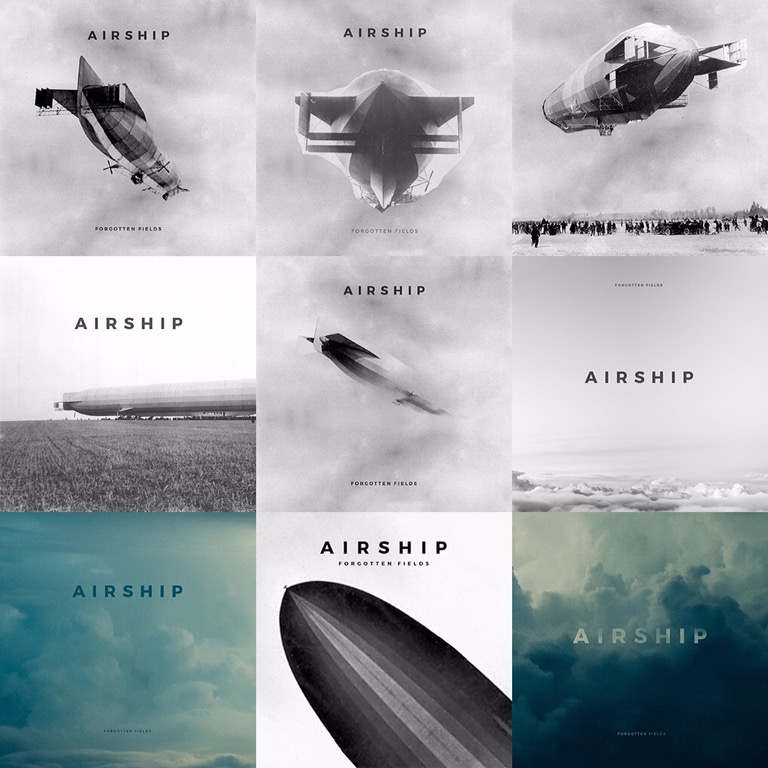
 Rough cover art mock-ups for the upcoming Airship album
Rough cover art mock-ups for the upcoming Airship album

Sketches

I thought I’d share some of the rough sketches I’ve done for the Airship album cover. They were made in the past couple of months to help me visualise the layout. I’ve written previously about the concept, but briefly, it illustrates the inspiration for the album: the maiden flight of an airship.

Concepts

I pictured the crew preparing for the test, the crowd looking on in anticipation—an atmosphere of excitement and wonder! Over time, this idea evolved and took on an abstract feel. I thought of the flight itself and the ship moving through the clouds. But, I kept coming back to the idea of the airship looming overhead, imposing and terrible, a giant in the sky! I pictured myself standing on the ground as it passes over—a speck in its shadow, agape with awe! Just look at the size of a Hindenburg in relation to the Empire State!

A graphic size comparison between the Hindenburg airship and the Empire State building
The Hindenburg vs the Empire State

Reveals

I hope I headed in the right direction, in the end. I will reveal the final artwork with the launch of the Forgotten Fields Bandcamp page, in the not too distant future. I’m excited and nervous—mostly nervous—but, I tell myself that’s a good thing.

FORGOTTEN FIELDS

Creating cover art for Airship, Part II

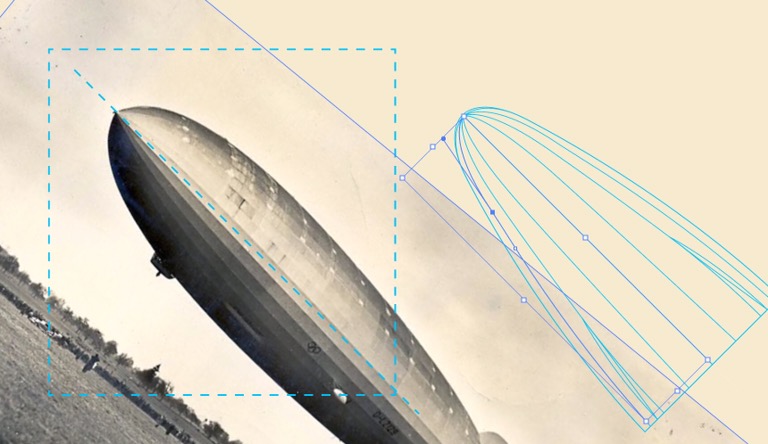
A screenshot of an airship photograph and vector rendering
A screenshot of the cover art design in progress

The fun

I officially started working up the Airship cover art layout, today. This is good, but I can’t help but feel a little sad when the creative process reaches this stage. When you’re still coming up with ideas, there’s an atmosphere of excitement: you’re looking, investigating, collecting and reinventing; there are doodles, collages, sketches and drafts—it’s messy and it’s fun, and anything is possible!

The doubt

But, once a final layout is in sight, there’s only executing the idea. You obsess over details and things take a more serious turn. On top of this, no matter how confident you are in your concept, you can’t help but doubt yourself, just a little. Suddenly, you find a dozen things wrong and you’re tempted to throw it all out and start again. Today, I found myself revisiting earlier concepts and asking all kinds of questions about the one I finally settled on. Like: did I choose the right idea?; would colour be better than black and white?; should the typeface be changed?; does the album even have the right title?

The pause

It helps to pause and take some time to calm down. If an idea is really that bad, it can be changed (or at least be embraced for its badness). I don’t think my concept is quite so terrible. But, you will be a more objective judge than I.

FORGOTTEN FIELDS