Creating cover art for Airship

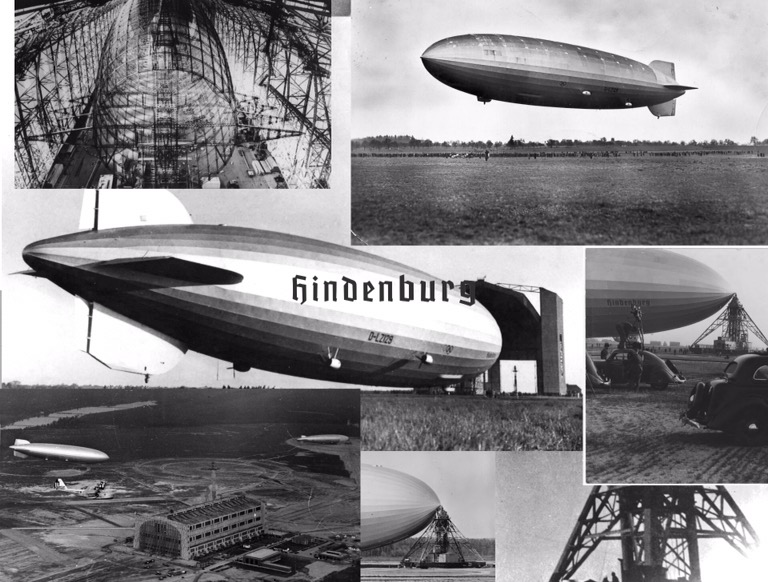
Black and white photographs of the Hindenburg airship
My moodboard for the Airship album cover art (Images: Wikipedia)

Finding a way to make it happen

Early on in the Airship project, I drew up rough ideas for the cover art. I thought the best solution would be to illustrate what I pictured when I conceptualised the music: a gigantic airship in midair, hovering above a crowd. Originally, I wanted the cover to have an illustrative feel, as if taken from a children’s book. But, the costs involved in commissioning an illustrator squashed that idea. I then thought of doing the illustration myself, but I am hopelessly out of practice and it will take a long time to develop a suitable style. Stock photography was another possibility. I thought I’d create a composite of various images. But, vintage imagery of airships are prohibitively expensive. So, I turned to the public domain and put together a collection of images I could use without running the risk of copyright infringement.

Mood board magic

I like working with mood boards. I even use them when I conceptualise music. It can be anything from a single image to an elaborate collection of pictures, music, sound clips and video—whatever sparks the imagination and sets the tone for the project. It informs my decisions and gives context to my ideas. And yet, as much as I like to work with mood boards, I didn’t create one for the Airship cover art. The concept grew out of impromptu digital “sketches”. Today, I essentially reverse-engineered a mood board using the public domain images. Even though I’ve already settled on a final concept and layout, the mood board helps me flesh out the idea, conceptually. It makes a big difference to how I think about what I am creating.

Abstract nostalgia

The best public domain images I found were of the Hindenburg; undoubtedly, the most famous airship of all time—a Titanic of the sky! Its proportions, shape and lines are the stuff of aviation dreams. When I look at the Hindenburg mood board, I am inspired! I look at the images and am filled with awe at its enormousness: 245 metres long and 43.7 metres high, it was the length of an ocean liner and the height of a 13-story building! That is something I very much want to convey on the cover. Then there is the black and white photography, symbolic of a bygone era, a nostalgic element I also want to include. I am going to take the cover art in an abstract direction. It leaves a little more to the imagination, which is better than being literal, at least in this instance—something I also tried to do with the music. I’ll post drafts of the cover, soon.

FORGOTTEN FIELDS
There is sweet music here…

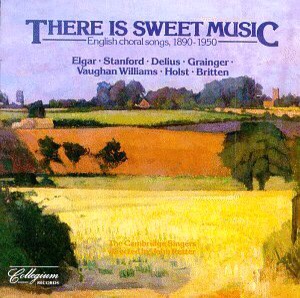
Album cover of There Is Sweet Music by John Rutter and The Cambridge Singers
The cover that caught my eye

… that softer falls than petals…

Whenever I am in low spirits, I turn to poetry and song. Years ago, I stumbled on a CD by John Rutter and The Cambridge Singers. The cover caught my eye—a colourful painting of fields in summer, and the title, There Is Sweet Music, begging me to listen. (I don’t know who did the painting, but the title is taken from The Lotos-eaters, a poem by Lord Alfred Tennyson.) At the time, I was listening almost exclusively to classical music and art songs; but somehow, I picked this collection of choral works. To this day, I thank the gods that I did! There Is Sweet Music became one of my favourite records. If ever I am banished to an island, it makes my list of music to take. The songs—from composers like Edward Elgar and Frederick Delius—are perfectly sung. They make you want to run through the fields and weep on the hills! The wistful voices enchant you, transport your soul, uplift your spirit. I listen whenever I feel a little sad—or a little happy.

It was on the fifth of August…

One of my favourite songs from the recordings is “Brigg Fair”. It’s an English folk song arranged for choir and tenor by Peter Grainger, in the early 1900s. Here are the words, speaking of love and longing, and the melody and singing (Apple Music) are equally sublime:

Brigg Fair

It was on the fifth of August-er’ the weather fine and fair,
Unto Brigg Fair I did repair, for love I was inclined.
I rose up with the lark in the morning, with my heart so full of glee,
Of thinking there to meet my dear, long time I’d wished to see.
I took hold of her lily-white hand, O and merrily was her heart:
“And now we’re met together, I hope we ne’er shall part”.
For it’s meeting is a pleasure, and parting is a grief,
But an unconstant lover is worse than any thief.
The green leaves they shall wither and the branches they shall die
If ever I prove false to her, to the girl that loves me.

FORGOTTEN FIELDS

Press release pressure (Asking for your feedback)

MacBook laptop and Magic mouse with spectacles on a wooden tabletop
Image by Craig Garner (unsplash.com)

Writing the Airship album press release

Whilst the Airship album is being mastered, I have turned my attention to album promotion. It is, by far, the most daunting part of self-releasing an album. I spent a little time writing a concept draft for the album press release, today. It’s not easy to be objective about yourself and your work. The challenge is to be accurate and honest, not presumptuous and pretentious. I don’t know if I’m succeeding, which is why I submit my draft here. I hope you’ll give me your impressions in the comments, friends? You are not caught up in this mess, the way I am. A fresh perspective is welcome!

The draft1

Airships have held a fascination for ambient electronic musician Ricardo Sauls ever since he first learned of their existence. Airship is his first release under the moniker Forgotten Fields. The album is a ticket for a [musical] trip through dark, abstract soundscapes, an invitation to be fascinated by the historic giants of the sky. It consists of six tracks inspired by the early days of dirigibles, taking the listener through a trial flight, described in a [soundtrack-like] instrumental experiment. The music has a strong ambient electronic [post-rock] influence. There are deep synths, mesmerising electric guitars, delicate glockenspiel and [even] a dignified French horn—all conspiring to fill you with a sense of awe [and a little nostalgia]. From the droning mechanical tone of the opening track (“In The Hangar”) to the graceful and soaring title track (“Airship”), Forgotten Fields’ first album promises a singular sonic journey.

Please tell me what you would change? It’ll be a great help. Thank you, all!

FORGOTTEN FIELDS

1 This is an unformatted, rough version of the core content of the press release. The final version will include necessary standard information, elements and formatting. Square brackets contain undecided or possible substitute words.