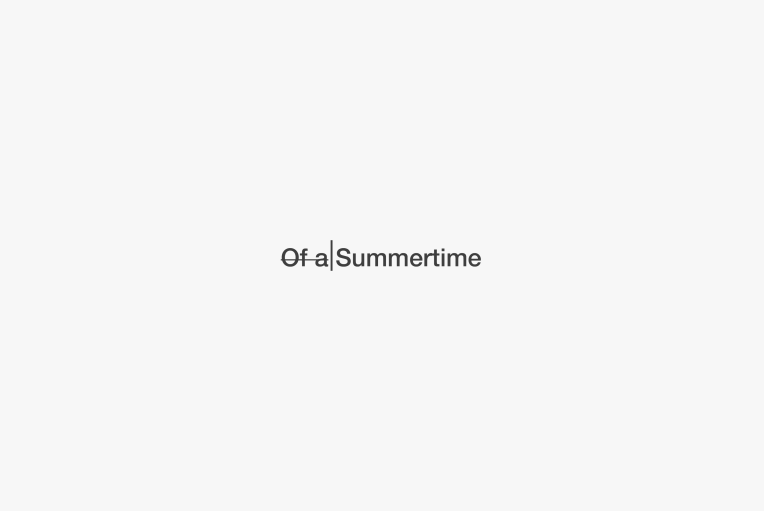
On Titles

“On Titles” Title Card, 20 September 2019. Copyright 2019 Forgotten Fields. All rights reserved.

To indulge my need for minimalism (something one would never guess from these verbose posts), simplicity and consistency, I thought to limit all the poem titles within the collection to no more than two words; but glancing through the list, it soon became clear that it was a fool’s errand—for whilst one or two-word titles suit some poems, their brevity adds nothing to others; I had to abandon the idea.

I was forced to admit the obvious: that there are instances where a longer title brings to a poem a necessary colour or meaning. The best example is “Of a Summertime” for nostalgic glimpses from childhood that “Summertime” fails to evoke. (Some instances are thematically more uncertain: is “A Crane at Eventide” more evocative than “A Crane”, or “The Last Time I Saw Fireflies” more wistful than “Fireflies”?)

Ultimately, beyond its pragmatic function, a title must encapsulate and, where necessary, complete a poem—or not exist at all (which, in my view, is preferable to the spineless, spiritless and evasive “Untitled”—a “title” I only accept in exceptional cases—but I digress). Happily, these are decisions I can make poem by poem; and my guiding principle remains: that the barest minimum is preferable.
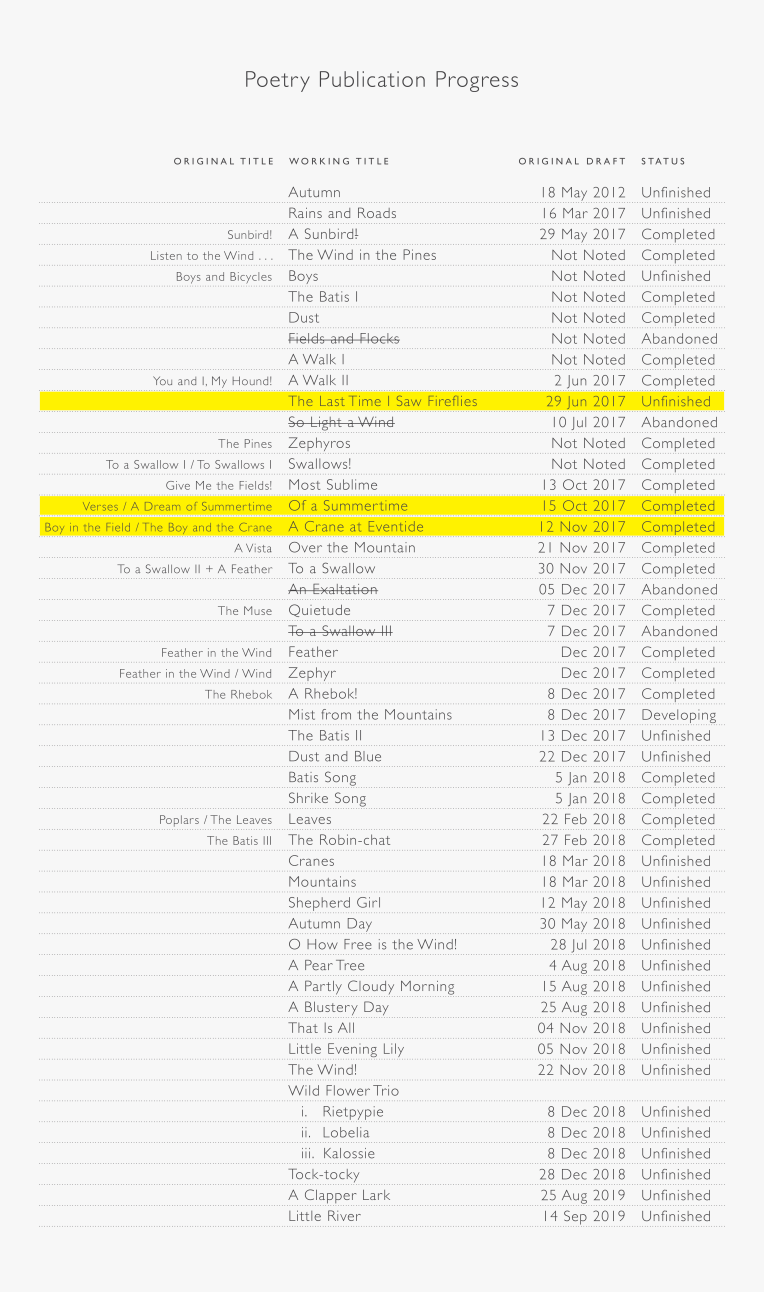
Poetry Publication Progress (2019-09-24)

Whilst the individual verse idea for the first direction of the “Mist from the Mountains” sketch appeals to me, the multi-stanza idea is developing beautifully, creating unique poetic opportunities of its own: internal rhyme, rhyme scattered across stanzas, subtle and overt literal and visual alliteration—all the joys of lyric poetry! I, therefore, lean heavily toward the multi-stanza idea for the poem’s first direction, but will develop the individual verse concept nonetheless—who knows what other opportunities I may encounter in the process!

Tseeoo, Tseeuuuu!

This morning, I filmed Cape Clapper Larks (of the sub-species Mirafra apiata marjoriae) in display flight. They were at a distance, so one must look closely at the footage, but this was my first (spontaneous) attempt at recording their performance. Unlike Mirafra apiata apiata (the subspecies I first identified), M. a. marjoriae has two descending whistles: “Tseeoo, tseeuuuu!”

Incidentally, the loud “Kraaaank, kraaaank!” calls you hear throughout the video are those of the glorious—nay, divine—Paradise Crane1 (also known as the Blue Crane, Anthropoides paradiseus, the subject of another poem, “A Crane at Eventide”); the cackling at the 01:36 mark (and elsewhere) is the ubiquitous (and pesky) Helmeted Guineafowl (Numida meleagris).

  1. See the “I watched a crane leaping in the wind” heading in “This January” for a brief account of a memorable sighting earlier this year.