In traditional poetry, a line should—in every sense—reflect its content. I am reminded of this daily as I compose—writing, revising, rejecting and refining ideas, words, lines and stanzas.
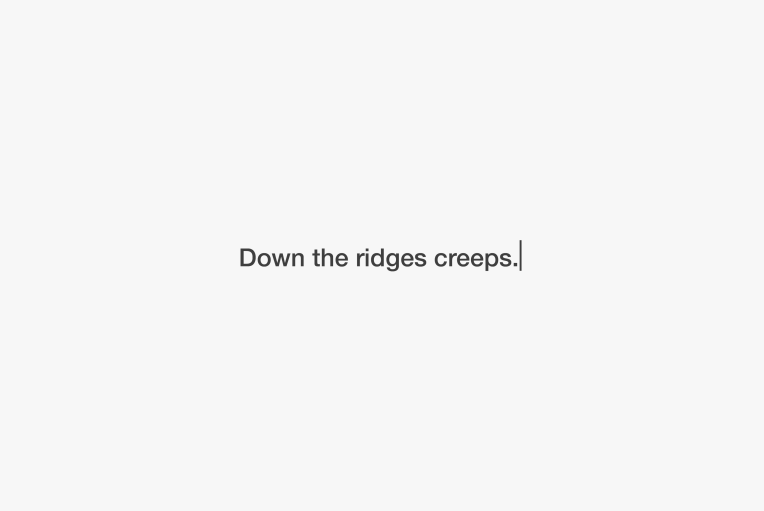
In “Mist from the Mountains” (the poem I am currently developing), consider this line:
“Down the ridges creeps.”
Its purpose is to describe the gentle passage of the mist down a rock face; but when read, the natural stresses of the words (down the ridges creeps), the plosives ([duh] in “down”, [djuh] in “ridges”, [kuh] and [puh] in “creeps”) and cadence of the phrase (DUM, da DA-DUM, DUM) are at odds with the subject—more suggestive of a bouncing ball than a drifting vapour—and therefore not ideal—its words should be weightless, its accents airy.
Then there is the position of the line within the stanza and the poem, and its rhyming scheme: since it concludes the second of three stanzas, does its terminating “creeps” create a perfect or imperfect rhyme with what precedes it? A perfect rhyme neatly concludes a stanza, making it “stable”; but an imperfect rhyme leaves one hankering (for a perfect rhyme), making it “unstable”—one wavers on a lingual precipice, ready for the next stanza.
Depending on the theme and style of the poem, any one consideration may override another—a blemish here may be necessary for a sublimity there. The poet must weigh every factor (too many to mention here—some literary, some intuitive) when deciding the fate of a word, line or even punctuation. This involves a repetitive process of exploration and reflection for which he requires time, perseveringly to search Language for Beauty.
 Forgotten Fields