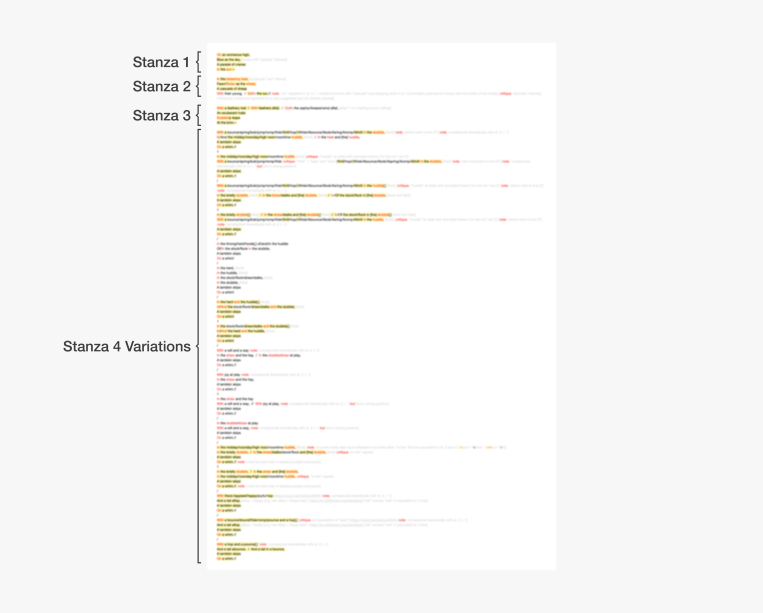
Composing “Cranes and Sheep”

Composing “Cranes and Sheep”, 14 November 2019. Copyright 2019 Forgotten Fields. All rights reserved.

In the current “Cranes and Sheep” draft, the first three stanzas are all but complete. There is here and there a word or line I am yet to decide upon, but having gone through numerous variations of each of the three, they seem to me the most evocative expressions of the theme.

As is often the case, the last stanza (here the fourth) proves the most challenging. I am left with seventeen variations after the last edit. These are the possible versions I am testing for the conclusion of the poem (the while my recent compositional dilemma remains unresolved).

They all describe the same subject—a lamb afrolic—but the exact lines with which to convey it is the great question that diligence (and a poet’s inclination) must answer. This then is my work in the days to come. It always seems an impossible task, but I find the right verse in the end!

It occurs to me how easy it would be in free verse to eliminate (indeed, altogether avoid) the compositional challenges traditional poets encounter by simply sweeping them away in unfettered lines; but, it is precisely those dilemmas (and here is a perfect example), created by the constraints and conventions of the style, that make the writing of traditional poetry so uniquely appealing—so intriguing, engaging and satisfying.

Yesterday, I stopped myself squandering a line on the “Cranes and Sheep” poem. Allow me briefly to explain. The tempo of “Cranes and Sheep” is lively, one does not so much savour its words as cavort with them. It occurred to me that the line in question would be better suited to a more contemplative work. That work, I realised, is the recently completed “Quietude”1. Its metre is the same as that of “Cranes and Sheep”, but its tempo slower. As if destined for the poem, the line fits unaltered at the end of its single stanza, rhyming word and all!

  1. The poems I reference are not yet published. They will be part of a themed collection—likely to be completed in 2021—and are, therefore, not available anywhere at present.