Poetic Temptations

Poetic Temptations, 23 May 2020. Copyright 2020 Forgotten Fields. All rights reserved.

The Purely Pragmatic

The traditional poet is often tempted to use a word solely for its rhyming ability and must, therefore, be ever wary of the possibility that his choice serves no other function than the purely pragmatic, adding nothing conceptual to the work.

I faced just such a trap in a variation for “Skaapwagtertjie”’s1 first stanza, where the word windjie’s2 sole purpose was to rhyme with kindjie3, contributing nothing beyond those lowest of functions: superfluous detail and mere rhyme.

The Delightfully Literary

Another temptation concerns my anachronistic compositional style—a Romantic use of language to complement my theme. I prefer, for example, “upon” and “whilst” over “on” and “while”; a line with a literary phrasing over a prosaic one.

In the Afrikaans counterpart of “Shepherd Girl”, I must presently decide whether the archaic newels4 or familiar mis5 (both mean “mist(s)”) best suits the poem. In cases such as these, it is fortunate that my artistic approach indulges!

  1. The Afrikaans counterpart of “Shepherd Girl” that I am now composing.
  2. Pronounced [veyngki] (with [ey] like the [ei] in “reign” and the [i] in “in”), Afrikaans for “breeze” (literally “little wind”).
  3. Pronounced [keyngki] (with [ey] like the [ei] in “reign” and the [i] in “in”), Afrikaans for “little child”.
  4. Pronounced [neevils] (with the [ee] in “deer” and [i] like the [a] in “about”).
  5. Pronounced [miss] (with [i] like the [a] in “about”).
The Words We Choose

The Words We Choose, 19 May 2020. Copyright 2020 Forgotten Fields. All rights reserved.

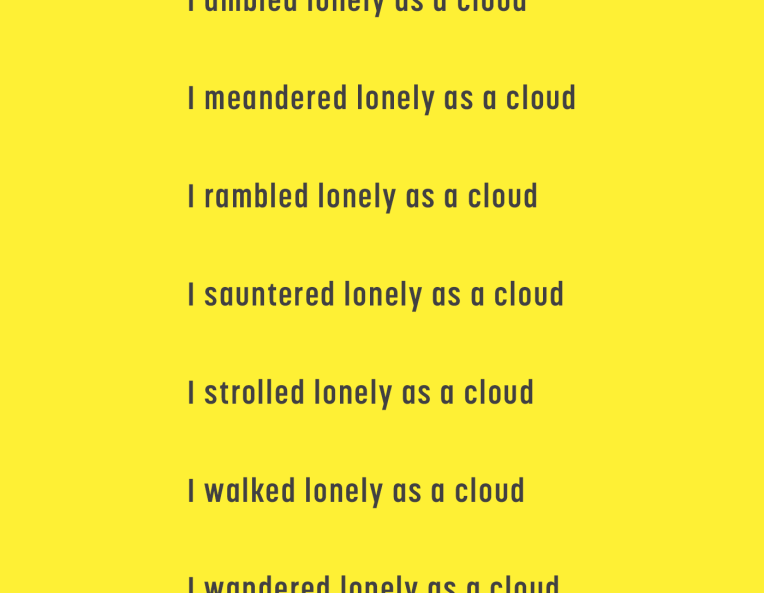
The poetic process is a fascinating one, especially when it comes to the selection of the “right” words. Consider those instances where we choose words not only for their Content and Construction but their Capacity (to perform a particular function) and Cadence (to actualise a particular meaning).

For example, Heinrich Heine uses “hold” (rather than, say, “lieb”) in “So hold und schön und rein”1 to produce a progression of vowels that “opens” like a flower; and a word like “wandered” that requires a certain unhurriedness to convey its sense2 which a high-tempo stanza would undermine.

  1. “Du bist wie eine Blume, / So hold und schön und rein” (You are like a flower, / So lovely and fair and pure) from “Du bist wie eine Blume”.
  2. The inherent slowness of the act as evoked by the sounds and trailing syllables of the word.

On Modern Poetry, A Rant

A Rant, 16 May 2020. Copyright 2020 Forgotten Fields. All rights reserved.

Poetry is not without its rules, and just as in every other discipline they must first be assimilated before they can be effectively broken, so in Poesy, there are basic mechanisms a poet must grasp and diligently seek to master in his work.

In contemporary poetry, this is a skill notably absent.

A failure to comprehend and appreciate the principles of expressive language is a scourge upon it. Nearly all compositions in the style would be vastly improved had the poet a rudimentary understanding of what makes a poem a poem.

There exists a fine line between prose and free verse.

Writing something that resembles a poem does not make it one. How much of what one reads today has themes not worth contemplating, blurted out (for composed they are not) in lumbering stanzas that do nothing to give them form?

Not every man who fancies himself a poet can verse.

For a poem to be good, it must resound in the halls of human experience. It must elevate the mundane through a celebration of language and a distillation of thought that compels the reader to exclaim: Yes! I know—I feel—your meaning!

Is such a thing too great a task for the modern poet?

Perhaps. Consider what we who long for a sublimation of the modern experience are presented with in vers libre: the poetic equivalent of Yeezy—crude phrasal fragments that barely resemble language, unworthy of the ear and soul.