What troubles me about the typical politician is the glibness of his words; he has ever an answer at the ready, never is there a pause—a moment of reflection to suggest genuine thought.
“Cranes and Sheep” Takes Shape, Part 2
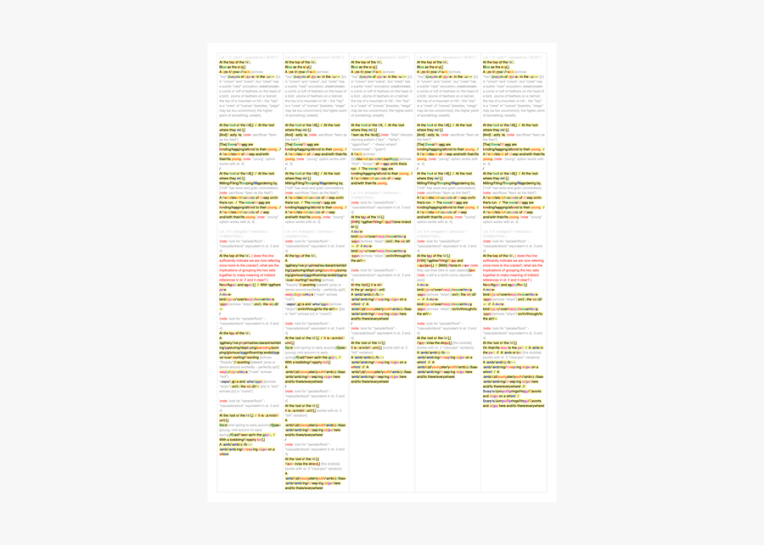
Thus far, the initial “Cranes and Sheep” sketch has produced a number of variations which have led to five versions of the draft. (I explain here how I end up with so colourful a body of text.)
Whilst the first stanza has a few word variations in its third line—as I consider internal rhyme with its corresponding second stanza—it is an established part of the poem and the three stanzas that follow echo its structure, tone and style.
I must now work through the variations of each of these versions towards a final draft. I shall inevitably discover new ideas and directions as I do so, adding more variations along the way.
The origination of a traditional poem may seem a tedious task to the unfettered free verse poet, but to the lyric poet, the meticulous assembly of a composition—word by word, line by line, stanza by stanza—is a source of great fulfilment.
From the earliest stages of a poem’s development, there is almost always one stanza that remains all but unchanged. I find it is usually the first in the poem for from it the rest of the stanzas proceed. While they generate many variations—versions of themselves informed by that stanza—it is a near-constant throughout.
 Forgotten Fields