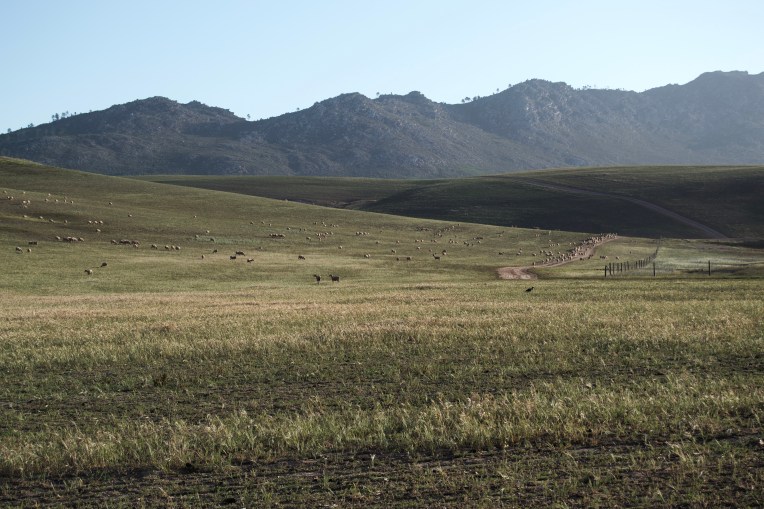
When I survey pastoral scenes such as these, I wish that I could outstretch my arms and embrace them! In my desperation, I do so with words—fumbling lines that do none of it justice. If I could write poetry so sweet, verses so simple—silences so sustaining!
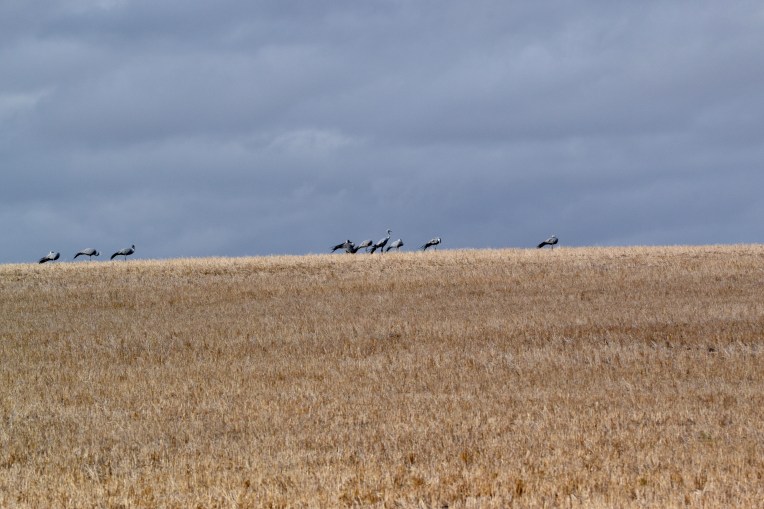
A herd of Blue (or Paradise) Cranes (Grus paradisea) on a hilltop. Taken mid-March in 2018 (early autumn in South Africa).
I hereby officially declare “Mist on the Mountain” complete and begin work on the “Dust and Blue” poetic sketch. I have conceived of a few new working titles for it—amongst others, “Feathers and Fleece”, “Cranes and Sheep” and “Herds” (a term of venery for both)—as “Dust and Blue” feels cryptic, and the other initial working titles are merely variations on that theme (for example, “Gold and Blue”).
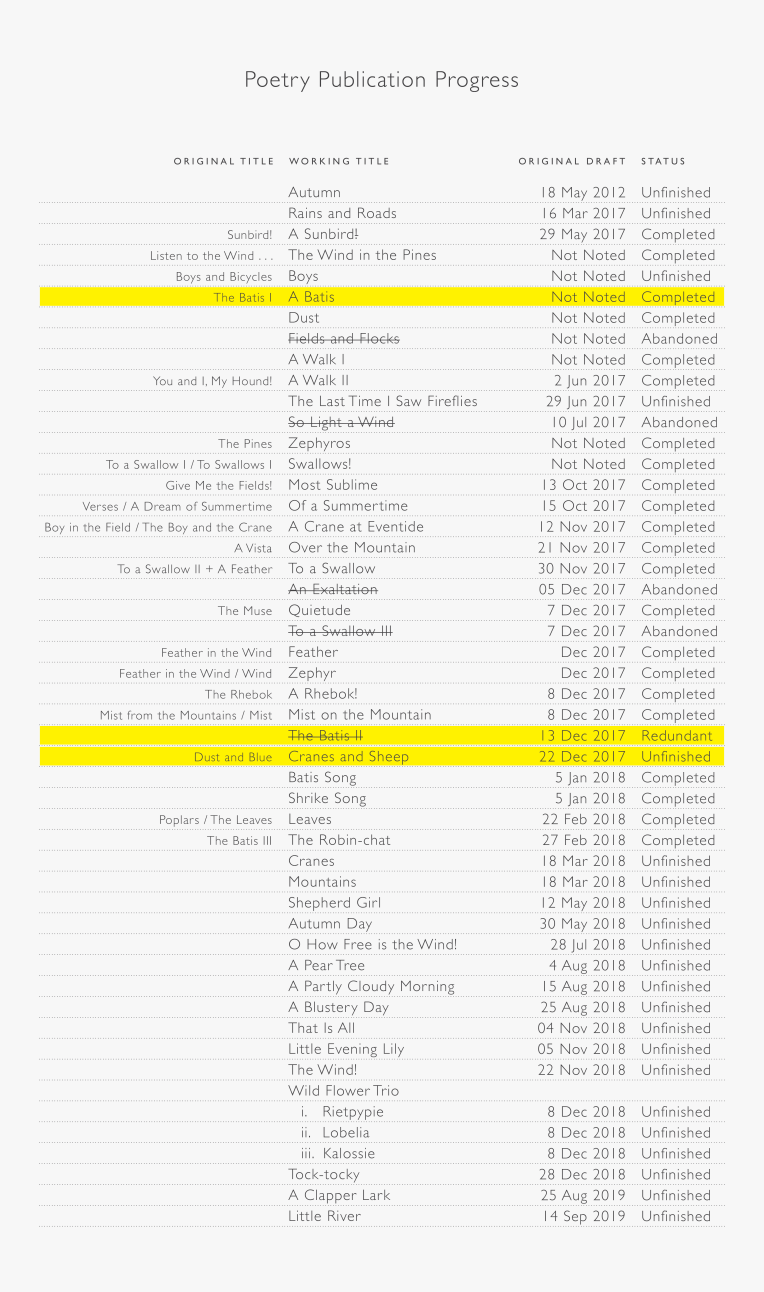
Though “Herds” is tempting, it does not capture the theme of the poetic sketch—a pity, it is rather smart. I shall, therefore, use the unaffected “Cranes and Sheep” in the meantime—ever partial in poetry to straightforwardness—and have updated the progress list accordingly. On the list, I have also removed “I” from the “The Batis I” title (since “The Batis II” is now redundant) and altered it to “A Batis”.
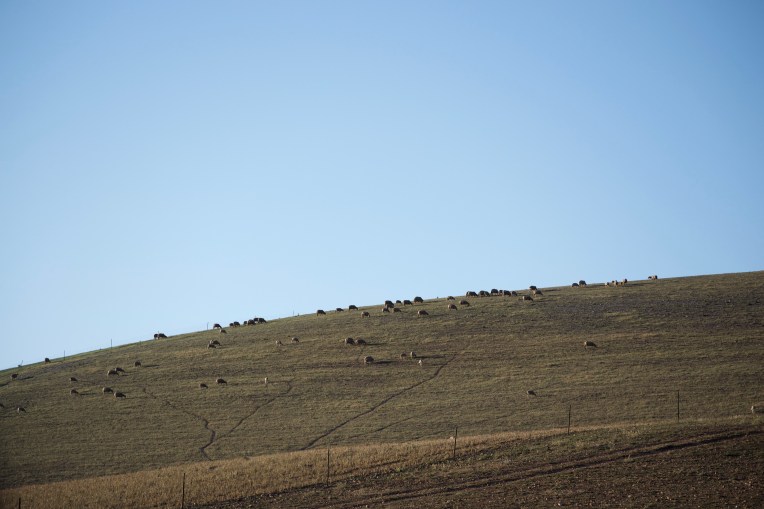
Blue cranes among the dusty Merino sheep. Taken earlier this year in February (summer in South Africa).
I am slowly accepting the completion of the “Mist on the Mountain” poem. There is almost always at this stage of an artwork a suspicion in me that I have left some word—some line or stanza—unturned, that there is some idea upon which I can improve; and so I try this and that but invariably return to the version that appears in the final draft.
These last little experiments are reverberations of the writing process: so caught up is one in a cycle of exploring, critiquing and refining, one is left spinning for a time after the work is done; but as I endlessly recite the final draft—I must now surely have done so more than a thousand times (this is not an exaggeration on my part)—it begins to feel “right”.
The while I look tentatively at the next sketch.
My list1 suggests “The Batis II”, a haiku conceived as a companion to “The Batis I”, but since I have applied its concept to the “Feather” and “Zephyr” haiku set, it is pointless to pursue. “Dust and Blue”, therefore, is next. The working title refers to a sight in late December 20172 of dusty Merino Sheep3 against the hillsides and Blue Cranes4 against the sky.
Yesterday, I read through the initial draft of the sketch—three rough free-verse variations that came to me upon surveying the scene—and extracted from them a potential framework for the verse’s ultimate traditional—that is, lyric—structure. Already I see its potential—but first I must recite “Mist on the Mountain” a few thousand times more.

 Forgotten Fields