Tseeoo, Tseeuuuu!

This morning, I filmed Cape Clapper Larks (of the sub-species Mirafra apiata marjoriae) in display flight. They were at a distance, so one must look closely at the footage, but this was my first (spontaneous) attempt at recording their performance. Unlike Mirafra apiata apiata (the subspecies I first identified), M. a. marjoriae has two descending whistles: “Tseeoo, tseeuuuu!”

Incidentally, the loud “Kraaaank, kraaaank!” calls you hear throughout the video are those of the glorious—nay, divine—Paradise Crane1 (also known as the Blue Crane, Anthropoides paradiseus, the subject of another poem, “A Crane at Eventide”); the cackling at the 01:36 mark (and elsewhere) is the ubiquitous (and pesky) Helmeted Guineafowl (Numida meleagris).

  1. See the “I watched a crane leaping in the wind” heading in “This January” for a brief account of a memorable sighting earlier this year.
A Pause

I wrote yet another new poetic sketch yesterday—the sunlight through the clouds on the wheatfields was magical—and had to pause.

It occurred to me that I had been treating the collection like an infinite publication, and of course, it cannot be so—a limit must be set.

I have therefore put this new sketch into a “for a future collection” category, and shall do the same with all new poetic sketches.

Poetry Takes Time

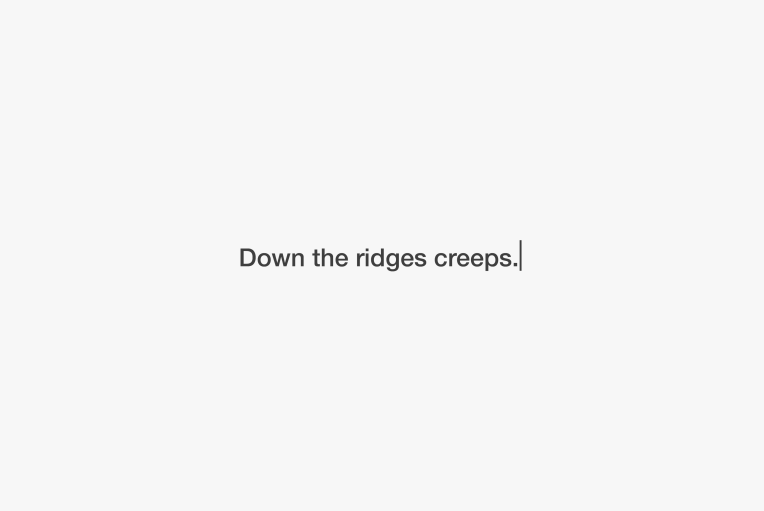
A line from the “Mist from the Mountains” variations, 20 September 2019. Copyright 2019 Forgotten Fields. All rights reserved.

In traditional poetry, a line should—in every sense—reflect its content. I am reminded of this daily as I compose—writing, revising, rejecting and refining ideas, words, lines and stanzas.

In “Mist from the Mountains” (the poem I am currently developing), consider this line:

“Down the ridges creeps.”

Its purpose is to describe the gentle passage of the mist down a rock face; but when read, the natural stresses of the words (down the ridges creeps), the plosives ([duh] in “down”, [djuh] in “ridges”, [kuh] and [puh] in “creeps”) and cadence of the phrase (DUM, da DA-DUM, DUM) are at odds with the subject—more suggestive of a bouncing ball than a drifting vapour—and therefore not ideal—its words should be weightless, its accents airy.

Then there is the position of the line within the stanza and the poem, and its rhyming scheme: since it concludes the second of three stanzas, does its terminating “creeps” create a perfect or imperfect rhyme with what precedes it? A perfect rhyme neatly concludes a stanza, making it “stable”; but an imperfect rhyme leaves one hankering (for a perfect rhyme), making it “unstable”—one wavers on a lingual precipice, ready for the next stanza.

Depending on the theme and style of the poem, any one consideration may override another—a blemish here may be necessary for a sublimity there. The poet must weigh every factor (too many to mention here—some literary, some intuitive) when deciding the fate of a word, line or even punctuation. This involves a repetitive process of exploration and reflection for which he requires time, perseveringly to search Language for Beauty.