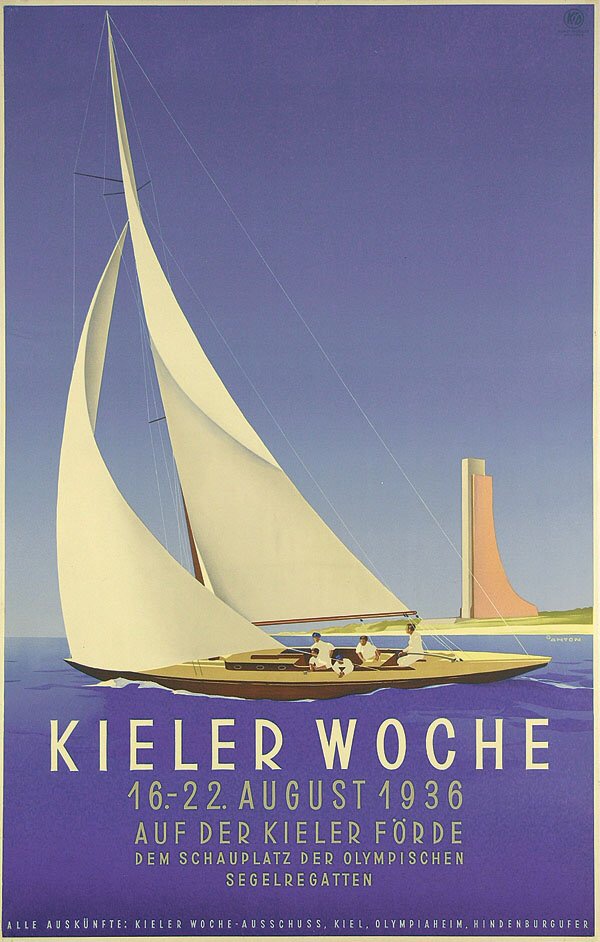
Poster for a sailing event near Kiel by Ottomar Carl Joseph Anton (1895-1976)
The allure of the Art Deco idyll
My earliest encounter with Art Deco was a magazine advertisement, somewhere during the ’80s. I don’t remember what was being advertised (it may have been chocolates), but the illustration struck a chord within me. I couldn’t get enough of the alternate world created on the page, an idyllic cityscape made of sleek lines and carefully choreographed colours. I recall elongated 1930s automobiles, towering palm trees and elegant people with borzoi dogs on leashes parading the street. It was all very impressive to my young mind. I stared at the advertisement for ages—in fact, I copied it, multiple times.
The inevitable album artwork application
To this day, Art Deco graphics have a special place in my heart. So much so, that I am leaning very strongly towards an abstract Art Deco feel for the Airship album artwork. I think it best illustrates the figurative nature of the music—and besides, airships were all the rage in the Art Deco era! For the next few days, I am stepping away from mixing the album, so I can return to it with “fresh” ears, next week. In the meantime, I’ve been gathering inspiration for the album artwork. I’ve already gone through a number of design iterations, which I will share, come crunch time, but I think Art Deco is the answer. Exciting times!
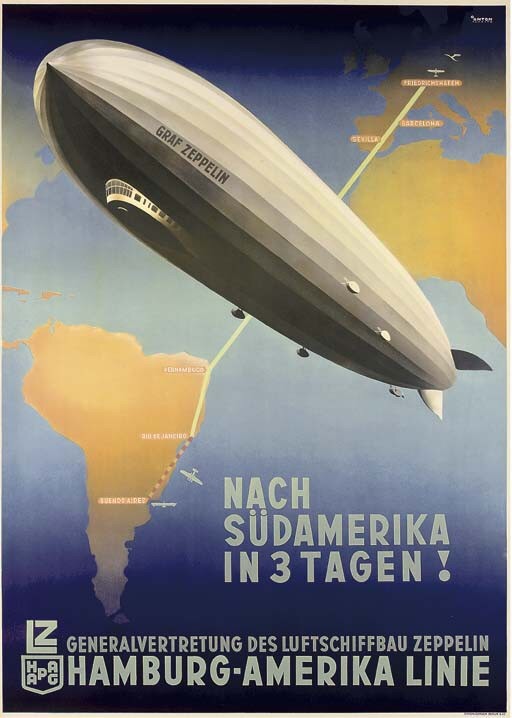
Europe to South America in three days via airship (and aeroplane)! Poster by Ottomar Carl Joseph Anton (1895-1976)FORGOTTEN FIELDS
Massacre of the Innocents (c.1565-67) by Pieter Brueghel the Elder (c. 1525-1569)
Breughel and tears
I was reminded of Breughel’s Massacre of the Innocents, today. My reason for thinking about that painting was curiosity of a personal nature. When I first laid eyes on it, I had to fight back the tears, so powerful was my emotional response to it (and I didn’t even like Breughel’s work, up until that moment!). This wasn’t an isolated incident. I sometimes find myself talking about something I consider to be an example of brilliance and I’ll become inexplicably emotional. It’s never made sense to me why this happens. Why, when faced with instances of great beauty, creativity, genius or some other mastery, I seem to disintegrate. There’s nothing more or less special about me than any of my peers, and yet they don’t fall apart when they hear Dvorak’s 8th!
Mother issues
Unsurprisingly, the origin lies in my childhood. I was an “accident”, the result of bad planning—I used to think of it as “a moment of passion”. After not being aborted, I was raised by a mother who didn’t really need me around. I was left in my grandmother’s care, whilst she pursued her career. But, as any adult child of a dysfunctional family will tell you, children can tell when they are not wanted, when they are not celebrated, when they are an inconvenient burden; and the effects of these circumstances are devastating. This was certainly my experience. Growing up, I had a sense of not being all that important to the big people, least of all my mother. I craved her love, care and affection. But, she was incapable of loving me. (There were reasons for this inability, which I now understand intellectually, but, of course, to my younger self, none of that mattered.)
The “good boy” game
As a result, I had to find ways of attracting the love I needed. I became a “good boy”: I never expressed feelings or needs and I always did what I was told. When I was well-behaved, I was praised and approved of, and when (on the rare occasion) I was ill-behaved, I was punished and disapproved of. My emotional security and my value became wholly dependent on my performance, not on anything inherently lovable within me. It left me feeling emotionally abandoned and unwanted. The “good boy” game was working, but a roller coaster of insecurity was the inevitable outcome. What I needed was unconditional love, love independent of what I did or didn’t do. And since I couldn’t make my parents love me, I needed a new plan. The game was up. I needed a love substitute.
The substitute
I found this in beauty. At first, it was the superficial beauty admired by a child: decorative items in the house, flowers in the garden, toys, favourite stories, songs, thoughts—tangible and intangible things I could collect. But, as I grew older, I began to see the beauty of creative genius in the arts, design, engineering, philosophy, science, and so forth. My reverence for what I collectively call Beauty became absolute. I began to see it as a constant: it wasn’t reactive, it didn’t become less beautiful, it was consistent and reliable, a kind of refuge from the loveless reality I experienced as a youngster.
An imaginary friend
The people in my world were insensitive, dismissive and unappreciative. They made me feel insignificant and worthless. All I could do to survive was to find ways to protect myself. But, in the presence of beauty, I could lower my defenses. I could drop the “good boy” act and just be. Admiring beautiful things was a way of vicariously giving myself the love, approval and worth I so desperately sought. It was twisted, but it became a genuine replacement for the conditional love and approval I was generating in my parents. Beauty became my imaginary friend, a source of joy with every new creative or intellectual discovery. It didn’t disapprove, ridicule or disappoint. It was only its wonderful self, admired by all who loved its form.
I cry because I’m vulnerable
And so, when I come face to face with something Beautiful—something excellent, pure and masterful—that unloved, wounded part of my soul is exposed. It’s no wonder I become a defenseless little boy who just wants to break down in tears. Beauty has protected, soothed and healed me, all my life. Without it, I don’t see how I could have survived—I owe it my life and sanity. I become emotional because for that brief moment, in the presence of something great, all my defenses are down. When I was a boy, my first exposure to true creativity was through music. The works of Beethoven and Tchaikovsky exposed me to genius I couldn’t even begin to understand, but it inspired me to make music, to try to create something beautiful, myself. Today, the very process of making music restores me and delivers me. May the music I make also bring beauty into the lives of others.
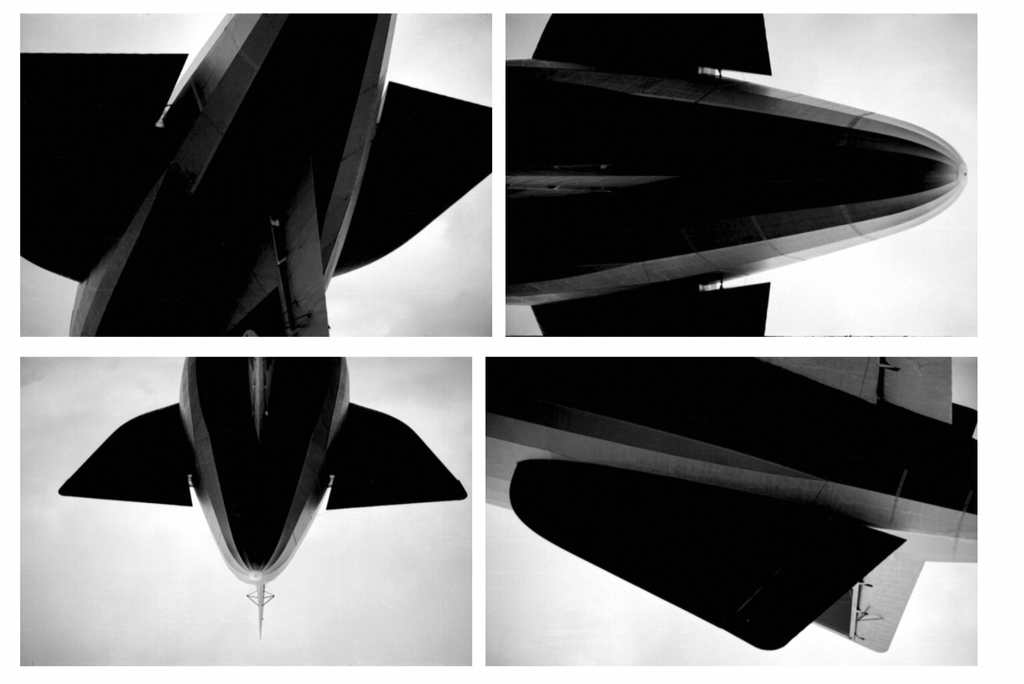
The Hindenburg photographed by Willard Morgan in 1936 at Lakehurst Naval Air Station, New Jersey (Willard Morgan/Getty Images)
I did research for the Airship album cover artwork, today, and I was reminded of Willard Morgan‘s photographs of the Hindenburg. Are they not incredibly good? He expertly captures the elegance and enormousness of the airship. The abstract shapes, the high contrast, the way there’s just enough visual information for you to picture the rest of the giant… I fall in love with these photographs, every time!

 Forgotten Fields