The soul of a thing
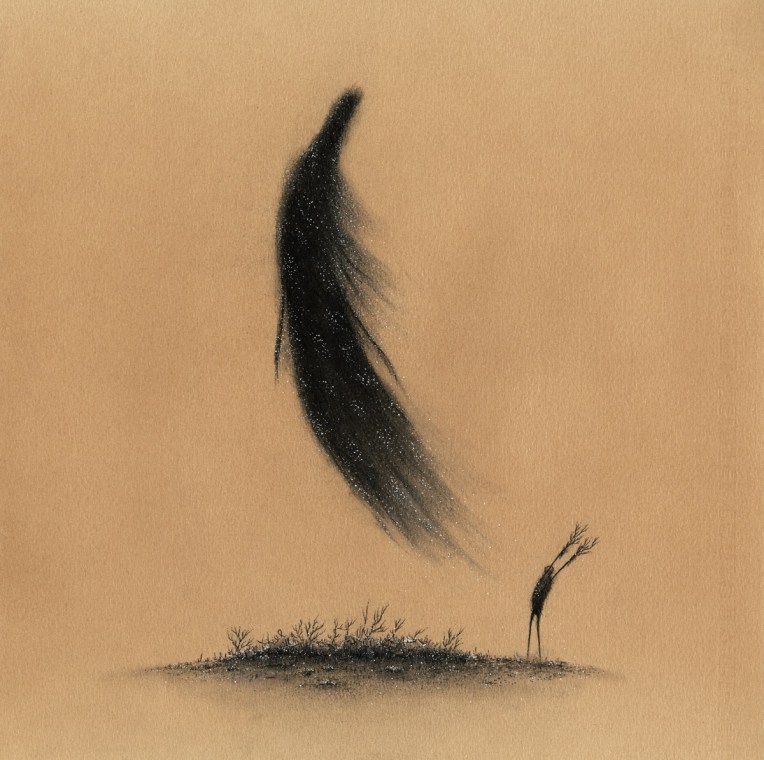
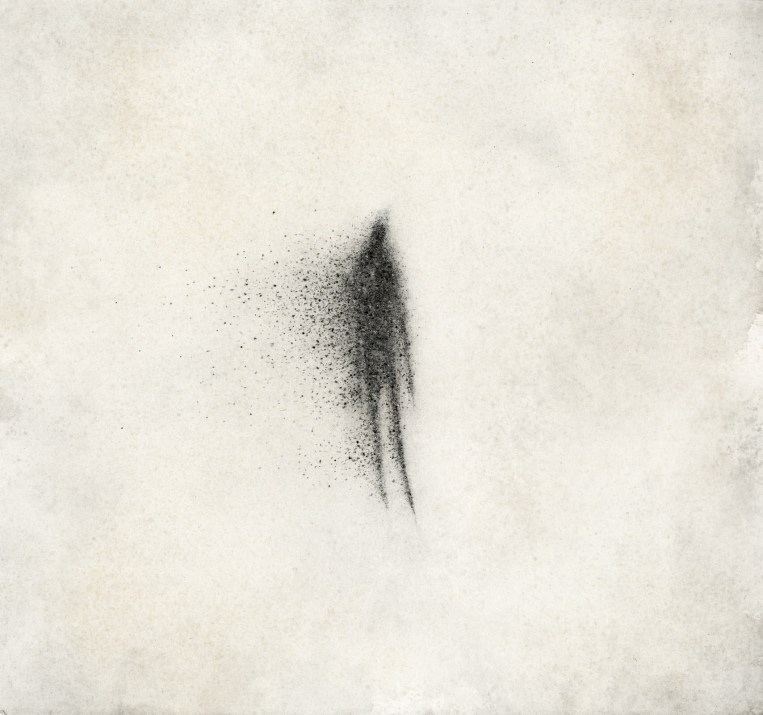
I only recently discovered the genius behind the art of post-rock band Eluvium. Over the years, the work of Jeannie Lynn Paske, labouring under the moniker Obsolete World, has graced the covers of a number of Eluvium albums, capturing their sound, aesthetic and emotional content in curious drawings and paintings. It’s easy to see why they would choose her work: she has that elusive ability to communicate the very soul of a thing in the simplest drawing. Consider her artwork for False Readings On, Eluvium’s 2016 album (pictured below); I look at that dark, featureless, disintegrating figure and cannot help but see myself, destroyed by the beauty of Eluvium’s music in one breathtaking image. It takes a special kind of imagination to produce something so modest and yet, so powerful, and in Obsolete World, Jeannie has successfully brought that imagination to life.
Obsolete…
I took a particular interest because Jeannie’s most recent work with Eluvium has reached a new level of sophistication. She has simplified and refined her style, removing the superfluous, focusing only on the essentials of her otherworldy creations. Her works are now more haunting than ever before; and this at a time when her menagerie of creatures have become less fantastical then ever before. This is not a criticism. This development has brought about a revolution in her work in terms of quality and intellectual and emotive content. You see, Jeannie’s artworks are places of refuge for beings from her (and our) childhood imagination. She calls this place of asylum “Obsolete World”. Here, these imaginary creatures live out their exile from our adult minds. They may no longer be needed by the minds that created them, but this world is theirs and here they are remembered. However, Jeannie has now replaced the fantastical monsters with simple human figures, thereby making the creators themselves the exiles. She has turned the tables on us and it makes for fascinating visuals and food for thought.
… but not forgotten
I draw parallels, however loosely, between what Jeannie is trying to do in her art and what I am trying to do in my music: collecting and conserving the abandoned. My own childhood spectres still haunt my grown-up world and writing music is my way of giving them a haunt of their own. As a child, I created many ways of coping with the fears that come with abandonment. I liken those fears to the melancholy denizens of Obsolete World. Now that I am an adult, I begin to see them for what they are: imaginary childhood creations I must exile from my mind. But, despite the havoc they caused, they helped protect me when I was helpless and lost. Creatures like “Hide-Your-Emotions” and “Be-Perfect-To-Earn-Approval” helped me feel loved and accepted, no matter how twisted they would become. So, I must not hate them. They were products of my childhood mind trying to make sense of the world. For better or for worse, they shaped me. They deserve not to be lost. And so, I let them live on in my music, where forgotten things are remembered and abandoned things are cherished.
Forgotten Fields
Thanks to Jeannie Lynn Paske for allowing me to use her images. Take a trip to Obsolete World for more captivating work.
First image: “Specter”, 2015, in graphite, charcoal, pastel, powdered pigment and ink
Second image: “False Readings On”, 2016, in watercolour, charcoal, pastel and ink
 Forgotten Fields