Composing “O, How Free is the Wind!”: A Final Draft

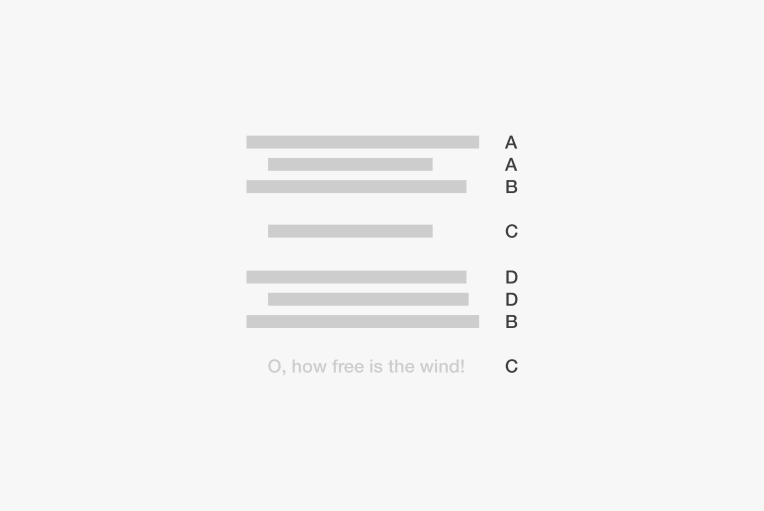
The rhyming scheme of “O, How Free is the Wind!”. (The purpose of the staggered, asymmetrical format is to suggest the movement of the wind.)

I am stunned by how easily and quickly “O, How Free is the Wind!” has developed into a finished work—as if it composed itself! Regardless of length, it usually takes four to five weeks for my compositions to come together, but this poem has taken one!

Following an AAB C DDB C rhyming scheme in staggered lines, there are two stanzas, each describing a mood of the wind: in the first, it is placid; in the second, full of life. Each stanza concludes with a separated exclamation—the title, that of the second.

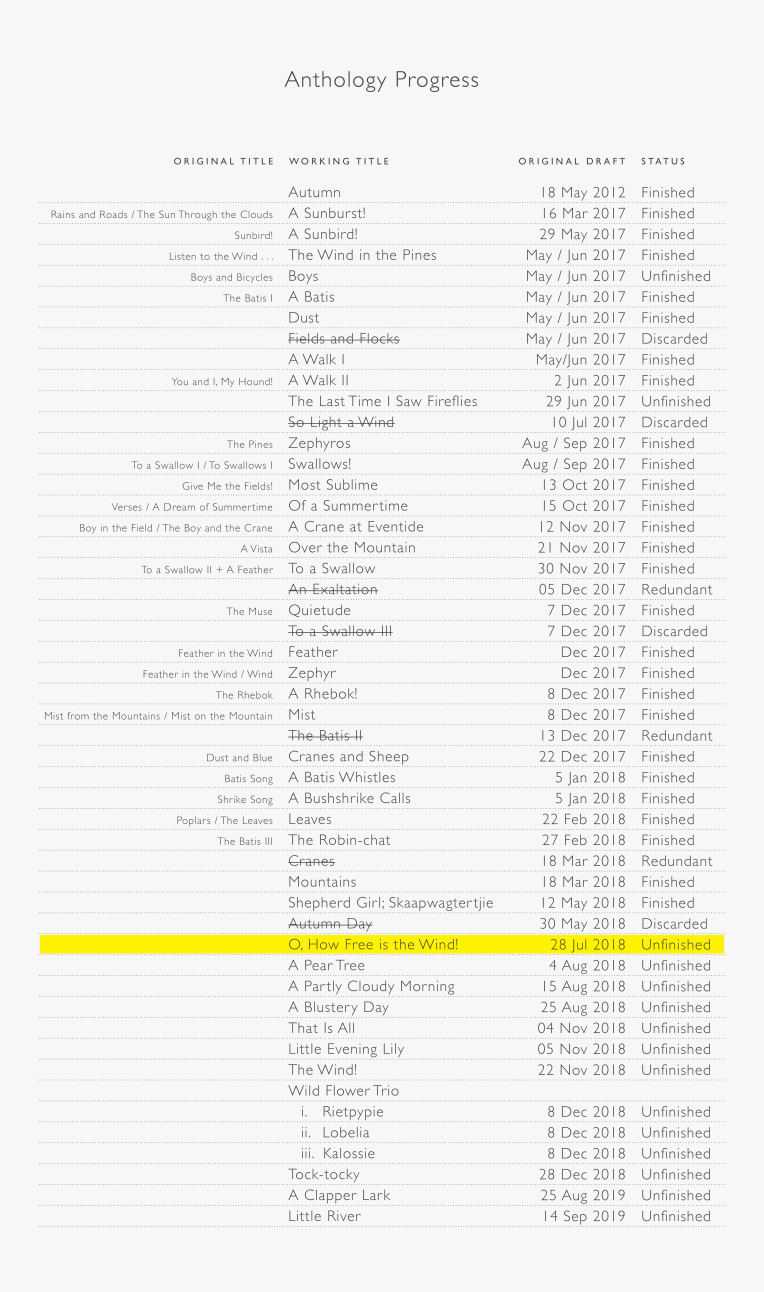
Poetry Publication Progress (2020-06-21)

Composing “O, How Free is the Wind!”

Sometimes, a poetic sketch contains within it the rudimentary structure upon which the final composition can be hung; sometimes, it is the beginning of an idea that evolves into a work bearing no resemblance to the first form. The latter is the case with “O, How Free is the Wind!”.

Reviewing my original lines from two years ago, I found they were nothing more than an enthusiastic translation of the Deutscher-Madison lyrics; therefore, I am engineering the poem anew by using as my starting point the three elements of the sketch that I consider salvageable:

  1. the working title (“O, How Free is the Wind!”, which I shall use as a refrain),
  2. the subject (the wind, which will be the focus of the poem) and
  3. the theme (the characteristics of the wind, its effects about and above us).

Around these then I am constructing a new draft which already shows great promise!

The Next Sketch

It appears I am not yet done with Afrikaans after completing “Skaapwagtertjie”—the counterpart in that language of “Shepherd Girl”—as the next poem to be developed is “O, How Free is the Wind!” (working title), a sketch prompted by an Afrikaans song: “Ruiter van die Windjiie”1 (Rider of the Breeze).

It was composed by Drafi Deutscher in the mid-nineteen-seventies for Heintje Simons and covered in the mid-nineteen-eighties by Bles Bridges.2 For the lyrics, Deutscher—under the alias Renate Vaplus—collaborated with singer Ben E. Madison, describing in simple verses, life on the wings of the wind.

The wind is a prominent theme of my work. When I heard the Deutscher-Madison lyrics anew, almost exactly two years ago, I was moved to compose several rough English stanzas in response. These I shall now review to determine whether they will work as a lyric poem, joyful and bracing as the song.

  1. Pronounced [RoyteR fun dee veyngkee] with the [R]s trilled, the [ee]s short like that in “it” and [oy] like that in “toy”, but uttering an “uh” rather than “aw”: [uhee].
  2. Like Simons in The Netherlands, Bridges in South Africa was famous for schlager songs: vocal-centred compositions with memorable tunes, dutiful accompaniment and light, sentimental lyrics. Simons recorded many songs in Afrikaans, a language similar to his native Dutch, from which it derives.

Poetry Publication Progress (2020-06-12)