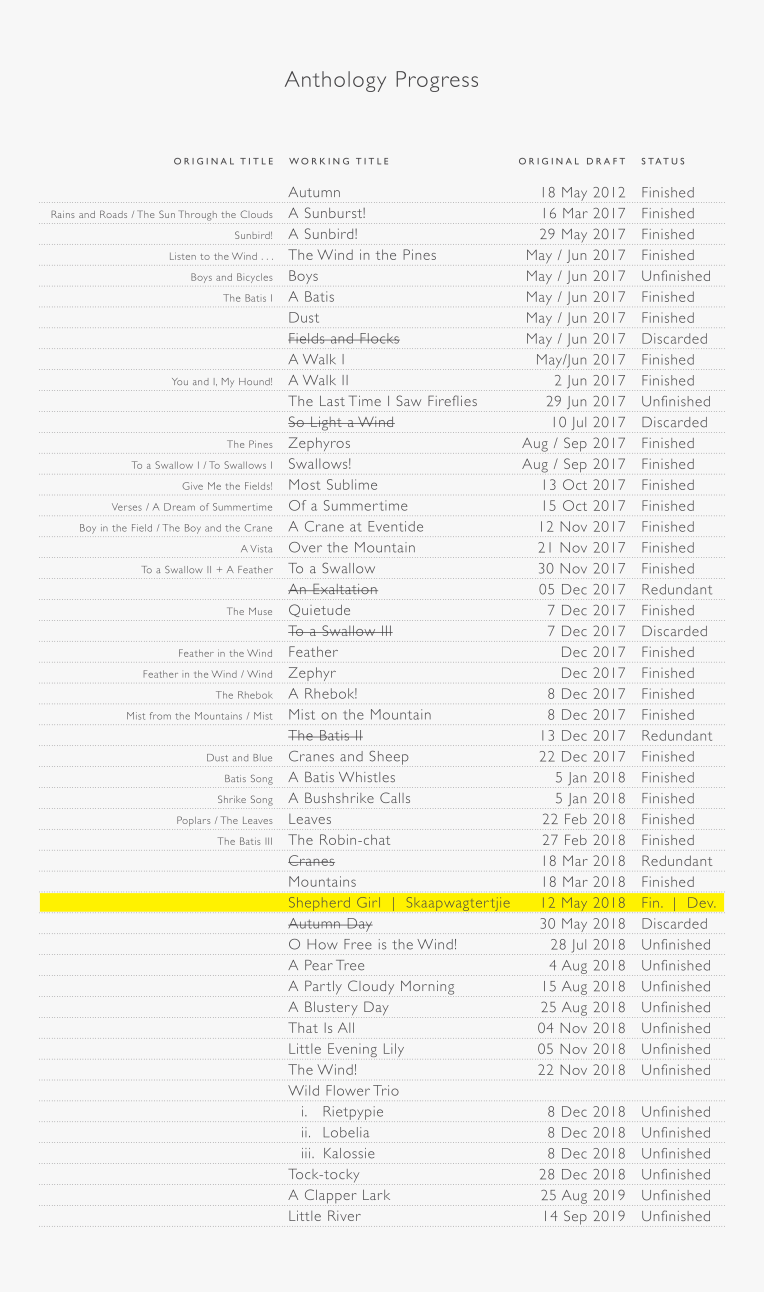
Working on “Skaapwagtertjie”, the Afrikaans version of “Shepherd Girl”, I am surprised at the first draft: how closely it approximates the English without being laboured; nonetheless, I do not intend slavishly to imitate the original. That manner of mere translation I find offensive—a gross abuse of language for the sake of fidelity (invariably at the cost of good verse) that I wholly condemn; and thus, whilst I began with a rudimentary direct Afrikaans translation, I shall let the language take its course and effect whatever changes to content and style it requires. Rarely do the poetic subtleties of a line migrate between languages, but where I can replicate these without contorting the Afrikaans, I shall do so.
Poetry
“Shepherd Girl” is Complete
The ballad inspired by my mother’s childhood shepherding days is complete! Though I yet reel from the achievement and bask in the joy of it, I am eager to begin work on the Afrikaans adaptation. Already, I have some lines roughly worked out and a title for it: “Skaapwagtertjie”1 (“[little] sheep-keeper”). Incidentally, the non-diminutive form—“skaapwagter”—is the common Afrikaans name for the Wheatear songbird (Oenanthe oenanthe).
- [skaahp-vuKG-teR-ki] Pronounced as one word, with the [u] in “up”, the guttural [KG] in the Scottish “loch”, a trilled [R] and the [i] in “in”.
Composing “Shepherd Girl”: Three Versions
I now have three versions of the “Shepherd Girl” poem from which I must choose one as the final composition. They are similar in most respects except for stanza two, which concerns how my mother passed the time whilst sheep watching. The dilemma: which pastime is most apt?
Another decision I must make concerns a line in stanza three: do I choose the figurative version, which allows for good onomatopoeia but poor fluidity, or the literal version, which allows for better flow but little lyrical effect—alliterative, onomatopoeic or otherwise? I cannot decide!
 Forgotten Fields