Can a Word Be a Poem?

“m” by Aram Saroyan, 20 December 2019. Copyright 2019 Forgotten Fields. All rights reserved.
Barely a word, “m” is a “one-letter poem” by Aram Saroyan.

A poem is the sublimation of words—the transfiguration of phrases through all the devices of language available to the poet—into a work of art. Through theme and style, it transforms an abstract idea into something perceivable and comprehensible when read, recited or heard.

A traditional poem is not mere rhyme, a modern poem not mere prose. To be a poem, a composition must transcend the common function of language. How it does so is up to the poet.

At the extreme of modern poetry, Aram Saroyan tampers with the very construction of letters and words to transform them into “one-letter” and “one-word poems”. In an infamous example, he adds a fourth leg to the letter “m”, creating a symbol that may be interpreted in any number of fanciful ways; in another, he modifies the spelling of “light” to read “lighght” (and in yet another, “eye” to read “eyeye”)1 to produce a kind of orthoepic novelty.

If these “compositions” are Poetry, they are barely so. They do the absolute minimum to be worthy of the title—low incarnations that mock the very discipline they profess to represent.

Such works receive the participation trophy but not the prize. Titillating to consume and quickly discarded for the next extreme, they are surely as unfulfilling to the poet as to the society that looks to him for Beauty, Clarity and Redemption which cleverness alone cannot supply.

  1. In both instances, the misspelt word by itself constitutes the entirety of the poem (hence “one-word poem”).
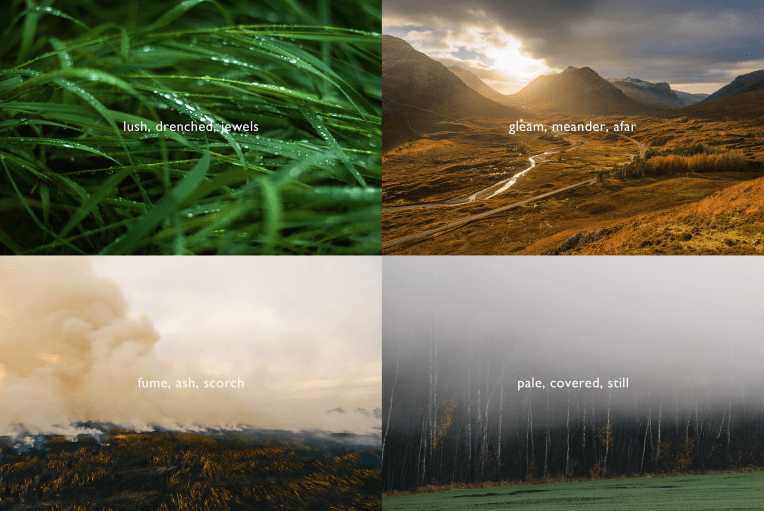
The Write Mood

"Autumn" Mood Board, 16 December 2019. Copyright 2019 Forgotten Fields. All rights reserved.

The mechanics of artistic thinking is as interesting to me as what it produces. One part of my creative process I have not written about before is the use of mood boards.

Sometimes they are abstract—mental images of the scenes or incidents I wish to embody in verse; sometimes concrete—collages of photographs and words. Whatever the form, as I compose a poem (or musical work), I draw upon these as a source of ideas.

To illustrate, I include a simplified mood board1 for “Autumn” (the poem I am currently composing). In 2012, when the original version was composed, I had not yet developed the mood board approach—moreover, the poem was very much an impromptu affair.

Since then, my process has improved significantly. The mood board visuals keep before me what inspired the verse—evoking words and phrases to express the theme.

  1. The photographs are not my own: top left is by Kuzmenko Viktoria, top right by Daniel Kay, bottom left by Neenawat Khenyothaa and bottom right by Gints Ivuskans.

Revising “Autumn”, Overcoming Attachment

When one revises an existing poem, it can be difficult to let go of some of its original ideas because they seem inextricable from the fabric of the composition. This has been my Achilles heel revising “Autumn”. Instead of accepting that I must forego certain parts of the original version to achieve a better work, I clung to elements I knew to be conceptually debilitating.

Over the past two days, as these shortcomings became ever more pronounced, I was forced to come to my senses; and lo, the beloved lines I lost were soon replaced by ones more fitting, liberated from the creative constraint that had plagued the revision hitherto.

“Autumn” was my first proper lyric poem.1 At the time (2012), it was an indulgence of my poetic ebullience, a manifestation of my love for Nature and Verse. Seven years later, it must be elevated into something greater: a work combining that love with skill and substance. Having embraced the inevitable, I can now do the composition justice whatever the cost to its first incarnation.

  1. I wrote a little about the significance of “Autumn” in my poetic journey in the fourth instalment of my “Artist Questions” series.