“Cranes and Sheep” Takes Shape, Part 2

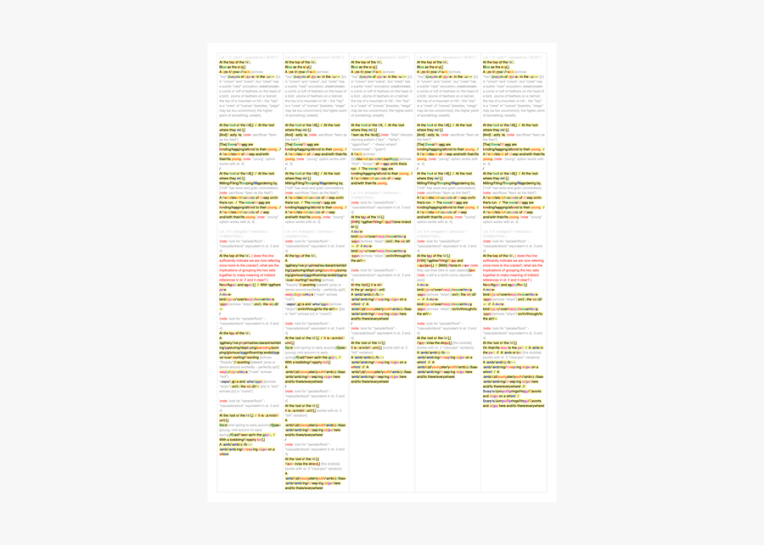
“Cranes and Sheep” Draft Versions, 26 October 2019

Thus far, the initial “Cranes and Sheep” sketch has produced a number of variations which have led to five versions of the draft. (I explain here how I end up with so colourful a body of text.)

Whilst the first stanza has a few word variations in its third line—as I consider internal rhyme with its corresponding second stanza—it is an established part of the poem and the three stanzas that follow echo its structure, tone and style.

I must now work through the variations of each of these versions towards a final draft. I shall inevitably discover new ideas and directions as I do so, adding more variations along the way.

The origination of a traditional poem may seem a tedious task to the unfettered free verse poet, but to the lyric poet, the meticulous assembly of a composition—word by word, line by line, stanza by stanza—is a source of great fulfilment.

“Cranes and Sheep” Takes Shape

From sketch to draft

The way a poem develops ever fascinates me: already “Cranes and Sheep”, initially a single four-line verse, has burgeoned into a four-stanza idyll1. Like “Mist on the Mountain”2, its stanzas emerged from variations on the original quatrain: as I experimented with different versions of the primary verse, the resulting variations became stanzas in their own right; I now have a draft with a recurring motif, an element that imbues it with a lyric quality.

From concept to theme

My approach to the poem is a juxtaposition of a scene at the top of a hill—where Blue Cranes congregate against the sky—with one at the bottom of the hill—where Merino Sheep graze against the slope. Thus, the stanzas come in pairs: one and three are devoted to the cranes at the summit, two and four to the sheep at the base (a meta-theme of Heaven and Earth3); moreover, one and two present a sense of stillness and three and four, movement.

From structure to style

Each stanza has three short lines with an average of six words per line. As with all my poems, the style is reminiscent of Maurice Carême and Eugène Marais in its simplicity, written in a combination of iambic dimetre4 and trimetre5; for example, in the first stanza (in its current form): didi-DUM didi-DUM / DUM didi-DUM / DUM didi-DUM didi-DUM. This cadence lends itself to the underlying theme of Wonder and Delight as you happily cavort through the verses.

  1. A short description in verse or prose of a picturesque scene or incident, especially in rustic life. (Oxford Dictionary of English)
  2. I should perhaps note that the poems I am composing are for a collection to be published together in a printed book (likely in 2021) and so none of the works I reference are available anywhere at present.
  3. I have made no secret in the past of my reverence for the Blue Crane.
  4. A line with two metrical feet, for example: “Jack and Jill / Went up the hill…” (Forgive my spelling of “dimetre”; it is usually rendered “dimeter” but I prefer the alternative spelling of “trimeter”—“trimetre”—and “dimetre” must therefore follow.)
  5. A line with three metrical feet, for example: “Ring-a-ring o’ roses, / A pocket full of posies…”

A Reflection on Yesterday’s Outburst

Blue Cranes and Merino Sheep. Loop filmed on 8 February 2019 at the height of the South African summer (December to February).1

My poems are, in essence, refined emotional responses to agrarian life. (Though not a farmer, I grew up surrounded by farms in the Overberg—an agricultural region in the Western Cape Province of South Africa—to which I feel a profound, near spiritual connection.)

They invariably begin as rough vers libre reflections, poetic sketches which I gradually shape into traditional lyric stanzas; an outburst like “An Exaltation” could easily be an example of how my poems begin—indeed, its title was taken from an abandoned sketch.

My verses are idylls, pastorals in the Romantic style, recreations of simple encounters in the countryside: a rarely-seen creature suddenly before you (“A Rhebok!”), a blanket of fog on the cliffs (“Mist on the Mountain”), a flitting passerine on the wing (“To a Swallow”).

The sketch I am developing now—“Cranes and Sheep”—is a joyful recollection of a familiar sight here one glorious December afternoon in 2017 (summer in South Africa) when the Blue Cranes were truly the hue of the sky and the Merino Sheep that of the field!

  1. The quality is low as they were at a distance; I had to use maximum zoom on the iPhone.