Compositional Quandaries

For the sake of symmetry, I am considering sacrificing the final verse from the “To a Swallow” draft. I may yet do so—once I assemble the selected variations into a poem and see the effect of the imbalance—but for now, it remains.

The poem has a traditional rhyming scheme: ABAB CDCD EFEF GHGH IJIJ. The asymmetry is created by lines 12 (F2) and 16 (H2) that follow a similar pattern (the repetition of a word set; for example, “Da-dum! Da-dum! Da-dum!”)—an element I want to keep.

I must, therefore, either embrace the “imbalance” for the sake of evocation in lines 12 and 16 or rethink the poem structure (which strikes me as ridiculous) to satisfy my aesthetic inclinations.
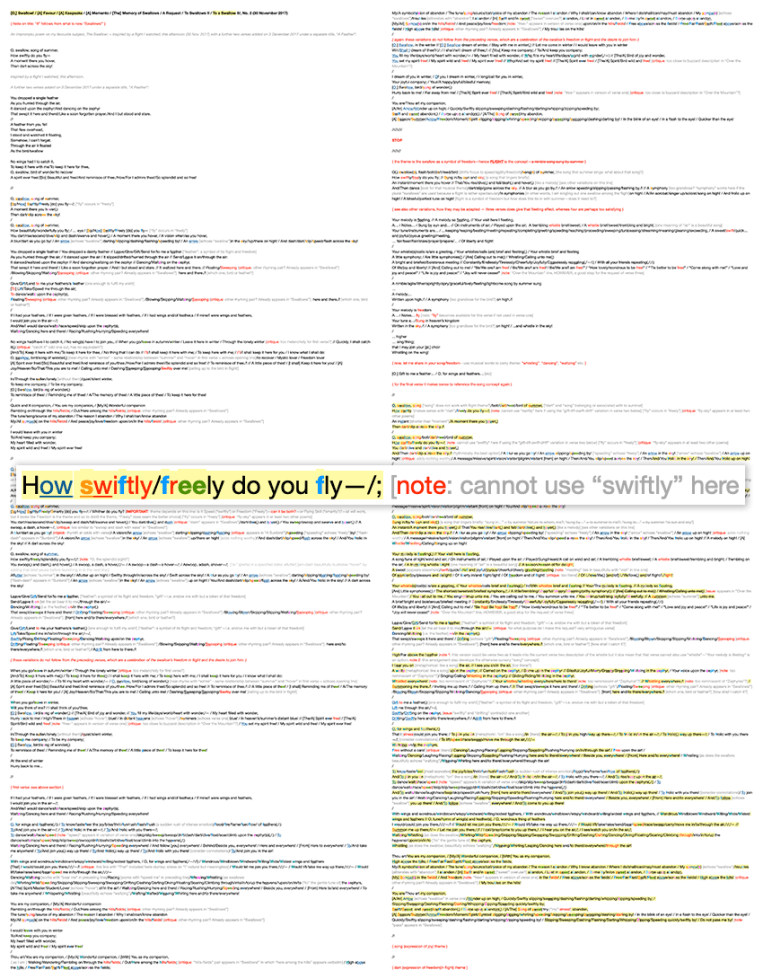
The Evolution of a Poem

Evolution of "To a Swallow", 04 May 2019. Copyright 2019 Forgotten Fields. All rights reserved.

It has been some time since I have shared the development of a poem visually. Here is the evolution of “To a Swallow”, from its first sketch to its current state, presented in two columns. The red text is notes, the colourful lettering how I keep track of alliteration, and the highlighted text those variations I am actively exploring towards the final work.

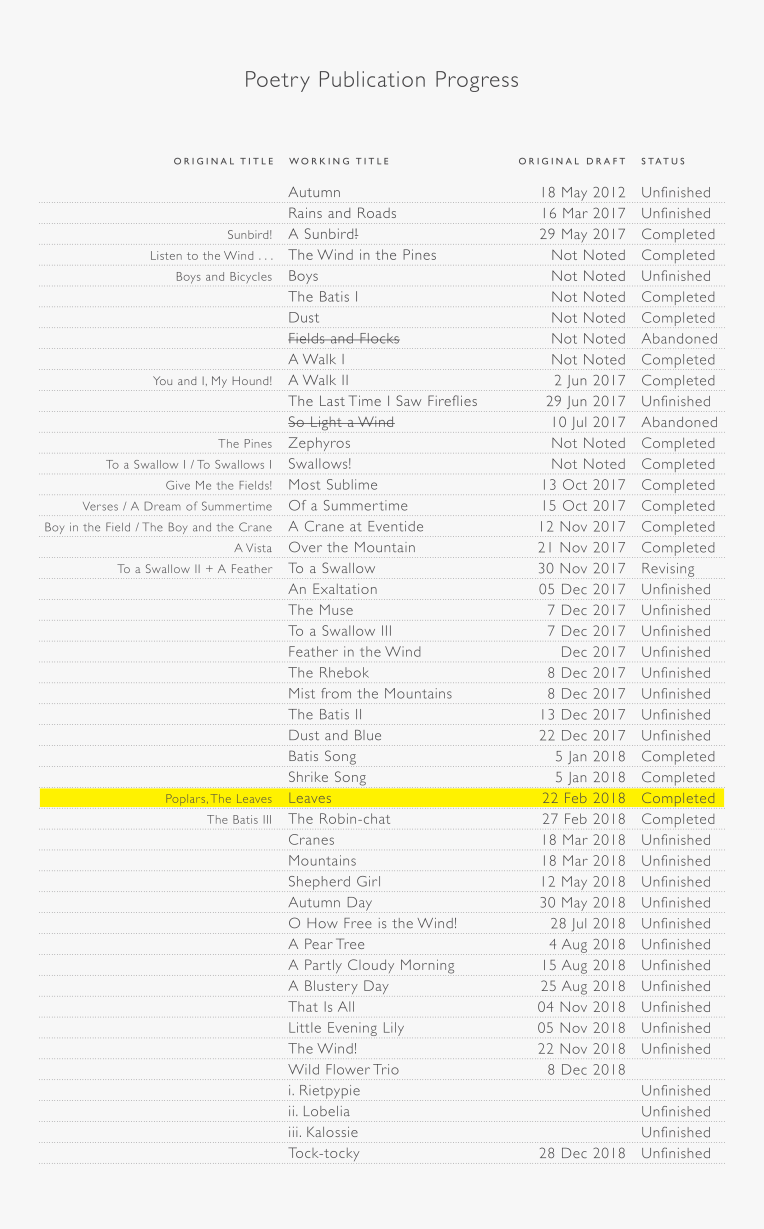
In the weeks to come, this welter of words will arrange itself into a traditional poem. By then, the word count of the document will likely be 13–15,000 words—it is now about 5000 (the final poem will be about 80)—needless to say, it will be some time before I arrive at a final draft. Incidentally, there are 16 poems completed (since 2017) and 28 unfinished—publishing in 2020 may be a somewhat optimistic goal!

The Value of Reflection

I completed “The Leaves” a few months ago. Today, I changed a few significant words within the two short verses to make them more consistent with the autumnal scene the poem describes, and whilst doing so was reminded anew of the benefits of distancing oneself from a work (completed or not) for an extended period.

Returning to a work after days, weeks and in this case months (but also years, as I found in another instance1), helps one see it more objectively, unrestricted by the sentimentality that sets in; for in the thick of the writing process, besotted with a line, a word or an idea, it can be difficult to let go and consider possibilities more ideal.

Depending on one’s level of self-awareness, the work will often suffer to some degree as a result, and it takes a tremendous amount of humility (and courage) to admit to oneself that a particular cherished idea is simply not the best. Distance allows one to reflect upon it all, to comprehend and appreciate what one has set out to do2.

SubscribeStar Poetry Publication Progress (2019-04-15)

Footnotes

  1. From my Twitter account (no longer active): “An idea may come to one in an instant but giving it form takes days, weeks, months, even years. I remember composing ‘Autumn’, one of my earliest poems, in 2012. It was completed in a matter of hours; and whilst the result is adequate, I now consider it nothing more than a draft.” (Tweeted 1 April 2019)
  2. Incidentally, in my ceaseless quest for simplicity, I have also reduced the title to “Leaves”.