
Stanza Two: What To Do?

Stanza Two: What To Do?, 24 May 2020. Copyright 2020 Forgotten Fields. All rights reserved.

“Skaapwagtertjie”

As if in lockstep with the development of its completed English counterpart (“Shepherd Girl”), “Skaapwagtertjie”’s second stanza is a challenge. Having reduced the number of versions for the stanza from just over twenty to two strong contenders for the final draft, I have reached an impasse.

Stanza one introduces shepherdess and flock on the mountain, whilst stanza two elaborates upon her solitary hours watching the sheep. The challenge: which of the two stanza versions most evocatively captures the scene in its four (very) short lines. To find the victor ludorum, I can but nitpick!

“Shepherd Girl”

If truth be told, I am still vacillating between—nay, tormented by—my final choices for stanza two in the English poem. In fact, I devoted today to composing six additional versions of the stanza (from which I have extracted three with promise) to assure myself that I have exhausted every variation.

I had hoped that completing the Afrikaans would bring resolution to my concerns about the English version, but it seems there is yet more work to be done on the latter before I can finalise the former. This is primarily due to the fact that I wish to bring the two poems into thematic agreement.

O, Symmetry!

The second stanza is the only one in which they sufficiently diverge (in subject matter) to cause me concern. In spite of my past pronouncements that the two compositions develop independently, my innate desire for uniformity compels me to seek symmetry, and I must attempt to create it!1

It may be that the aforementioned new English second stanza trials produce nothing worthy and I must humbly accept that the current version is my best offering; but, until I am satisfied that I have summoned every poetic ingenuity within my power, I shall not proceed with the Afrikaans.

  1. I am, of course, in the fortunate position that I can so shape both poems that they agree without compromise—the English version informing the Afrikaans and vice versa. This is not one poet translating the work of another, but a poet casting his own composition into another language (a most fascinating exercise).
The Words We Choose

The Words We Choose, 19 May 2020. Copyright 2020 Forgotten Fields. All rights reserved.

The poetic process is a fascinating one, especially when it comes to the selection of the “right” words. Consider those instances where we choose words not only for their Content and Construction but their Capacity (to perform a particular function) and Cadence (to actualise a particular meaning).

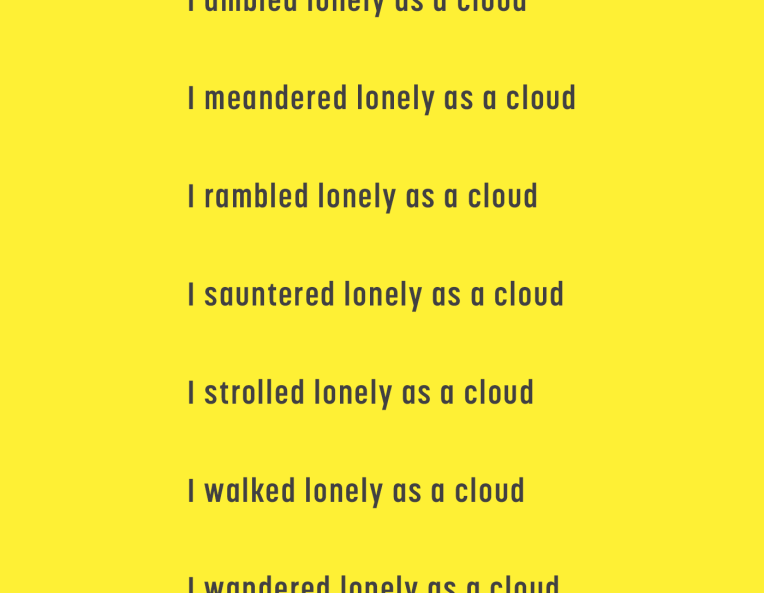
For example, Heinrich Heine uses “hold” (rather than, say, “lieb”) in “So hold und schön und rein”1 to produce a progression of vowels that “opens” like a flower; and a word like “wandered” that requires a certain unhurriedness to convey its sense2 which a high-tempo stanza would undermine.

  1. “Du bist wie eine Blume, / So hold und schön und rein” (You are like a flower, / So lovely and fair and pure) from “Du bist wie eine Blume”.
  2. The inherent slowness of the act as evoked by the sounds and trailing syllables of the word.

On Translating Poetry

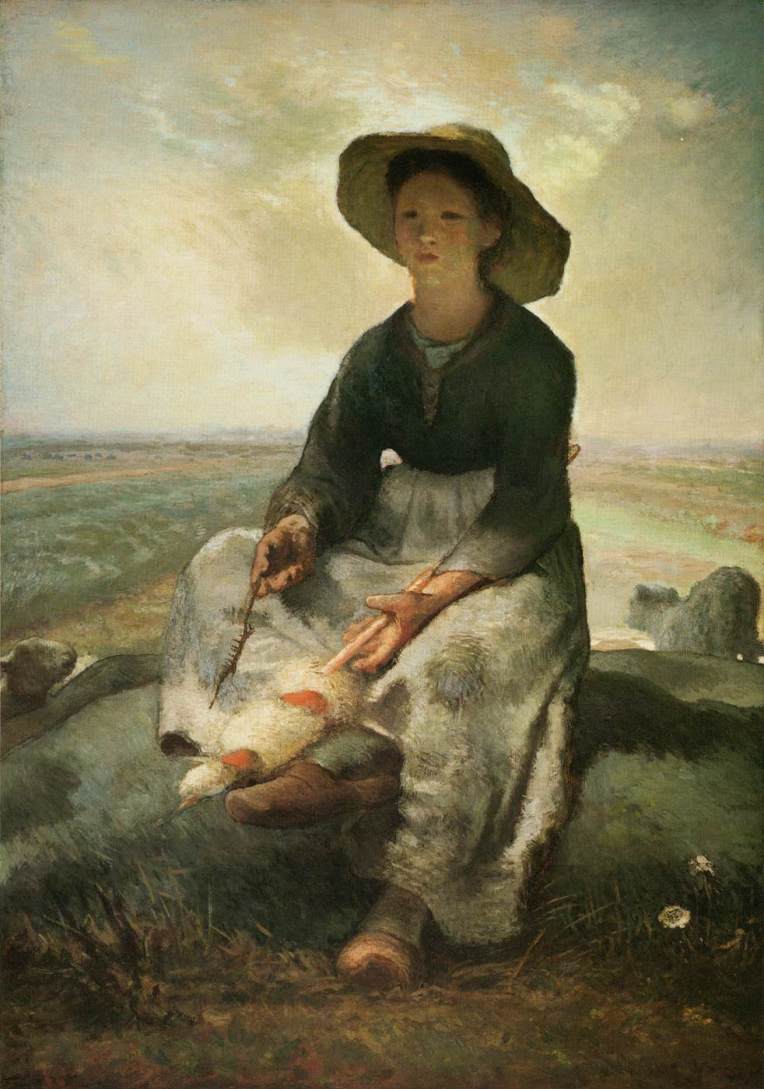
Young Shepherdess by Jean-François Millet (1870–73) in oil. Public Domain.
Young Shepherdess by Jean-François Millet (1870–73) in oil.

Different Language, Different Opportunities

I recently stated that poetic subtleties rarely migrate between languages, and as I attempt to cast “Shepherd Girl” into “Skaapwagtertjie”1, an Afrikaans translation, the statement rings true with every stanza. Even in the rare instance where the Afrikaans allows for a faithful rendition of any given line, with all its poetic content intact, another becomes semantically impossible—either for lack of an appropriate rhyming word or some other linguistic complication.

This is, of course, the result of the inherent differences between languages, for just as each affords unique opportunities for polysemy and rhyme, so do its mechanisms for producing meaning—what word must go where (syntax), what syllable must be emphasised (accentuation), what rhythm must connect this word with that (cadence)—dictate the rules a poet must follow (or flout) to establish meaning and style.

The poet’s use of expressive device (through onomatopoeia, understatement, alliteration, imagery, cliché, symbol, metaphor, simile, hyperbole, personification, idiom and prosody) in one language, may simply not be available in another, and thus the essence—the gestalt—of his poem is compromised or even lost entirely when translated. The result, therefore, will be an inferior facsimile—an approximation that is no more than a shell of the original. Allow me to illustrate:

An Example

A. G. Visser’s “Die Ruiter van Skimmelperdpan” (“The Rider of Dapple Grey Flat”) is a tense poem describing the gruesome ghost of a headless soldier on a fleeing horse. Impossible to translate in English are the movement and contextual dread contained within what is arguably its simplest line:

“‘Die galop … die galop … die galop?!’”2

In the Afrikaans, the natural downbeat of the syllables and the way in which the sounds of the two words connect in the repetition perfectly mimic the rhythmic doo-doo-DOOF, doo-doo-DOOF, doo-doo-DOOF of galloping horse (and racing heartbeat): [dî-KGa-lop, dî-KGa-lop, dî-KGa-lop].

Moreover, the depth of the [duh] in [dî] has the impact of a hoof stroke and the sliding guttural [KG] connecting the two syllables before and after it imitates the sound of gravel. All of this is lost in the staccato of an English rendering: “‘The gallop… the gallop … the gallop?!’” The downbeats, cadence and pronunciation—the “feel” of the English—deliver none of the urgency, desperation, tension and sheer terror that the very nature of Afrikaans invokes and sustains.

A poem—indeed, any artwork—is untranslatable because its Form and Content are inextricably linked. Just as Millet’s oil painting Young Shepherdess (if I may select a work particularly apt3) in watercolour loses a fundamental part of its import (namely the solemnity that oil imparts), so does rendering “Shepherd Girl” in Afrikaans sacrifice something integral to it. Changing the medium changes the meaning, wherefore a translation must take on a life of its own.

From “Shepherd Girl” to “Skaapwagtertjie”

Thus, I depart from the English where the Afrikaans demands it. I have already moved content from one stanza to another to recreate the narrative of the ballad within the confines of Afrikaans rhyme, introducing different details from my mother’s shepherding youth to facilitate the change. It is an enlightening and thrilling project. As I extract from the English original an Afrikaans counterpart, my goal is not to compose a copy, but an Afrikaans poem in its own right.

  1. Afrikaans, [skaahp-vuKG-teR-ki], pronounced as one word, with the [u] in “up”, the guttural [KG] in the Scottish “loch”, a trilled [R] and the [i] in “in”.
  2. [dî KGalop] with the [î] in “in” and the guttural [KG] in the Scottish “loch”. The line is uttered by the soldier’s wife, who also appears in the haunting, as she implores him to stop tormenting her with his nightly race past their cottage (hence the unorthodox punctuation): “‘Waarom rus jy nie, rus jy nie, Jan van der Meer? / Waarom jaag jy my elke nag op? / Sal daar nimmer ’n einde kom … altyd maar weer / Die galop … die galop … die galop?!’” (“‘Why rest you not, rest you not, Jan van der Meer? / Why chase me up every night? / Will there ne’er be an end … again and again / The gallop … the gallop … the gallop?!’”)
  3. Young Shepherdess was one of Millet’s largest and last works, the lowly peasant elevated to near godlike divinity by medium, composition, pose and halo-like lighting—not unlike the way in which the eight-year-old poet within me elevates his mother. (Incidentally, today is her 66th birthday.)