Eureka!

An impasse ended

My recent “Cranes and Sheep” dilemma has been resolved in a triumph of clarity and symmetry. The compositional knots constraining me have been neatly untangled by a willingness to forego an idea to which I had clung, and I have achieved the aesthetic, structural and stylistic objectives I had originally envisaged for the poem, in a new way.

The conundrum centred around a set of lines of which I was particularly fond. They were integral to my conception of the poem, the focal points of the first two stanzas describing Blue Cranes against the heavens and Merino Sheep against the hills in two tableaux. The stanzas were to be static, contrasted with movement in the two that followed.

So established was this concept that everything was constructed about it, creating a compositional crossroads. It was only when I entertained the possibility that it might not be the best approach, that the solution became clear: introduce movement throughout the poem! It seems obvious now, but till that moment, such a change was inconceivable.

A final draft in sight

Once embraced, however, I could consider stanzas three and four from a new perspective. Yesterday, whilst mulling over their subject and style, suddenly—almost automatically—everything fell into place. Possessed by the Muse (or some other benevolent force), I encapsulated all the variations I had written for them previously into pithy stanzas!

I now have a draft that expresses the theme clearly, evocatively and concisely. I am thrilled with the outcome; it feels light, natural—“right”. Once I have descended from this ecstasy, I shall review it and see whether I have indeed such cause for celebration; but, I am confident. Thereafter, it will be a matter of refining the stanzas for the final work.

A lesson I learn repeatedly, but never fully grasp until I am at my wits’ end, is that a poem reaches a point where, like a stubborn youth, it refuses to be anything other than what it wishes to be—where it insists that you change, not it. It is then futile to attempt to bend it to your will, for it has taken on a life of its own. Success comes when you give in.

Clarity versus Symmetry

“Clarity versus Symmetry” Title Card, 10 November 2019. Copyright 2019 Forgotten Fields. All rights reserved.

In the current version of the “Cranes and Sheep” draft, I must choose between pairing “in the sun” (at the end of the first stanza) with either “with their young” or “in the run” (at the end of the second stanza). Whilst “in the run” allows for visual alliteration between the last lines of the first two stanzas, its meaning—“in the pasture and sheep tracks”—may be unclear (I could use “on the run”, but it would be inapt1); “with their young” solves this problem, but it eliminates the symmetry (and is an imperfect rhyme, which here I wish to avoid).

Further complicating matters is the fact that my decision will determine which variations I may use for the stanzas that follow. My choice, then, is between the clarity, asymmetry and imperfect rhyme of “with their young” and the ambiguity, symmetry and perfect rhyme of “in the run”. I suspect I shall choose clarity, but symmetry is hard to resist. Shall I choose the former and risk being criticised by a future reader baffled as to why I did not choose the latter—and does this not perfectly answer my recent question on the subject of artistic choice?

  1. “On the run” may be a possibility, if I could strip it of its idiomatic meaning (“attempting to avoid capture”), but thus far, I have been unsuccessful in that regard.

In Terms of Venery

Blue Cranes, 16 March 2018. Copyright 2018 Forgotten Fields. All rights reserved.
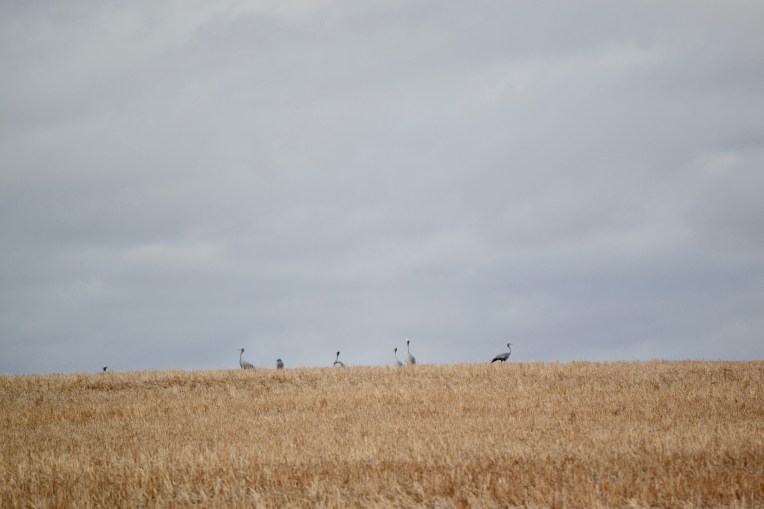
A small herd of Blue Cranes (Grus paradisea) on a hilltop. (Taken 16 March 2018 in the Overberg region of the Western Cape of South Africa.)

In the “Cranes and Sheep” poetic sketch I am presently developing, I refer to the creatures in the title as I often encounter them: in small congregations on the hillsides. In terms of venery (that is, hunting) both are collectively described as a “herd” (along with “sedge/sege” or “siege” for cranes and “flock” for sheep).

I have long been fascinated by terms of venery for they possess a poetry of their own: there is a flamboyance of flamingos, a charm of goldfinches, an ostentation of peacocks, a bouquet of pheasants, an unkindness of ravens, a lamentation of swans and—without a doubt my favourite—an exaltation of larks!

I am certain “an exaltation of larks” was the origin of my “An Exaltation” title as the sketch was composed in 2017 when my interest in the subject was at its peak. So smitten was I with its figurative power that it must have lingered with me, later to emerge as a title. I am pleased it did—“exaltation” is a glorious word!