The Value of Reflection

I completed “The Leaves” a few months ago. Today, I changed a few significant words within the two short verses to make them more consistent with the autumnal scene the poem describes, and whilst doing so was reminded anew of the benefits of distancing oneself from a work (completed or not) for an extended period.

Returning to a work after days, weeks and in this case months (but also years, as I found in another instance1), helps one see it more objectively, unrestricted by the sentimentality that sets in; for in the thick of the writing process, besotted with a line, a word or an idea, it can be difficult to let go and consider possibilities more ideal.

Depending on one’s level of self-awareness, the work will often suffer to some degree as a result, and it takes a tremendous amount of humility (and courage) to admit to oneself that a particular cherished idea is simply not the best. Distance allows one to reflect upon it all, to comprehend and appreciate what one has set out to do2.
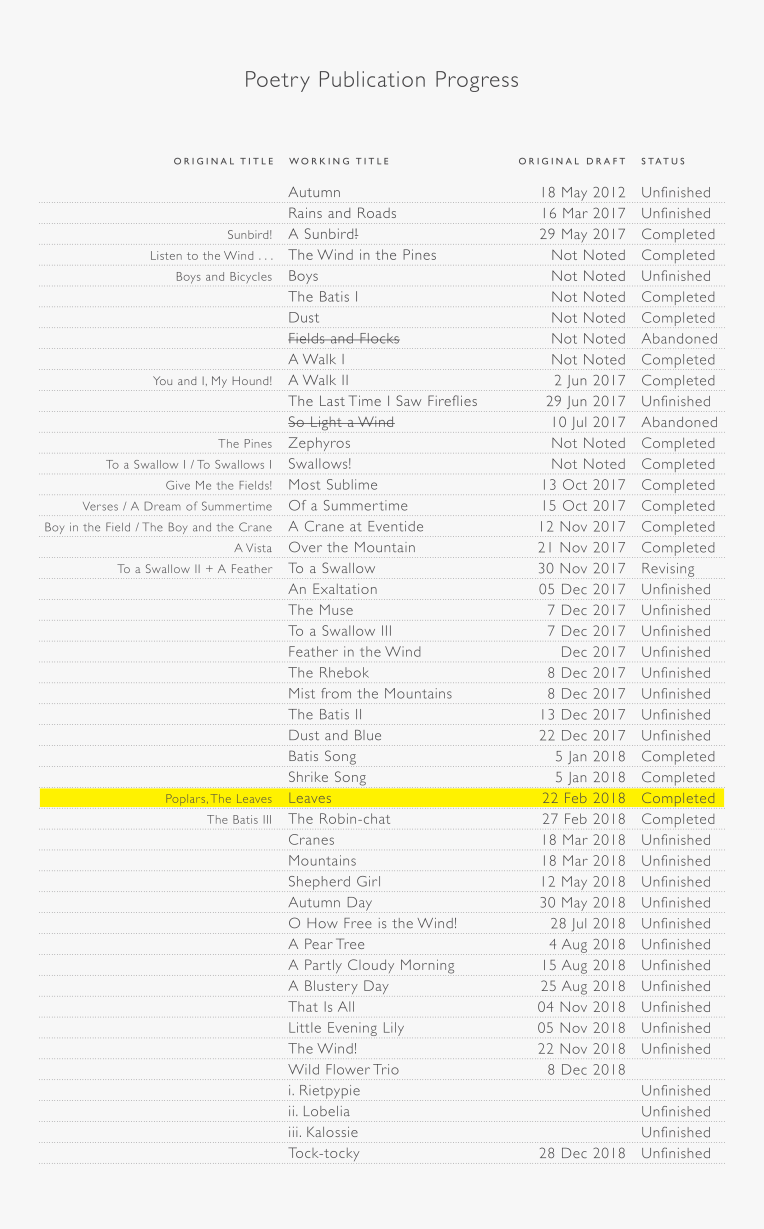
SubscribeStar Poetry Publication Progress (2019-04-15)

Footnotes

  1. From my Twitter account (no longer active): “An idea may come to one in an instant but giving it form takes days, weeks, months, even years. I remember composing ‘Autumn’, one of my earliest poems, in 2012. It was completed in a matter of hours; and whilst the result is adequate, I now consider it nothing more than a draft.” (Tweeted 1 April 2019)
  2. Incidentally, in my ceaseless quest for simplicity, I have also reduced the title to “Leaves”.
“To a Swallow” Update

I have now extracted from all the various verse variations those options that contain within their lines the most evocative expression of the poetic theme: freedom. The text does not quite resemble in its structure a poem yet—as there are many word and line variations within the verses (which I separate with slashes, for example, “skipping/slipping/sweeping/swooping”), making them appear convoluted—but the familiar traditional stanza shape will slowly emerge from the nebula in the weeks to come.

How do you work? (Part 1)

SubscribeStar AQ06

AQ06

My Approach

Slow and Steady

I am a “rational artist”: I must know why I do what I do, and so I have formulated a clear artistic vision. Analytical by nature, making sense of my artistic motivations and processes is not only illuminating but gratifying. A big part of my work involves dissecting it, and my approach to fulfilling it can best be described as methodical.

For this reason, I tend to work slowly, thoroughly exploring every idea for a work (or part of a work) that comes to mind. The moment of inspiration is only the beginning to me. The joy of being an artist lies in the struggle between the inception and completion of the work: in the perfection of its concept, content and execution.

I think of an artwork as a microcosm of an artist’s life, containing the sum total of his experience up until the moment of its conception. My work then is the process of distilling into an artwork the content of my heart and mind, of concretising in a musical or poetic composition what I felt and thought at the moment of inspiration.

Realising a Response

My theme is the wonder of nature, especially as seen in pastoral beauty—at once my muse and subject. I may encounter a wild flower, or a creature, or survey a landscape from which I cannot withdraw my gaze, that will evoke an impression: a feeling that seems to require music or poetry to express. This is how a piece begins.

It appears first as an emotional reaction that transforms into a thought, which in turn becomes a poetic line or verse, or a musical idea. What follows for both music and poetry are fundamentally the same: I begin with a rough idea which I methodically develop, producing many variations until I find those that best fulfil my intentions.

Devils and Details

At any given time, I work on a specific piece in a project—a poem or a musical composition—rather than many at once. I must immerse myself wholly in the work, without distraction, that I may extract from it whatever artistic potential it possesses; I do not move on from a piece until there is nothing more I can do to improve it.

The least interesting part of the process to me is the “gear”: I only require that it helps and not hinder my work, and that it be of sufficient quality for my purposes. My tools, therefore, are few, simple and convenient: for music, I use a digital audio workstation and session musicians, and for poetry, a physical and digital notebook.