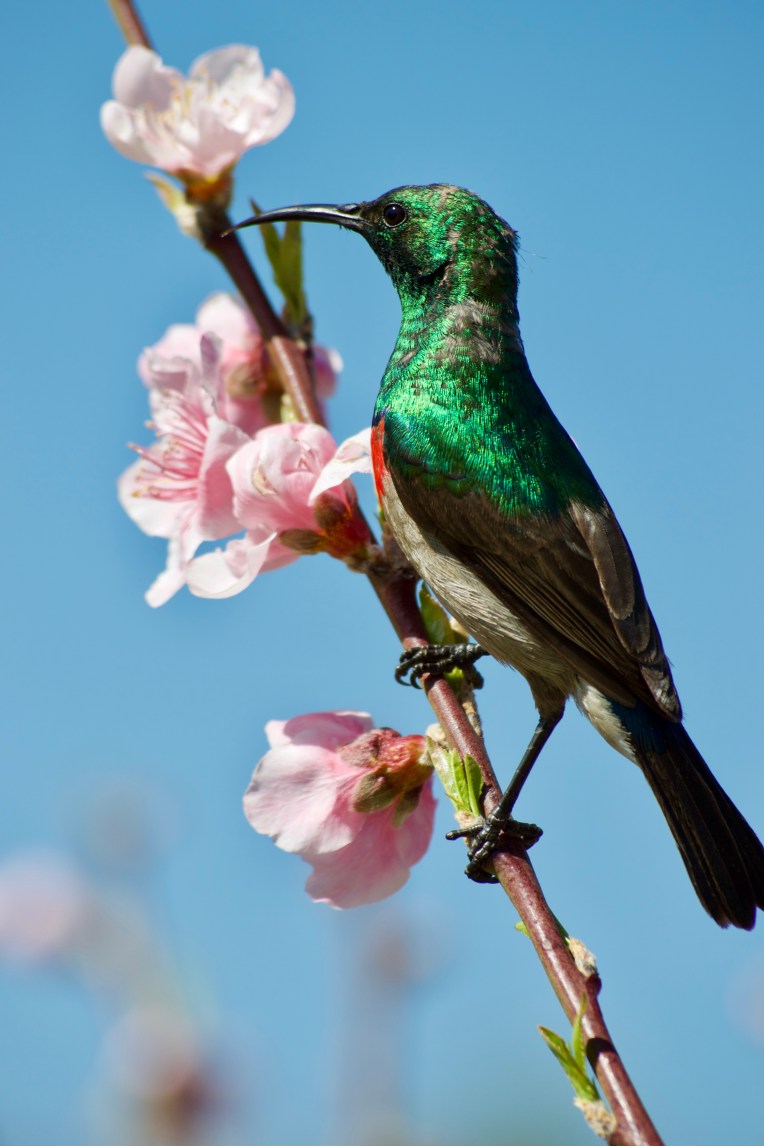
A Sunbird in the Blossoms

A Sunbird in the Blossoms, 26 September 2019. Copyright 2019 Forgotten Fields. All rights reserved.

© 2019 Forgotten Fields

The South African spring brings blossoms and sunbirds to the garden. Surprisingly forgiving of my intrusion, they permit me to come within less than a metre (four feet) of their presence, allowing me to capture photographs like this one.

This is a Southern Double-collared Sunbird (Cinnyris chalybeus) male, named for the bright red and blue (not obvious here) bands upon its chest. Its Afrikaans name, Klein-rooibandsuikerbekkie1, translates to “little-redbandsugarbeak”.

  1. Pronounced [cleyn–Roowaybunt–soykeRbecky] with a trilled [RRR].

Tseeoo, Tseeuuuu!

This morning, I filmed Cape Clapper Larks (of the sub-species Mirafra apiata marjoriae) in display flight. They were at a distance, so one must look closely at the footage, but this was my first (spontaneous) attempt at recording their performance. Unlike Mirafra apiata apiata (the subspecies I first identified), M. a. marjoriae has two descending whistles: “Tseeoo, tseeuuuu!”

Incidentally, the loud “Kraaaank, kraaaank!” calls you hear throughout the video are those of the glorious—nay, divine—Paradise Crane1 (also known as the Blue Crane, Anthropoides paradiseus, the subject of another poem, “A Crane at Eventide”); the cackling at the 01:36 mark (and elsewhere) is the ubiquitous (and pesky) Helmeted Guineafowl (Numida meleagris).

  1. See the “I watched a crane leaping in the wind” heading in “This January” for a brief account of a memorable sighting earlier this year.

In the morning, as one walks along the country lanes, now and then on the fences, Cape Clapper Lark males (Mirafra apiata apiata) make an entertaining display. Flapping their wings, they fly straight up into the air from the posts—which produces a fast “pup-pup-pup-pup” clapping sound (about 25 to 28 claps per second) that increases in speed—uttering a mid-air “Phwoooeeeeeet!” before descending. This is done to attract a mate, and one cannot help but stop and take pleasure in it; indeed, one is oneself tempted to clap for sheer enjoyment!

Sonogram of Cape Clapper Lark (Mirafra apiata apiata) Display Flight Whistle and Clapping Sounds (Recording by Lynette Rudman, 2015)

Audio Copyright Lynette Rudman. Sonogram Copyright Xeno-canto Foundation.