Composing “Shepherd Girl”: Three Versions

I now have three versions of the “Shepherd Girl” poem from which I must choose one as the final composition. They are similar in most respects except for stanza two, which concerns how my mother passed the time whilst sheep watching. The dilemma: which pastime is most apt?

Another decision I must make concerns a line in stanza three: do I choose the figurative version, which allows for good onomatopoeia but poor fluidity, or the literal version, which allows for better flow but little lyrical effect—alliterative, onomatopoeic or otherwise? I cannot decide!
Composing “Shepherd Girl”

“Shepherd Girl” is developing beautifully. Three of the four stanzas have their variations reduced to one or two preliminary versions for the final draft; only the second stanza has yet to be brought to that point, with about nine variations under consideration.

I spent much of the week on those variations, attempting to weed out the least workable among them; but, with every one I eliminated, several more would spring up! From more than twenty options, I have now set apart nine from which I must extract one.

It sounds complicated, but the poem is a simple ballad with short lines. The challenge is finding the right details to cast in verse—those that best capture the subject and theme (a biographical glimpse into my mother’s youth—its innocence, hardship and beauty).

Balancing Fancy and Fact

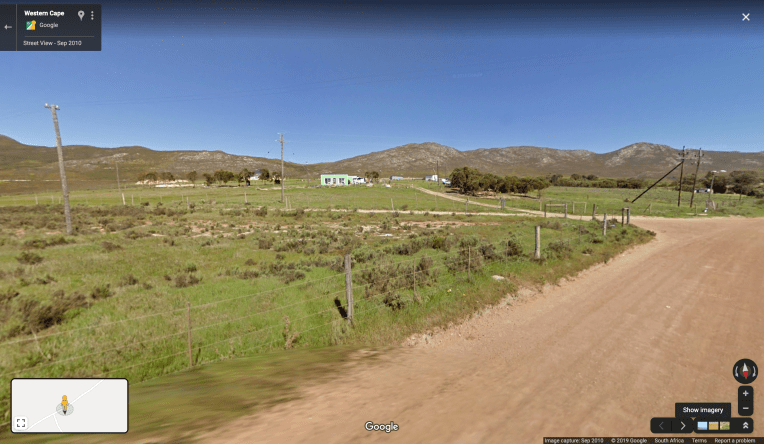
Dot's Cottage. Copyright 2010 Google.
The cottage my mother grew up in, very different in appearance today. Directly to the left behind it, the gentle divide between two elevations of the Little River Mountains where I assumed (incorrectly) she tended the sheep. The actual pasture was toward the far left of the scene, up and over the slope (just left of the first telephone pole; at the time, she lived in a little hamlet just beyond the frame). (Google Street View)

“Shepherd Girl”, the poem I am currently developing, describes a day in the hard but simple youth of my mother. At eight years old, it was her duty to watch sheep up the nearby mountain, spending many hours alone on the eastern extension of the Little River range. Twice now have I been confronted with an erroneous understanding (on my part) of the details she had shared of that period.

The slope and fold, for example, were not where I thought they were, and she lived then in a different locale! These discoveries I had to weave anew into the composition as, upon pressing her further, she provided greater clarification. There is in the work a touch of pastoral romanticism—a fragile girl on a rugged mountain—but I want as far as possible her actual experience reflected in the lines.