Revising “Autumn”, Sifting Through Variations

I continue my work on the “Autumn” poem, extracting from its many stanza variations those that best express the theme.

The composition consists of eight couplets. Presently, I have whittled the variations for each down to two for the first couplet, one for the second, third and fourth couplets, two for the fifth couplet, one for the sixth couplet, and five for the seventh and eighth couplets—most of these have internal refinements yet to be made.

Now and then, a new idea for a variation interrupts me, but it is a welcome delay. I hope to have a final draft in January.
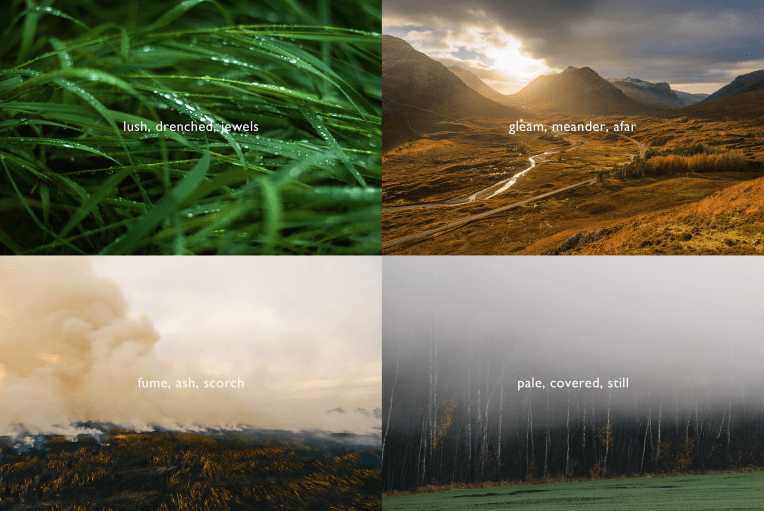
The Write Mood

"Autumn" Mood Board, 16 December 2019. Copyright 2019 Forgotten Fields. All rights reserved.

The mechanics of artistic thinking is as interesting to me as what it produces. One part of my creative process I have not written about before is the use of mood boards.

Sometimes they are abstract—mental images of the scenes or incidents I wish to embody in verse; sometimes concrete—collages of photographs and words. Whatever the form, as I compose a poem (or musical work), I draw upon these as a source of ideas.

To illustrate, I include a simplified mood board1 for “Autumn” (the poem I am currently composing). In 2012, when the original version was composed, I had not yet developed the mood board approach—moreover, the poem was very much an impromptu affair.

Since then, my process has improved significantly. The mood board visuals keep before me what inspired the verse—evoking words and phrases to express the theme.

  1. The photographs are not my own: top left is by Kuzmenko Viktoria, top right by Daniel Kay, bottom left by Neenawat Khenyothaa and bottom right by Gints Ivuskans.

Revising “Autumn”, Overcoming Attachment

When one revises an existing poem, it can be difficult to let go of some of its original ideas because they seem inextricable from the fabric of the composition. This has been my Achilles heel revising “Autumn”. Instead of accepting that I must forego certain parts of the original version to achieve a better work, I clung to elements I knew to be conceptually debilitating.

Over the past two days, as these shortcomings became ever more pronounced, I was forced to come to my senses; and lo, the beloved lines I lost were soon replaced by ones more fitting, liberated from the creative constraint that had plagued the revision hitherto.

“Autumn” was my first proper lyric poem.1 At the time (2012), it was an indulgence of my poetic ebullience, a manifestation of my love for Nature and Verse. Seven years later, it must be elevated into something greater: a work combining that love with skill and substance. Having embraced the inevitable, I can now do the composition justice whatever the cost to its first incarnation.

  1. I wrote a little about the significance of “Autumn” in my poetic journey in the fourth instalment of my “Artist Questions” series.