This is part two of a three-part series about the new self-titled album. Read “A New Album, Part One: The Poem”, here.
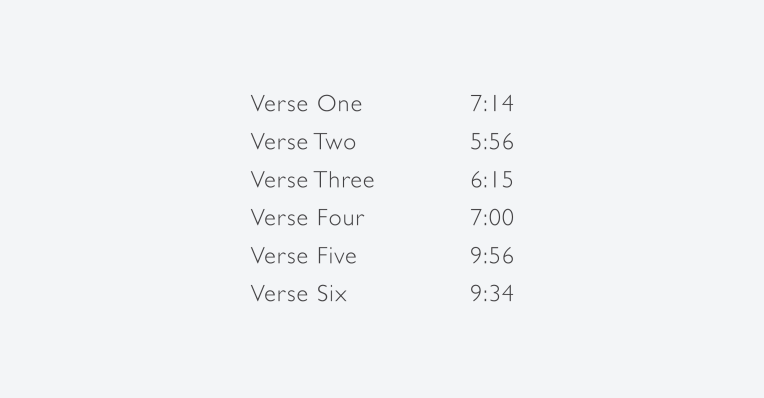
“Verse One”, the first track from the self-titled album.
Six Verses, Six Tracks
I started work on the music as soon as the theme of the poem became clear. Already in December 2016, I had put together a collection of sketches, early experiments with melodies and instrumentation based on the direction the poetry was taking. When at last I had the final draft of the poem, I turned my attention to the sketches. I began by deciding which of them to develop into complete tracks, focusing on the ideas that were most in line with the poetry; and since there were six verses, I conceived of an album with six tracks: a series of movements to correspond with the verses of the poem.
The poem played a central role in the writing of the music and the naming the tracks. As with The Zephyr and the Swallow, where the poetry inspired the music and the tracks took their titles directly from the lines, I looked to the verses to inform my creative decisions. I therefore followed in the compositions where the poem led. I named each track after the number of the verse it described, which resulted in the sequential “Verse One”, “Verse Two”, “Verse Three”, and so on. This helped reinforce the track-verse connection and emphasised the importance of the poetry.
Composing the Music
Like the verses, each track went through scores of rewrites as I wrestled with track form, instrumentation and melodies. I would spend days on an idea only to discard it and then reintroduce it later. Two of the tracks changed structure in addition to receiving brand new parts as late as the final mixing phase! Often, things I thought were cast in stone, had to be altered or abandoned for the sake of a better solution. There were countless interpretations of melodies and renditions of musical phrases, each experimenting with different instrumentation and degrees of embellishment or simplification.
All the while, I had to be vigilant not to overcomplicate the music because I wanted to retain an ambient quality. For this reason, it was important to tread the fine line between “soundscape” and “soundtrack”—how much compositional drama could I use before the music stopped being “ambient”?—the goal was to stay faithful to the poetry without being overly descriptive or orchestral. I tried to achieve this by using only a handful of instruments, relying on minimal compositions to bring the melodies to life. The music, therefore, does its best to sweep one along with the simplest instrumentation.
Producing the Album
Building the music around the poem brought a natural cohesion to the album. As the tracks progressed, the scenes, thoughts and emotions conveyed in the lines slowly emerged in the music. Gradually, the compositions began to reflect the substance of the poetic verses, the sketches becoming with every revision the lyrical pieces I had envisioned, months before. The main themes I set to woodwinds, keyboards and guitars, and accompanied them with synthesisers and strings. The result is a vivid expression of the lines of the poem, the music wistful and musing with moments of joy and regret.
Once the compositions were complete, recording went smoothly. The album is a combination of digital and real instruments. For the latter, I worked with session musicians, artists with an intuitive understanding of what I was trying to achieve and consequently, how their parts needed to be played. I decided to use real instruments, especially for the flutes and English Horn because there are nuances in woodwinds that are difficult to reproduce digitally. Working with session musicians brought home to me the beauty of the real instrument and I am convinced that the recordings are better for it.
Read “A New Album, Part Three: The Artwork”, next. Forgotten Fields will be released on 17 November 2017.
 Forgotten Fields