New Year, New Music

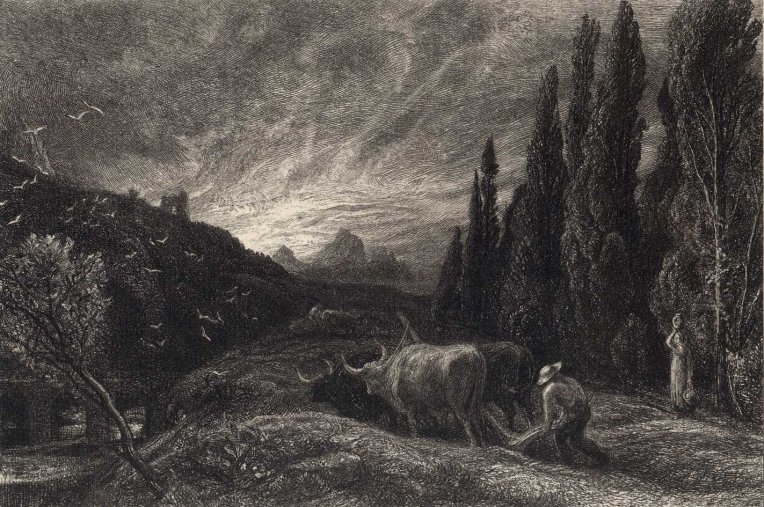
“The Early Ploughman”, circa 1860, an etching by Samuel Palmer (1805–1881). Source: Tate

Story

Whilst it is possible to enjoy ambient music without any context, an album concept can transform the way one experiences the music. Depending on the objectives of the musician, the concept will lie somewhere between elegantly explained and deliberately obscured. My approach is nearer to the former. I enjoy telling stories and music allows me to do so in words, pictures and sound. This year, I want to give context to my music using words in the form of poetry and pictures in the form of unique album artwork.

Poetry

To me, words are inextricable from music, whether they are the lyrics to a song or the title of an instrumental track. On my first album, I experimented with this word-music relationship, adding lyrics (to be sung by the listener) to “Silently You Sail”, and I want to further explore this idea by using poetry as an integral part of new music. There are currently two projects in pre-production which will be built around poetry. They draw inspiration from many poems but two stand out as being most influential in developing the concepts behind the music: the untitled verses for the rabbit Silverweed by Richard Adams in Watership Down chapter 16 and “Winternag” (Afrikaans, “winter’s night”) by Eugène Marais. Richard Adams captures the wistfulness and Eugène Marais the melancholy I want to express in my own poetry and music.

This is the first stanza of the Richard Adams poem containing my favourite opening line in poetry:

The wind is blowing, blowing over the grass.
It shakes the willow catkins; the leaves shine silver.
Where are you going, wind? Far, far away
Over the hills, over the edge of the world.
Take me with you, wind, high over the sky.
I will go with you, I will be rabbit-of-the-wind,
Into the sky, the feathery sky and the rabbit.

And this is the first stanza of the Eugène Marais poem describing a landscape scorched by fire:

O koud is die windjie (O cold is the slight wind)
en skraal (and spare).
En blink in die dof-lig (And bright in the dim light)
en kaal (and bare),
so wyd as die Heer se genade (as vast as the grace of the Lord),
lê die velde in sterlig en skade (lie the fields in starlight and ruin).
En hoog in die rande (And high in the ridges),
versprei in die brande (scattered in the fires),
is die grassaad aan roere (are the grasses astir)
soos winkende hande (like beckoning hands).
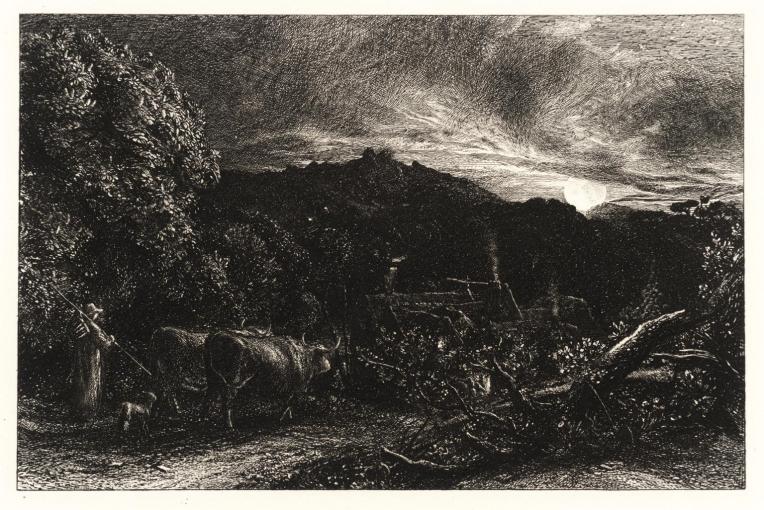
“The Weary Ploughman”, circa 1860, the companion piece to “The Early Ploughman”, an etching by Samuel Palmer (1805–1881). Source: The British Museum

Artwork

It may seem premature to think of artwork this early in pre-production but it is a defining feature of an album and one of the chief ways in which an ambient musician can communicate the main theme of his music. I want to use artwork to augment the overall concepts of my new projects, so I think it makes sense to develop the artwork in tandem with the music. This is how I approached the artwork for my first album. By making it part of the process from the outset, the result feels like a natural outcome of the process rather than an arbitrary afterthought.

I have approached a number of artists about developing artwork for upcoming projects. I am particularly interested in the idea of presenting machine-made music in a handmade medium. It introduces an element of contrast in the production process, which I like for its complementary quality. This is why I am investigating traditional methods of creating artwork. Etching is one possibility—the highly atmospheric prints of Samuel Palmer are great examples of what it can produce—but whatever the final method, this will be its underlying philosophy.

Music

The music will build on the idea of repeating musical phrases but will incorporate new elements. My tracks typically start out as piano sketches which I then reinterpret digitally, adding elements that suit the theme of the music. On my first album, this included a combination of digital keyboards and synthesised classical instruments, such as the French horn in “Airship” and the bassoon in “Giant in the Sky”. This really appeals to me and hence all the tracks currently in pre-production will make use of this combination in some form.

In addition to the solo material, I will also work on two separate collaborations with Krzyzis and Astoria Sound. (There may be one other collaboration with Ghost Signs but nothing has been decided.) I am planning a two-track EP with Krzyzis as a kind of preview of what is to come but in collaborative form; and my work with Astoria Sound will be for a dedicated collaborative album of theirs. I am excited to see how these projects influence my solo music and I am truly grateful for this opportunity to work with these very talented musicians:
FORGOTTEN FIELDS

Apple | Spotify | Bandcamp | Twitter | Facebook | YouTube

Why Beauty Makes Me Cry

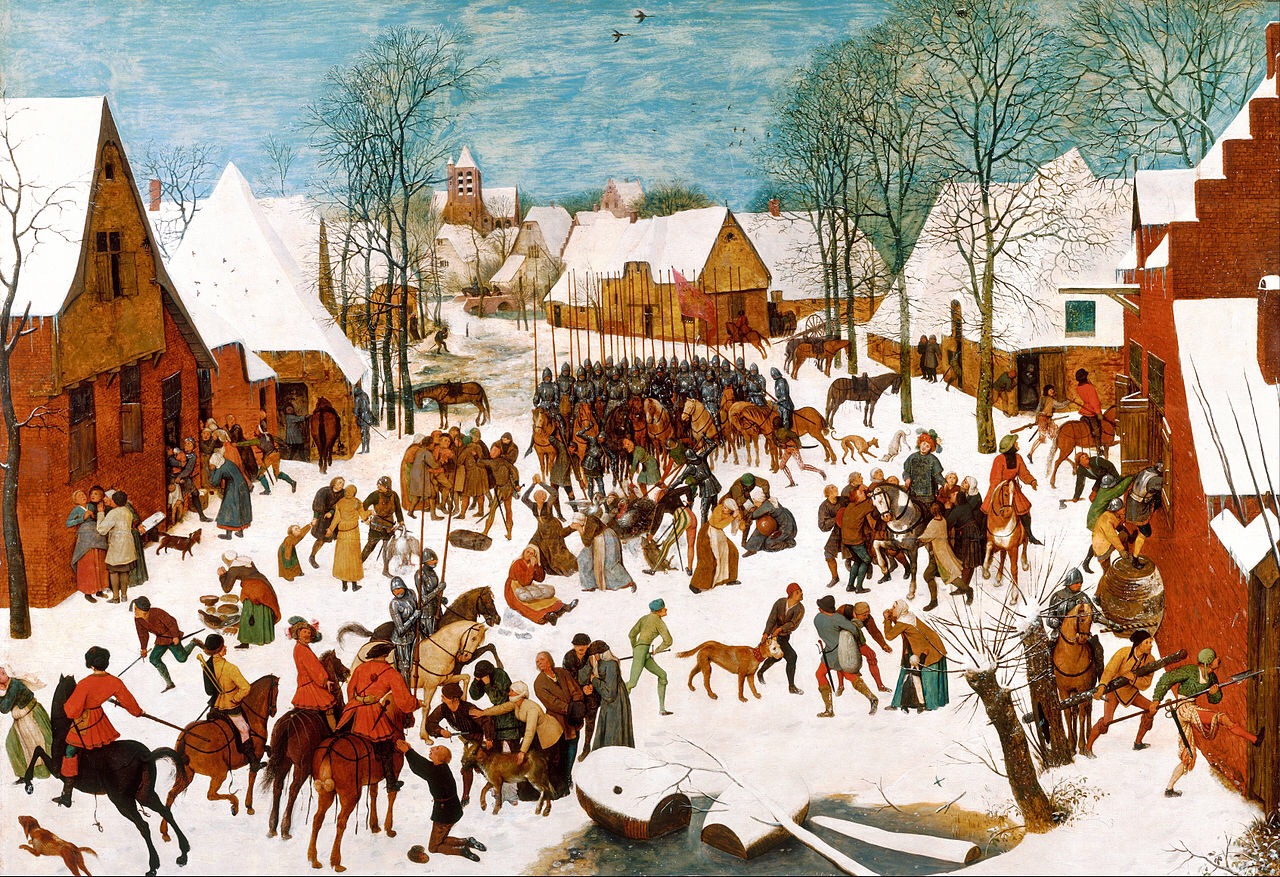
Massacre of the Innocents (c.1565-67) by Pieter Brueghel the Elder (c. 1525-1569)

Breughel and tears

I was reminded of Breughel’s Massacre of the Innocents, today. My reason for thinking about that painting was curiosity of a personal nature. When I first laid eyes on it, I had to fight back the tears, so powerful was my emotional response to it (and I didn’t even like Breughel’s work, up until that moment!). This wasn’t an isolated incident. I sometimes find myself talking about something I consider to be an example of brilliance and I’ll become inexplicably emotional. It’s never made sense to me why this happens. Why, when faced with instances of great beauty, creativity, genius or some other mastery, I seem to disintegrate. There’s nothing more or less special about me than any of my peers, and yet they don’t fall apart when they hear Dvorak’s 8th!

Mother issues

Unsurprisingly, the origin lies in my childhood. I was an “accident”, the result of bad planning—I used to think of it as “a moment of passion”. After not being aborted, I was raised by a mother who didn’t really need me around. I was left in my grandmother’s care, whilst she pursued her career. But, as any adult child of a dysfunctional family will tell you, children can tell when they are not wanted, when they are not celebrated, when they are an inconvenient burden; and the effects of these circumstances are devastating. This was certainly my experience. Growing up, I had a sense of not being all that important to the big people, least of all my mother. I craved her love, care and affection. But, she was incapable of loving me. (There were reasons for this inability, which I now understand intellectually, but, of course, to my younger self, none of that mattered.)

The “good boy” game

As a result, I had to find ways of attracting the love I needed. I became a “good boy”: I never expressed feelings or needs and I always did what I was told. When I was well-behaved, I was praised and approved of, and when (on the rare occasion) I was ill-behaved, I was punished and disapproved of. My emotional security and my value became wholly dependent on my performance, not on anything inherently lovable within me. It left me feeling emotionally abandoned and unwanted. The “good boy” game was working, but a roller coaster of insecurity was the inevitable outcome. What I needed was unconditional love, love independent of what I did or didn’t do. And since I couldn’t make my parents love me, I needed a new plan. The game was up. I needed a love substitute.

The substitute

I found this in beauty. At first, it was the superficial beauty admired by a child: decorative items in the house, flowers in the garden, toys, favourite stories, songs, thoughts—tangible and intangible things I could collect. But, as I grew older, I began to see the beauty of creative genius in the arts, design, engineering, philosophy, science, and so forth. My reverence for what I collectively call Beauty became absolute. I began to see it as a constant: it wasn’t reactive, it didn’t become less beautiful, it was consistent and reliable, a kind of refuge from the loveless reality I experienced as a youngster.

An imaginary friend

The people in my world were insensitive, dismissive and unappreciative. They made me feel insignificant and worthless. All I could do to survive was to find ways to protect myself. But, in the presence of beauty, I could lower my defenses. I could drop the “good boy” act and just be. Admiring beautiful things was a way of vicariously giving myself the love, approval and worth I so desperately sought. It was twisted, but it became a genuine replacement for the conditional love and approval I was generating in my parents. Beauty became my imaginary friend, a source of joy with every new creative or intellectual discovery. It didn’t disapprove, ridicule or disappoint. It was only its wonderful self, admired by all who loved its form.

I cry because I’m vulnerable

And so, when I come face to face with something Beautiful—something excellent, pure and masterful—that unloved, wounded part of my soul is exposed. It’s no wonder I become a defenseless little boy who just wants to break down in tears. Beauty has protected, soothed and healed me, all my life. Without it, I don’t see how I could have survived—I owe it my life and sanity. I become emotional because for that brief moment, in the presence of something great, all my defenses are down. When I was a boy, my first exposure to true creativity was through music. The works of Beethoven and Tchaikovsky exposed me to genius I couldn’t even begin to understand, but it inspired me to make music, to try to create something beautiful, myself. Today, the very process of making music restores me and delivers me. May the music I make also bring beauty into the lives of others.

FORGOTTEN FIELDS

The Chaos of Creativity

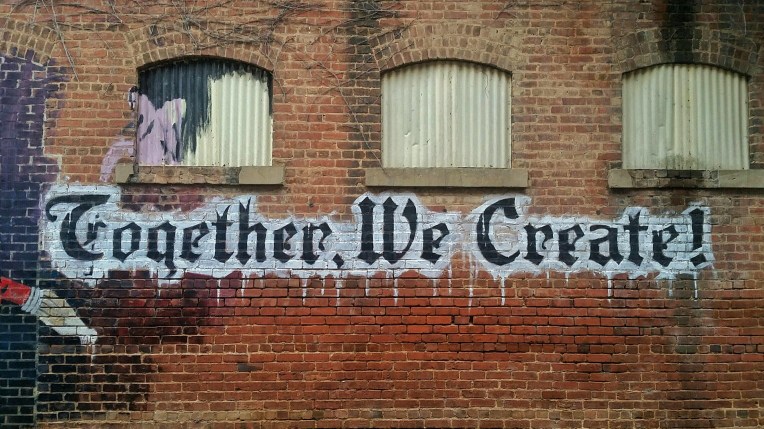
Together We Create wall graffiti
Image by My Life Through A Lens

Finding an idea

Walt Disney once said:

We don’t make movies to make money, we make money to make more movies.

It was natural, for me, to substitute “movies” with “music”. I am a graphic designer by profession. I like to think of it as making shapes by day and sounds by night. In many ways, graphic design is like music, but instead of manipulating sound to communicate a message, you manipulate visuals to do so. I find both disciplines satisfying because they allow me to make things that add beauty to the lives of others. To create beauty, one must often begin with the not so beautiful. I was never one for getting dirty, but creativity is very messy, at least, in its early stages. There are scribbled notes and cutouts, rough sketches and experiments, a host of silly solutions and obvious ideas easily exposed for their unoriginality. But, as the process develops, workable solutions emerge, a good idea crystalises, and order slowly imposes itself on the chaos.

Like most creative folk, I tend to think my first idea is my best idea. (This is especially true if you’ve been around for a while). I have to learn, again and again, that this is rarely the case. Almost every first idea can be improved upon. In art school, I learned to love this process of development and improvement, of looking at an idea from different perspectives and getting feedback from others. (For the best feedback, Paul Arden (I think) brilliantly suggests that we don’t ask people if they like our idea, but that we ask them what they would change about our idea—I can report that this works, every time.) Sometimes, an idea must be totally abandoned in favour of a better one, or it must be abandoned temporarily and returned to later with fresh eyes and ears. This is how one goes beyond the obvious and arrives at something new and even unique. But, ideas are only part of creating beauty. Finding the right medium in which to develop those ideas can be a challenge.

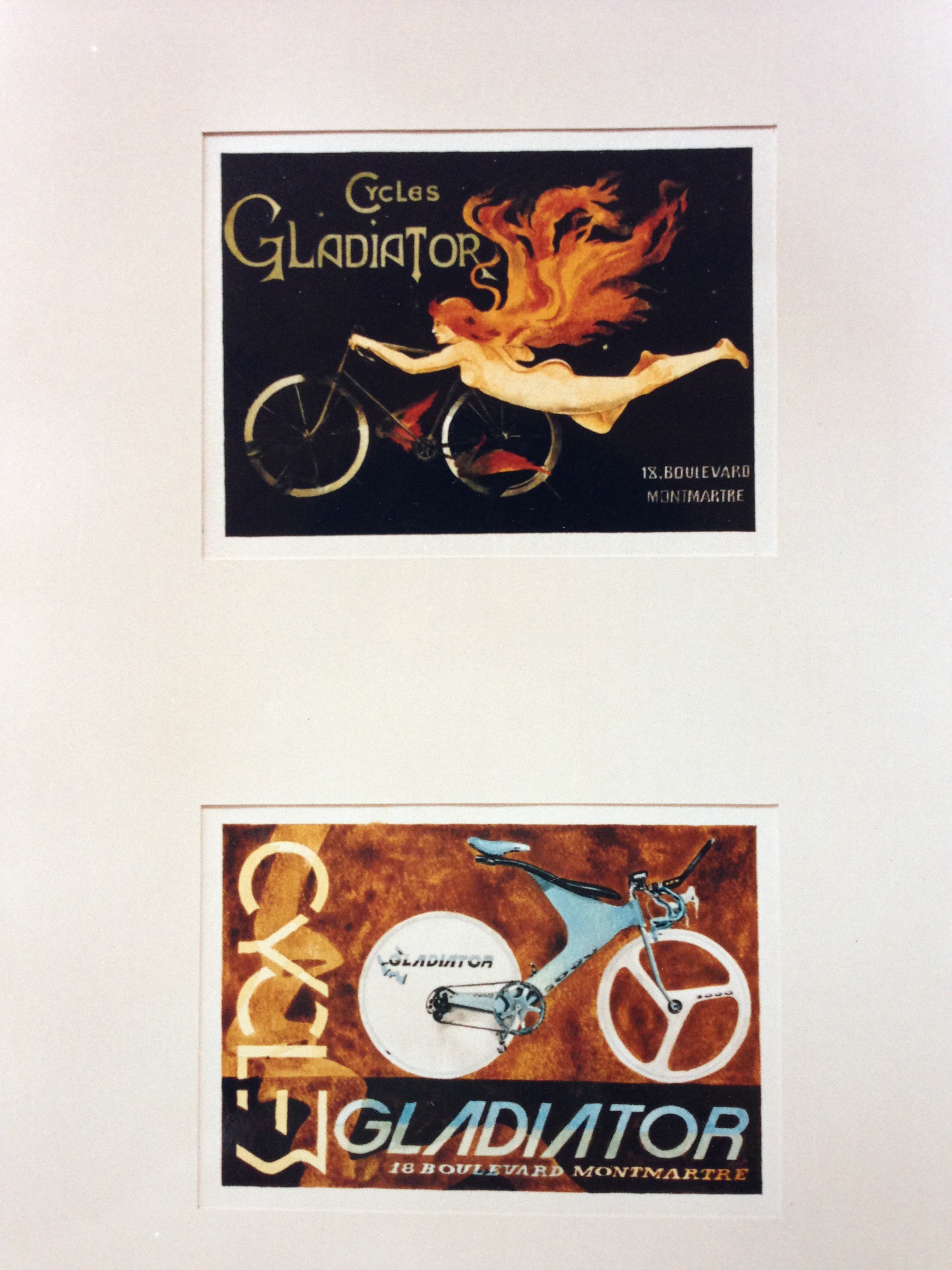
Vintage Gladiator Cycles advertisement
One of my early art school graphic design projects involved redesigning a vintage advertisement. I did the project in watercolours.

Finding a medium

When I began specialising in graphic design at art school, I needed a medium with which to hash out ideas. Something that was inspiring to work with, but still suited to the precision necessary for the discipline. During my first year, I had developed a way of working with watercolours that met these requirements, perfectly. Watercolours became my trademark medium for preliminary designs and I think my work was better as a result of having found the right medium to explore in. A lot of my early final pieces of design were not rendered on the computer and printed. Instead, I painstakingly produced them in watercolours. Working with watercolours gave me an opportunity to master something that seemed to defy mastery. It gave me a sense of power and control, something I have always felt I lacked inwardly. A similar quest for a suitable medium of exploration took place for me in music. (Of course, the struggle to master that medium is ongoing.)

My early training in music was classical. I composed precise little pieces for the piano, but they were so structured I couldn’t stand them. I loosened up a little when I learned to play the guitar. I wrote lots of folk songs, but they were forced and embarrassingly pretentious. For a long time after that, I experimented with different genres, looking for a music style that felt natural and honest. Stories High was my most recent attempt in this quest. But, I found working with lyrics to be restrictive. I wanted to be liberated from them—besides, I felt ambivalent about singing. What I needed was the musical equivalent of watercolours. When I couldn’t find it, I stopped making music, for a while.

Finding a Muse

Then, a few months ago, I heard Sketches From New Brighton by Loscil. The album described Scott Morgan’s fascination with an oceanside park in Vancouver. I was captivated by both the concept and the execution of this idea. Scott Morgan was doing what I had subconsciously wanted to do, all this time. It’s baffling, but even though I’d listened to ambient electronic music for years, I’d never seriously considered composing in that genre. Somehow, having so clear an example in Scott Morgan was just the catalyst I needed. Here was a musician telling a story in abstract soundscapes. He did this by building layers of musical loops, creating a kind of sonic chaos. From this, he extracted musical phrases. At least, this was how I interpreted his work. To me, it was a revelation. I had found my watercolours of sound! Suddenly, I had a medium from which to draw my own melodies and meaning. It was only a matter of time before Forgotten Fields was born. There’s another quote involving Disney:

Disney movies touch the heart, but Studio Ghibli films touch the soul.
— Unknown

Scott Morgan’s Sketches From New Brighton had the Studio Ghibli effect on me. One day, I’ll write him a letter of thanks. Even if no one ever reads this blog or listens to a single track, I have him to thank for giving me a new medium and a new love for musicmaking. And here I am, putting together my first album, composing my first story in music. There is an incredible amount about making instrumental music I am in the process of learning, but what better way to do so than by making instrumental music? I feel a tremendous sense of relief finally being able to make the music I want to listen to.

Finding a message

As for the subject and theme, the very childhood demons I have been wrestling with in recent times have provided them. I never understood what people meant when they said that a curse can become a blessing (or something to that effect), but I think I know what they mean. All my life, I have struggled with abandonment issues. It would not be an exaggeration on my part to call it a curse. But in music, I can work through these issues, expressing the grief, loss and loneliness, but also the beauty, wonder and adventure of childhood as experienced by adult children of dysfunctional families. Perhaps in my music I can give myself and others a place of refuge and release. That would be my curse turned into a blessing. It is an exciting time for me. I am eager to see what happens next.

FORGOTTEN FIELDS