The U.S. Coast Guard Douglas RD-4 Spica escorts the Hindenburg on arrival at Lakehurst, New Jersey (USA), after its inaugural flight from Germany in 1936.
A gargantuan garage
Airship hangars are specialised buildings that are used for sheltering airships during construction, maintenance and storage. Rigid airships always needed to be based in airship hangars because weathering was a serious risk.
“Hangar”
“Hangar”, the first track on Airship, was inspired by Hangar No. 1 at Naval Air Engineering Station Lakehurst (pictured above). The music describes the interior of the enormous building with driving synths, hovering strings and atmospheric percussion. I cannot wait for you to hear it!
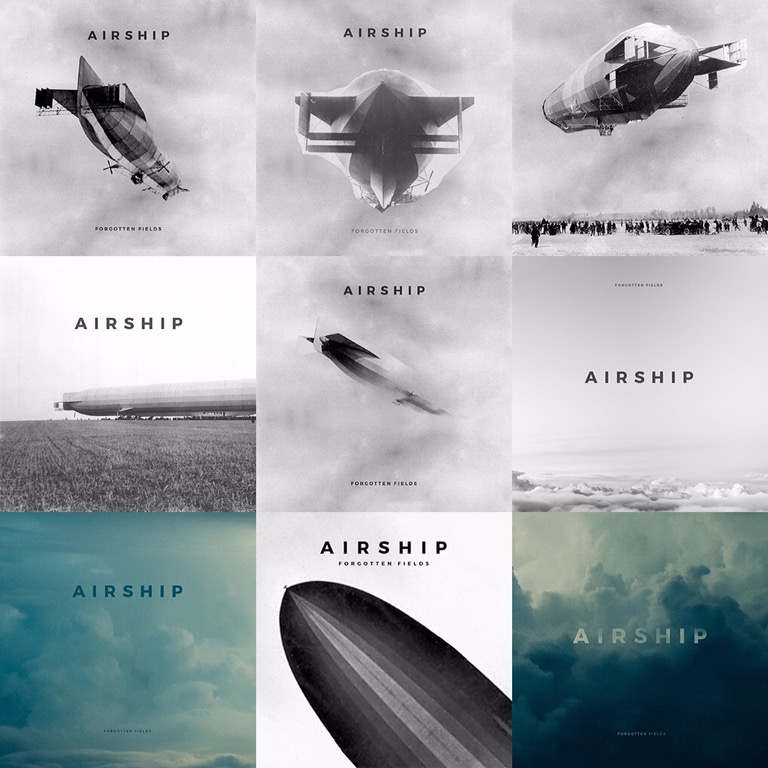
Rough cover art mock-ups for the upcoming Airship album
Sketches
I thought I’d share some of the rough sketches I’ve done for the Airship album cover. They were made in the past couple of months to help me visualise the layout. I’ve written previously about the concept, but briefly, it illustrates the inspiration for the album: the maiden flight of an airship.
Concepts
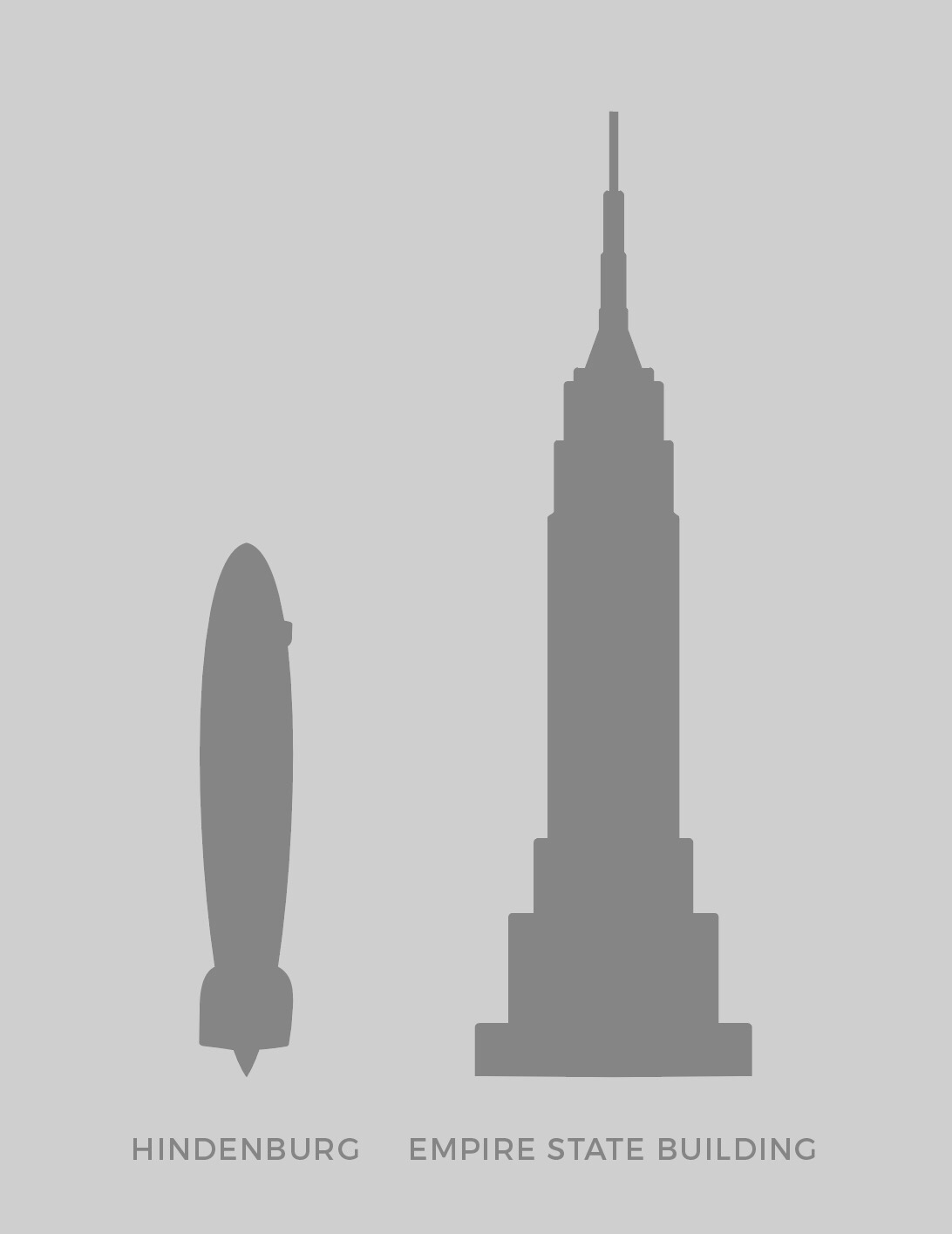
I pictured the crew preparing for the test, the crowd looking on in anticipation—an atmosphere of excitement and wonder! Over time, this idea evolved and took on an abstract feel. I thought of the flight itself and the ship moving through the clouds. But, I kept coming back to the idea of the airship looming overhead, imposing and terrible, a giant in the sky! I pictured myself standing on the ground as it passes over—a speck in its shadow, agape with awe! Just look at the size of a Hindenburg in relation to the Empire State!
The Hindenburg vs the Empire State
Reveals
I hope I headed in the right direction, in the end. I will reveal the final artwork with the launch of the Forgotten Fields Bandcamp page, in the not too distant future. I’m excited and nervous—mostly nervous—but, I tell myself that’s a good thing.
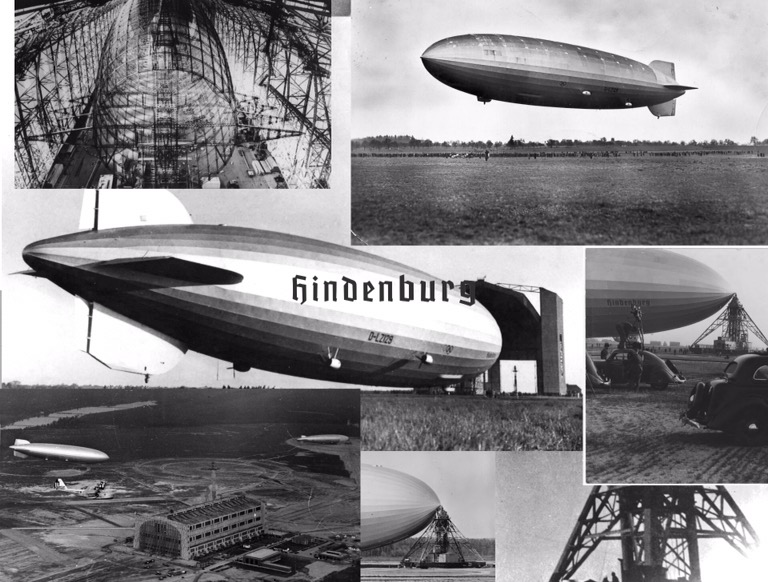
My moodboard for the Airship album cover art (Images: Wikipedia)
Finding a way to make it happen
Early on in the Airship project, I drew up rough ideas for the cover art. I thought the best solution would be to illustrate what I pictured when I conceptualised the music: a gigantic airship in midair, hovering above a crowd. Originally, I wanted the cover to have an illustrative feel, as if taken from a children’s book. But, the costs involved in commissioning an illustrator squashed that idea. I then thought of doing the illustration myself, but I am hopelessly out of practice and it will take a long time to develop a suitable style. Stock photography was another possibility. I thought I’d create a composite of various images. But, vintage imagery of airships are prohibitively expensive. So, I turned to the public domain and put together a collection of images I could use without running the risk of copyright infringement.
Mood board magic
I like working with mood boards. I even use them when I conceptualise music. It can be anything from a single image to an elaborate collection of pictures, music, sound clips and video—whatever sparks the imagination and sets the tone for the project. It informs my decisions and gives context to my ideas. And yet, as much as I like to work with mood boards, I didn’t create one for the Airship cover art. The concept grew out of impromptu digital “sketches”. Today, I essentially reverse-engineered a mood board using the public domain images. Even though I’ve already settled on a final concept and layout, the mood board helps me flesh out the idea, conceptually. It makes a big difference to how I think about what I am creating.
Abstract nostalgia
The best public domain images I found were of the Hindenburg; undoubtedly, the most famous airship of all time—a Titanic of the sky! Its proportions, shape and lines are the stuff of aviation dreams. When I look at the Hindenburg mood board, I am inspired! I look at the images and am filled with awe at its enormousness: 245 metres long and 43.7 metres high, it was the length of an ocean liner and the height of a 13-story building! That is something I very much want to convey on the cover. Then there is the black and white photography, symbolic of a bygone era, a nostalgic element I also want to include. I am going to take the cover art in an abstract direction. It leaves a little more to the imagination, which is better than being literal, at least in this instance—something I also tried to do with the music. I’ll post drafts of the cover, soon.

 Forgotten Fields