In many ways, I think of the landscape and creatures of the Overberg (the region in which I live in the Western Cape of South Africa) as divine; and as such, in my poetry, I respond to them, for they fill me with a sense of awe.
Inspiration
Why “Forgotten Fields”?
AQ05
“Fields”
I grew up in the Overberg region of the Western Cape province of South Africa. There are farms of every description in every direction. In the part where I was raised (and where I live now), they are chiefly for the cultivation of wheat and barley, and the rearing of sheep. It is a region with endless hills, divided here and there by modest rivers, and presided over by low mountain ranges. I spent the whole of my childhood there—here—and it was—and is—heaven on earth.
It was only when I left for college that I fully experienced city living. It was not palatable to me then (though I did my best to adjust to it), nor is it to me now (so I do my best to avoid it). Whilst for many years, I lived in a large town beyond the Hottentots Holland Mountains—the Overberg region lies beyond or “over” these mountains or berge (Afrikaans)1—I always sought accommodation on the edges of the town, even though the town itself was not densely populated.
Nonetheless, I would visit my family home in the countryside as often as I could, as a means of escape. Nearly every weekend, I would make my way “over the berg” and immerse myself in the loveliness of pastoral life. When I could bear being separated from it no longer, I started thinking about returning permanently. I distinctly remember the moment I made the decision to do so: alone upon a hill, listening to the sound of a distant flock. A few months later, I moved back.
“Forgotten”
But eventually, familiarity did its work, and with time, I grew accustomed to the landscape and its creatures. They were still a comfort, but I was unable to recognise their true wonder. Much of this I now ascribe to a sense of alienation that has plagued me all my life, born of a deep sense of abandonment and disconnection that I felt in childhood. This perception came to a head at age six when I was sent to what for brevity’s sake, I shall call boarding school.
I would not have felt the periodic separation from my family quite so keenly had I earlier in life known that natural bond (and its security) with my parents. Sadly, the failings of my father and the pressures upon my mother meant that I was raised as an infant by my grandmother and nursemaids. Consequently, being sent away for most of my school life was overall a negative experience which produced in me a tendency to detach from people—and, I now realise, places.
That I would drift away from the very countryside I so loved was perhaps inevitable. It was a concerted effort on my part to overcome my inner struggles that led me to reconnect with it once again. This project was born at the beginning of that process. I soon found the more progress I made psychologically, the more I reconnected with the rural wonder about me. The Zephyr and the Swallow was my first, lucid response to it. “Forgotten Fields” then describes this journey.
Footnotes
- Berge is Afrikaans for “mountains”; the singular is berg. The former is pronounced “beh-R-guh” with the “eh” (and “g”) in “get” and a trilled “R”; the latter, “beh-R-CH” with a trilled “R” and “CH” the guttural “kccch” sound in “loch”, that is, not the “ck” in “lock”.
This January
I saw flights of swifts and swallows
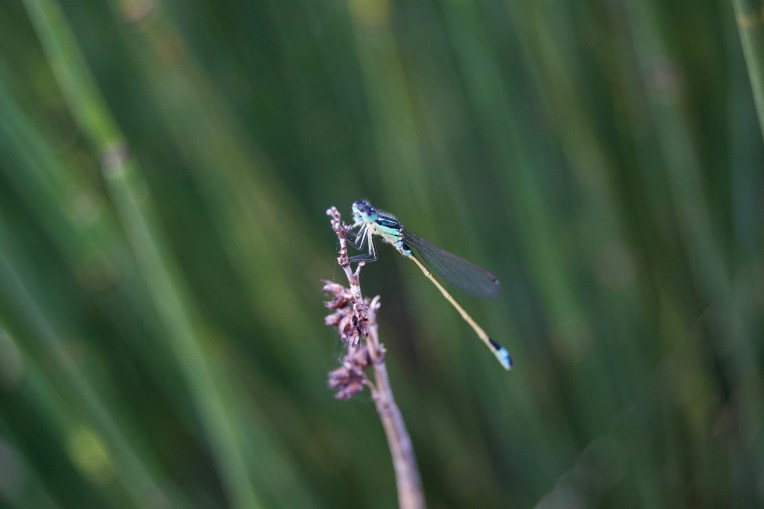
Whilst out among the hills, I was amazed to see three separate flights of swifts and swallows along the route! The biggest of these I filmed, a flock of at least a hundred birds: Alpine and African Black Swifts and White-throated Swallows. Though swifts look very much like swallows on the wing, they are in fact classified as hummingbirds; even so, they behave much the same. Watching them mill high and low about me was otherworldly! They do this to feed on flying insects, but I like to think also for the pure exhilaration of flying.
I watched a crane leaping in the wind
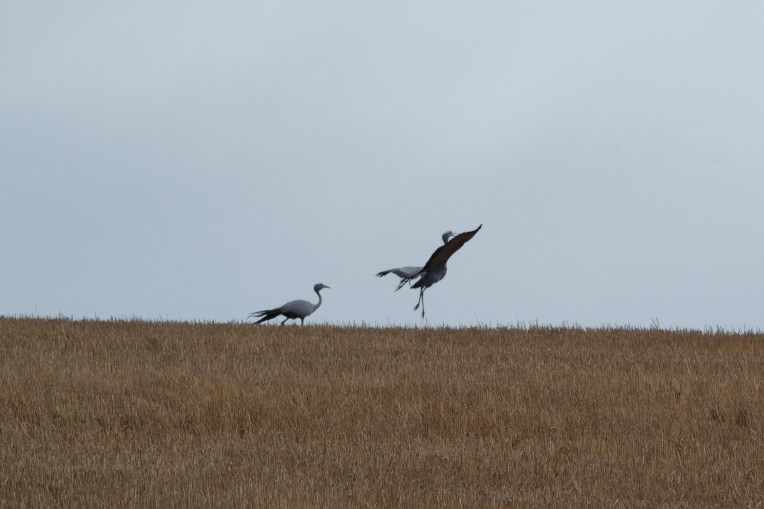
On another occasion, I saw two pairs of Blue or Paradise Cranes (Grus paradisea) among the hills. This time of year, they are watching their eggs, laid directly on the ground, usually in the stubble of harvested wheat fields. The first pair was at the summit of a gentle hill. At one point, the male spread his wings and leapt into the air on the wind! Blue Crane males dance to attract a partner, but since he was already paired up, I presume he was simply enjoying the flow of air. The second pair was more serene, quietly pacing in the stubble.
I started composing “Over the Mountain”
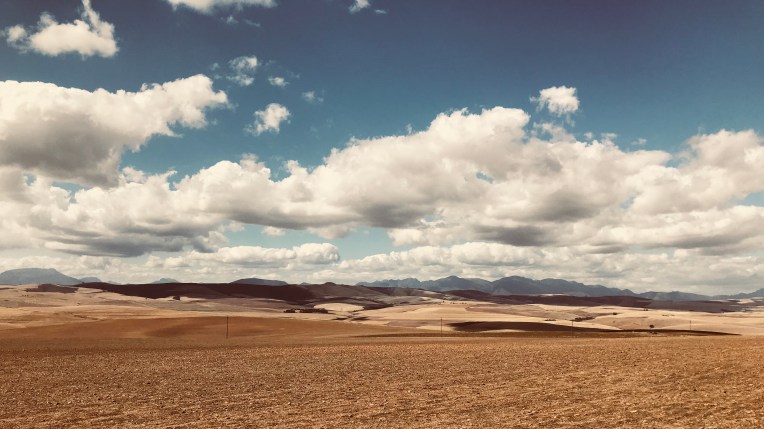
“Over the Mountain” started out as a caption to a photograph I posted to social media1 in late 2017. It showed the open skies, rolling hills and distant mountains so typical of the region in which I live, the Overberg2. Accompanying this impromptu photograph was the line “The fields become the hills and the mountains become the sky”. Not long after, it occurred to me that it may have poetic value. Initially, I thought to explore in “rolling” lines the undulating landscape of the region, and a rough sketch titled “A Vista” was born.
At the end of 2018, I began developing the draft. My intention was to compose one verse extolling the beauty of the landscape, but as I reflected on the photograph—and the frame of mind that prompted the original sketch—it became clear that this would not be adequate. There is so much more to the region than the distinctive patterns and colours of agriculture upon the land: splendid creatures dwelling in the valleys and mountains! I sought therefore to encapsulate my admiration for the Overberg in a kind of poetic “song”.
Inspired by the name of the region, “Over the Mountain”—a play on Overberg—slowly took shape, resulting in a number of amusing verses and refrains, amongst others: “Over the berg! / Over the berg! / Over the berg I go! // No more ’scrapers, / No more papers, / Over the berg I go!” This, of course, did not align with the style and tone of the collection, and it was clear that I had to write from a different perspective. The “song” route was not entirely fruitless, however, for it provided the raw material for the approach that would replace it.
Instead of composing a lighthearted “ditty”, I chose to think of the poem as a “hymn”. Consequently, it became more solemn—though no less exuberant—each verse painting a vignette of the Overberg, scenes I would not trade for the world: the hillsides where the Rhebok3 watches, the fields where the wheat blows in the wind, the heavens where the buzzard4 circles, to name a few examples. The poem is now in its final phase where I must select from the many verse variations I developed, those most promising for the final composition.
I learnt about the plight of the rhebok
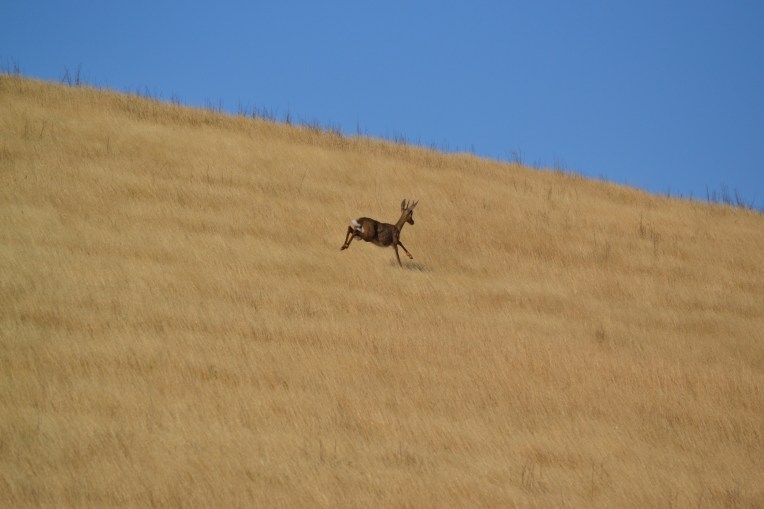
“Over the Mountain” naturally lead me to research the Rhebok. I was dismayed to discover that it was declared endangered in September 2017. This is mainly the result of hunting and a loss of habitat. Hunters consider them a great prize since they are difficult to find, stalk and shoot. You see them very rarely; they are shy, cautious and fast. Hunting, in addition to the expansion of farmland and the use of traps set for other animals, has devastated their numbers; and thus they join the Blue Crane on the threatened species list.
The unfortunate news brought to mind my earliest encounter with the Rhebok (or Ribbok5, in Afrikaans). It was not a sighting, but a song from my childhood. “Die Oukraalliedjie” is a well-known Afrikaans folk song (about a song) about a farm called Oukraal6. In one of its verses, it mentions “’n ribbok wat daar teen die rantjie staan”7 (“a rhebok that stands against the hill”). Imagine my delight when decades later, upon one of my rambles, I should see a Rhebok for the first time in just such a scene: quietly grazing against a hillside—
Incredibly, at first, my presence did not disturb it. It was only when I produced my camera that it lost its nerve and bolted swiftly up and over the hill. I was fortunate to capture this flight in a series of photographs which I later used to confirm that it was indeed the Grey Rhebok, Pelea capreolus. Though I pass that area often, I have not seen it since. There was one evening I saw a buck darting by the wayside in the bushes; I suspect it may have been a young Rhebok, but in the low light, I could not tell. I wait patiently to see one again.
Footnotes
- The original post can be viewed here (Twitter).
- A chiefly agricultural region in the Western Cape province of South Africa. “Overberg” (pronounced “oowuh-fiR-beh-R-CH”, a trilled “R” and a guttural “CH” as in “kccch” or “kgggh”) is Dutch for “over the mountain”.
- The Rhebok is a medium-sized South African antelope.
- Incidentally, the buzzard is a large bird of prey resembling a hawk. I photographed it early in 2018 and posted it here (Twitter). As you will see, it is not a vulture, as American English suggests. It is often seen circling high above, something I was able to capture (by complete accident) in 2017, which can be watched here (Twitter).
- Pronounced “Rh-bock” with a trilled “R” and the “o” a shortened version of that in “or”.
- “Die Oukraalliedjie” (pronounced “di oh-kRaahl-likki” with the “i” in “it” and a trilled “R”) is Afrikaans for “The Ol’ Pen Ditty”. “Liedjie” (pronounced “likki” with the “i” in “it”) is Afrikaans for “ditty” or “little song” and “Oukraal” (pronounced “oh-kRaahl” with a trilled “R”) is Afrikaans for “Ol’ Pen” (“ol’” as in “old” and “pen” as in an enclosure for animals), the name of a farm.
- Literally, “a rhebok that there against the little hill stands”. The line appears at the end of the first verse around the 0:20 mark. You can listen to the song as recorded by Groep Twee (Afrikaans for “group two”, pronounced “CHRoup tweeuh” with the guttural “CH” as in “kccch” or “kgggh” and a trilled “R”) on Apple Music, Spotify or Youtube.
 Forgotten Fields