This January

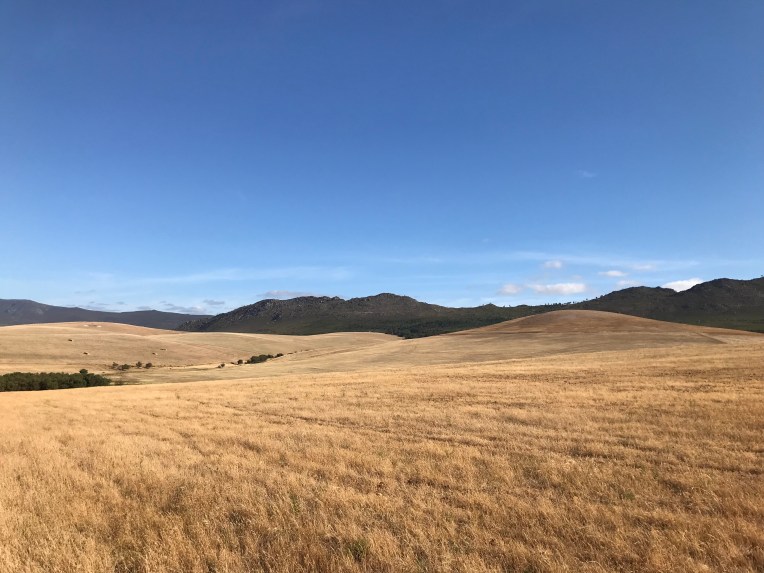
Landscape, 2 January 2018
I took this photograph on 2 January 2018 in the rural surroundings that inspire my work. It is summer in South Africa from November to February and the fields are awaiting the rain.

I returned to Twitter after a month-long hiatus.

Previously, I had a list of blocked words the length of my arm as people found increasingly more innovative ways to moral grandstand. The artistic community feels compelled to comment on political and social issues in the most petulant manner imaginable on a platform wholly unsuited for productive conversations on such matters. This counterproductive behaviour detracts from an artist’s work and has become a blight on the artistic landscape. For this reason, I follow no one—it eliminates unnecessary unpleasantness whilst I continue to follow artists where it matters: their shopping carts.

I spoke to the first artist for the Lonely Swallow label.

I was introduced to the music of Affan, an unsigned neo-classical composer from London, six months ago. He contacted me long before I had any thoughts of launching a label. Earlier this month, I approached him about making Origins, his forthcoming and first EP, the inaugural release of the Lonely Swallow label. His improvisational style is exemplified by this composition for the piano titled “Origin II”:

I started working on new poetry.

Last year, I composed a number of poetic sketches inspired by my rural surroundings. This month, I started refining them. The first sketch, “The Sunbird”, was written at the end of May in 2017 and the last, “The Bush Shrike”, at the beginning of this month—both have since been completed. The poems are my latest attempt at extolling the beauty of nature in verse. I have long thought about releasing a small publication of poetry and these verses could work as a collection, but it is too soon to decide on how they will ultimately be presented—for now, I shall focus on completing them.

Piano & Coffee Co. wrote about the Forgotten Fields album.

Blake Parker of Piano & Coffee Co. wrote a thoughtful review of my most recent album—an experiment in expressing poetic themes in ambient music. There is nothing more fascinating to a creator than seeing their work through someone else’s eyes and this review summarises the self-titled album, beautifully:

“The themes of Forgotten Fields deal with memory as an emotional catalyst.”

Mentioned in this post:

@forgottenfield (Twitter)
Affan (Soundcloud)
Lonely Swallow (Official Website)
“The Sunbird” Poem (Blog Post)
Piano & Coffee Co. (Album Review)
A New Album, Part Two: The Music

This is part two of a three-part series about the new self-titled album. Read “A New Album, Part One: The Poem”, here.

“Verse One”, the first track from the self-titled album.

Six Verses, Six Tracks

I started work on the music as soon as the theme of the poem became clear. Already in December 2016, I had put together a collection of sketches, early experiments with melodies and instrumentation based on the direction the poetry was taking. When at last I had the final draft of the poem, I turned my attention to the sketches. I began by deciding which of them to develop into complete tracks, focusing on the ideas that were most in line with the poetry; and since there were six verses, I conceived of an album with six tracks: a series of movements to correspond with the verses of the poem.

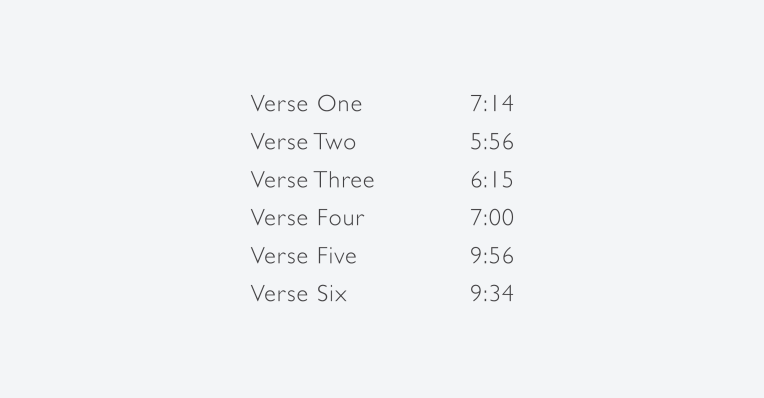
The poem played a central role in the writing of the music and the naming the tracks. As with The Zephyr and the Swallow, where the poetry inspired the music and the tracks took their titles directly from the lines, I looked to the verses to inform my creative decisions. I therefore followed in the compositions where the poem led. I named each track after the number of the verse it described, which resulted in the sequential “Verse One”, “Verse Two”, “Verse Three”, and so on. This helped reinforce the track-verse connection and emphasised the importance of the poetry.

The tracklist of the Forgotten Fields album.

Composing the Music

Like the verses, each track went through scores of rewrites as I wrestled with track form, instrumentation and melodies. I would spend days on an idea only to discard it and then reintroduce it later. Two of the tracks changed structure in addition to receiving brand new parts as late as the final mixing phase! Often, things I thought were cast in stone, had to be altered or abandoned for the sake of a better solution. There were countless interpretations of melodies and renditions of musical phrases, each experimenting with different instrumentation and degrees of embellishment or simplification.

All the while, I had to be vigilant not to overcomplicate the music because I wanted to retain an ambient quality. For this reason, it was important to tread the fine line between “soundscape” and “soundtrack”—how much compositional drama could I use before the music stopped being “ambient”?—the goal was to stay faithful to the poetry without being overly descriptive or orchestral. I tried to achieve this by using only a handful of instruments, relying on minimal compositions to bring the melodies to life. The music, therefore, does its best to sweep one along with the simplest instrumentation.

Producing the Album

Building the music around the poem brought a natural cohesion to the album. As the tracks progressed, the scenes, thoughts and emotions conveyed in the lines slowly emerged in the music. Gradually, the compositions began to reflect the substance of the poetic verses, the sketches becoming with every revision the lyrical pieces I had envisioned, months before. The main themes I set to woodwinds, keyboards and guitars, and accompanied them with synthesisers and strings. The result is a vivid expression of the lines of the poem, the music wistful and musing with moments of joy and regret.

Once the compositions were complete, recording went smoothly. The album is a combination of digital and real instruments. For the latter, I worked with session musicians, artists with an intuitive understanding of what I was trying to achieve and consequently, how their parts needed to be played. I decided to use real instruments, especially for the flutes and English Horn because there are nuances in woodwinds that are difficult to reproduce digitally. Working with session musicians brought home to me the beauty of the real instrument and I am convinced that the recordings are better for it.

Read “A New Album, Part Three: The Artwork”, next. Forgotten Fields will be released on 17 November 2017.

A New Album, Part One: The Poem

The rural beauty of the Western Cape of South Africa, the inspiration behind my work.
The rural beauty of the Western Cape (South Africa) inspires my music and poetry.

Rural Inspiration

Over the past few months, I have been working on a new album. It began at about the same time as my collaboration with Krzyzis in late 2016. Early on, I knew that both projects would share a theme and have a similar concept. These were first explored in The Zephyr and the Swallow—the collaborative EP with Krzyzis—a combination of poetry and ambient music inspired by my love for the countryside. The EP was built around a couplet, a short poem of two lines I wrote to inspire the music; but for the album, I wanted to expand on the idea and write a larger work, a series of verses for a ballad.

The Zephyr and the Swallow EP illustrated a pastoral scene—the wind blows over a field and a swallow dashes into the sky—an idyllic moment of beauty set in a rural landscape. In my youth, at the height of summer, I would spend hours in the fields watching the wind making waves in the grass and the swallows flying overhead. Even now, I find this simple pastime a most enchanting and vivid experience. It is just such a scene I describe in the couplet I wrote for The Zephyr and the Swallow—“Over the field the zephyr blew, / Into the sky the swallow flew”—lines I set to music to create an ode.

Writing the Poem

I started writing the poem for the album in late 2016, going through numerous drafts until I eventually found a form and approach that felt appropriate. In much the same way one agonises over the notes of a musical composition, one pores over a poem—every syllable of every word carefully chosen to exquisitely articulate a meaning or express an emotion. After three months of assembling and dismantling verses, I finally produced “Forgotten Fields”, a self-titled ballad with six verses. In the poem, a daydreamer nostalgically recalls a happy moment in time, surrounded by fields and swallows.

Central to the theme of the poem is the feeling of wistfulness—a longing tinged with regret—conveyed by the imagery. It describes a world of endless fields, swallows impossible to catch, a memory forgotten and rediscovered. The lines are gentle and flowing—the musings of someone lost in thought. They are beautifully read by English narrator Chris Lateano for the compact disc release. “Forgotten Fields”, the all-encompassing title, is alluded to in the final verse:

Far away and left untrodden
Under summer skies
Lie the fields I had forgotten
Where the swallow flies!

This is part one of a three-part series about the new self-titled album. Read part two, “A New Album, Part Two: The Music”, next. Forgotten Fields will be released on 17 November 2017.