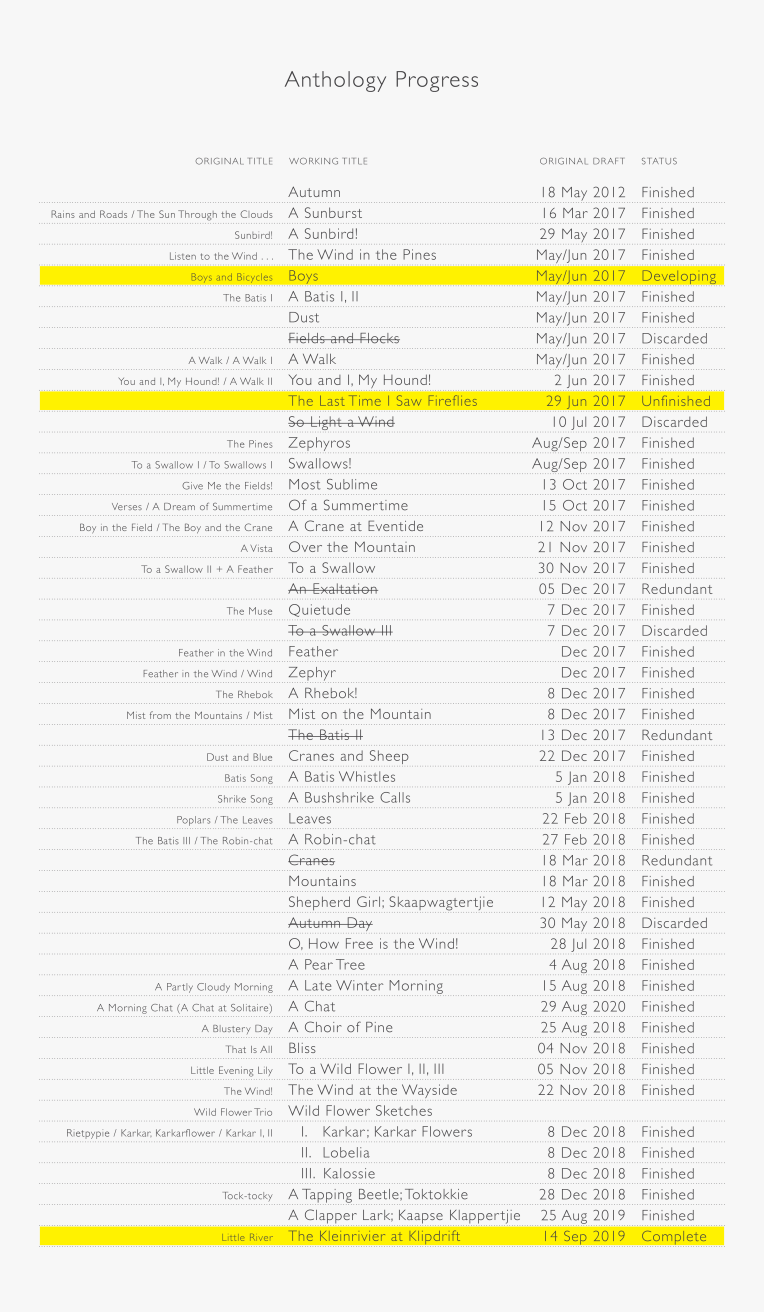
How the progress list evolved over the years as poetic sketches were completed, added, discarded, titled and retitled.
I have officially begun the process of editing the anthology, bringing to an end the composition phase of the collection. A set of fifty-two lyric nature poems is the result, which I refer to as ‘idylls’, a paean to the Overberg (a rural region in the Western Cape province of South Africa), its creatures, flowers and landscapes.
The first poem (‘Autumn’) was written in 2012, followed by fifty-plus poetic sketches between 2017 and 2019, developed into complete works these past five years. Now, I have begun preparation for a rough draft print—a ‘chapbook’, as it is also known—refining each poem and assessing its rightness for the anthology.
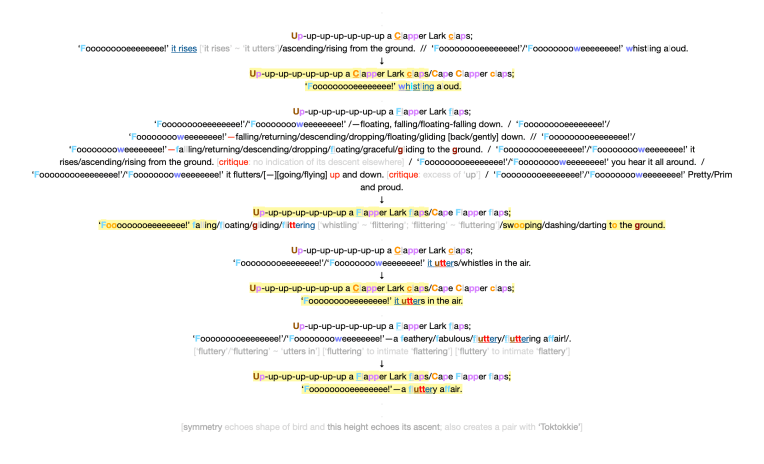
Nearly all the poems presently exist as highlighted lines or stanzas in often chaotic developmental documents. This is a version of ‘A Clapper Lark’ (which, in all likelihood, will not appear in the collection), an example of the collating work still before me (and the naivety with which I wrote!).
During the composition phase, I kept every version of every stanza of every poem as it evolved from sketch to poem in lengthy documents with tens of variations per stanza. My task is now to extract the final stanzas and assemble them as individual poems onto individual pages, which I can then arrange and rearrange.
Once I have done this, I can create the above-mentioned rudimentary booklet. It is with this draft volume that I shall work thenceforth to determine which poems to include, the order in which they should appear and so forth. For so long have the stanzas existed only on the screen; at last, they take physical form!
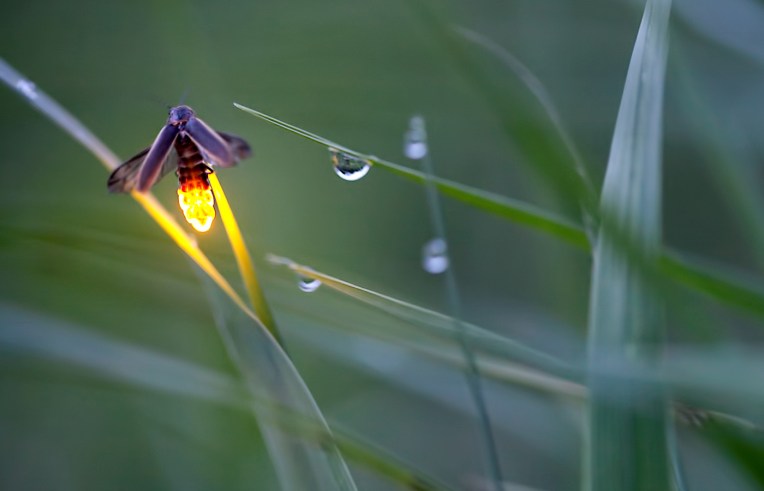
Whilst composing ‘The Last Time I Saw Fireflies’, I constantly referred not only to memory, but also the remarkable firefly photography of Radim Schreiber for inspiration. ‘Amber Firefly’ (above) was my constant reference, evoking the memory of that summer night. (Copyright Radim Schreiber. All rights reserved. Used with permission.)
Revisiting ‘The Kleinrivier at Klipdrift’
The poems ‘Boy’1 and ‘The Last Time I Saw Fireflies’ are complete. This would have marked the conclusion of the composition period, but my interest in the previously abandoned Afrikaans draft of ‘The Kleinrivier at Klipdrift’,2 titled ‘Die Kleinrivier by Klipdrift’,3 was suddenly revived after its stanzas came to me, virtually complete, one morning on the hills of South Limburg (The Netherlands) a few weeks ago.
Developed under the working title ‘Boys’.
Kleinrivier [claynRhfeeR] (trilled [R]) is Afrikaans for ‘little-river’, a river; and Klipdrift [klipdRift] (trilled [R]), Afrikaans for ‘stone-ford’ or ‘Stanford’, a farmland area.
Pronounced [di claynRhfeeR bay klipdRift] with the [i] in ‘did’, a trilled [R] and for ‘klipdrift’, both instances of [i] as the [e] in ‘folded’.
Suddenly, early this morning whilst out on the hills of South Limburg (The Netherlands), I am graced by the Muse and the Afrikaans version of ‘The Kleinrivier at Klipdrift’ comes to me virtually complete. pic.twitter.com/NG5BZAHYlO
Therefore, I shall compose the Afrikaans version after all, doing so under the working (and likely final) title, ‘Die Kleinrivierliedjie’.3 The Afrikaans expresses the diminutive of ‘The Little River Song’ (thus, ‘the little Little River song’) and is at once a reflection of the lyric nature and structure of the poem and a homage to ‘Die Oukraalliedjie’, an Afrikaans folk song dear to my heart.
Pronounced [di claynRhfeeRlikki] (with the [i] in ‘did’) and a trilled [R].
As a result of the Afrikaans title, I have changed the title of the English version of the poem (‘The Kleinrivier at Klipdrift’) to the corresponding ‘The Little River Song’. I enjoy its double meaning: ‘little’ reflecting both the name of the river and the brevity of the poem or ‘song’. ‘Die Kleinrivierliedjie’ will occupy me for the next few weeks, at the completion of which the editing process of the anthology will finally begin.
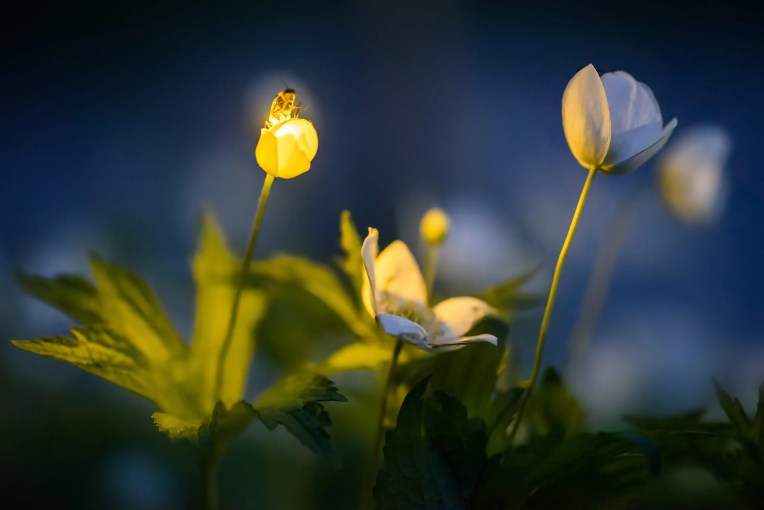
‘A Flash of Hope’ by Radim Schreiber (Copyright Radim Schreiber. All rights reserved. Used with permission.)
On ‘Boy’ and ‘The Last Time I Saw Fireflies’
A montage of childhood memories, the original draft of ‘Boys’ recalled happy adventures in the countryside with my best friend Bradley: riding bicycles on dirt roads, picking pears from an old pear tree, watching clouds from the wayside; however, when I considered the sense of isolation I felt, even in those happier moments, it seemed more fitting to write from that perspective, and thus ‘Boys’ became ‘Boy’.
The poem has three short trochaic stanzas that move swiftly through the boyhood scenes described above. The lines are perhaps the most clear, concise and uncomplicated I have achieved yet, capturing the simplicity of that time. Somewhat more complex is ‘The Last Time I Saw Fireflies’, a four-stanza recollection of my encounter with those magical creatures as a six or seven-year-old.
It was the first numinous moment of my life—though at the time, I was too young to grasp it. I was camping with my family at the beach, rather appropriately, during a church gathering. I wandered about the site and saw in the darkness of a shrub the light of fireflies. Deeply impressed, I quietly marvelled at the sight. The poem attempts to wrap in words my naive wonder—the experience in nature of the divine.
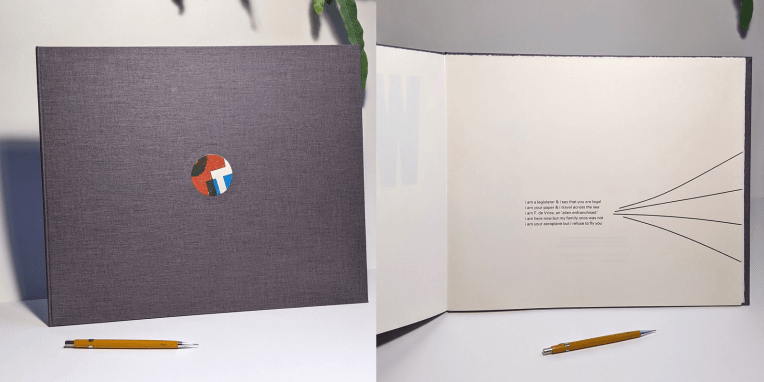
The format of the final publication will be a limited letterpress edition by David Armes of Red Plate Press who created the sleeves for my self-titled 2017 musical release. Above is an example of his work. (Copyright Red Plate Press. All rights reserved. Used with permission.)
Publishing the Poems
Progress on the poems has been slow, but this year, I intend to assemble a chapbook, that is, a rudimentary booklet to distribute for scrutiny amongst followers of my work. As one writes, one becomes so deeply involved in the process that one misses obvious errors, obscurities and superfluities. A chapbook is the ideal way to identify and address such shortcomings and improve the verse where it is wanting.
It will also give me a sense of how the poems fit together as a collection: whether it is best to include the full set of fifty-two compositions or a selection, whether they are best arranged chronologically (by date composed or completed) or thematically (by subject matter, for example, ‘flowers’ and ‘birds’) and whether it is best to present one poem per page or per double-page spread.
Also to be decided is the title. I have narrowed down my options to Idylls, Odes and Over the Mountain. The first two describe my genre, lyric nature poetry, and the third is the title of a poem in the collection about the Overberg,5 the region that inspired it. Both approaches appeal to me. ‘Over the Mountain’ and Other Idylls (or Odes) is another option, in the style of Toon van den Heever’s Eugene en Ander Gedigte.6
The Overberg (pronounced [oohuhfeR-behRCH] with a trilled [R] and the guttural [CH] in ‘loch’) is Afrikaans for ‘over-mountain’, a reference to its location beyond the Hottentots Holland mountain range, its natural border with the Cape Town region.
‘Eugene and Other Poems’, the reworked title of the South African Afrikaans poet’s first anthology, originally titled Gedigte. Eugene en Ander Gedigte is pronounced [yoogene en undeR CH’h-diCHtih] with a trilled [R], the guttural [CH] in ‘loch’ and the [i] as the [e] in ‘folded’).
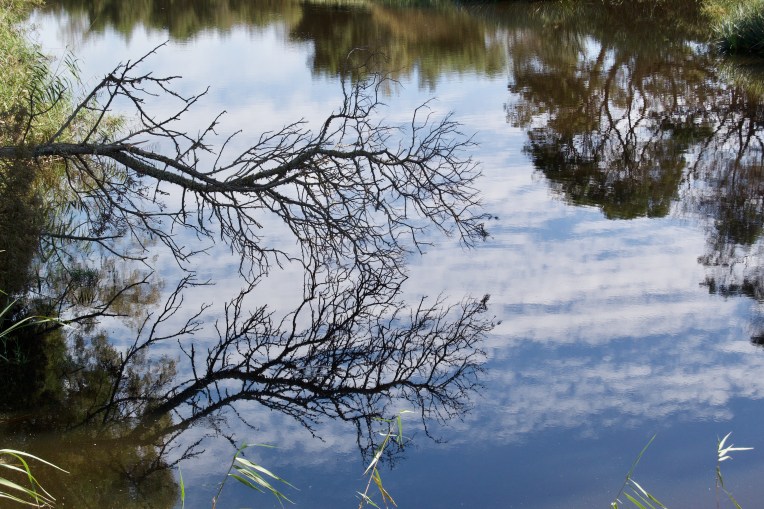
A broken branch dips its fingers in the Kleinrivier as it quietly runs through Klipdrift in the Overberg region of South Africa. Taken 10 April 2020.
Riverine Reflections
‘The Kleinrivier at Klipdrift’1 began as a short description for a video recording to be included in ‘Wander and Wonder’, a brief account of an afternoon in the Overberg, the rural region in the Western Cape province of South Africa where I lived for a decade and a half. The video was ultimately omitted from the piece, but the description remained, dancing with cadence and alliteration, evoking the river and its sights, resulting inevitably in a new poetic sketch titled ‘Little River’ at the time.
Kleinrivier [claynrhfeer] is Afrikaans for ‘little-river’, a river; and Klipdrift [klipdrift], Afrikaans for ‘stone-ford’ or ‘Stanford’, a farmland area.
Joyfully, the lines summoned finches, reeds and eucalyptus, and it occurred to me to refer to some of these by their Afrikaans2 names, which are often idiosyncratic, thus, adding novelty to the poem. Finches, for example, are vinkies [fngkiss], reeds, riete [retuh] and eucalyptus, bloekom [blukom]. Also mentioned was vleitinktinkie [flaytnk-tnky], the common name for Levaillant’s cisticola, a songbird native to marshlands—one cannot help but smile at its cheerfulness, a word as lively as the bird!
A language of South Africa derived from Dutch.
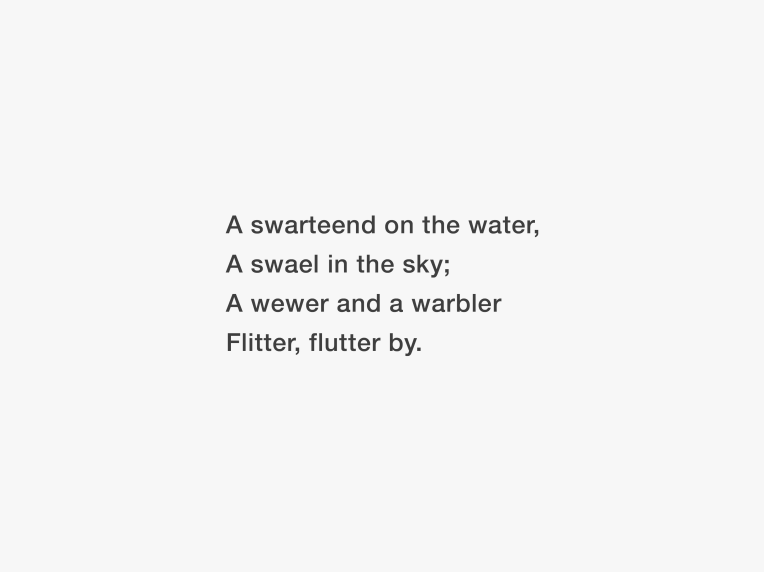
A variation of the second stanza with Afrikaans nouns swarteend [swahrteeynd] (‘black-duck’), swael [swahl] (‘swallow’) and wewer [veeyuhver] (‘weaver’).
I, therefore, proceeded to weave the Afrikaans into the English lines, which, through rhythm and alliteration, brought to the composition the quirkiness only Afrikaans can supply. This, however, created a problem: since the poem was primarily an English work, rhyming required English nouns at the end of a line, and where two nouns appeared together in a line or stanza, one Afrikaans, the other, English, I found the result arbitrary, indulgent, making the words fumbling and the lines needlessly complex.
A further complication of this bilingual melange was the need for the reader to learn the pronunciation of no less than twelve Afrikaans nouns before reading could be fluent. The stanzas would be easy to digest for those familiar with Afrikaans, but others would find them cumbersome and frustrating. This spelt the end of the concept. Therefore, in the final work, the Afrikaans survives in place names only, namely Kleinrivier, Klipdrift and Oukraal,3 which are easy to learn and unnecessary to translate.
Oukraal [ohkraahl] is Afrikaans for ‘old-stockade’, a farm.
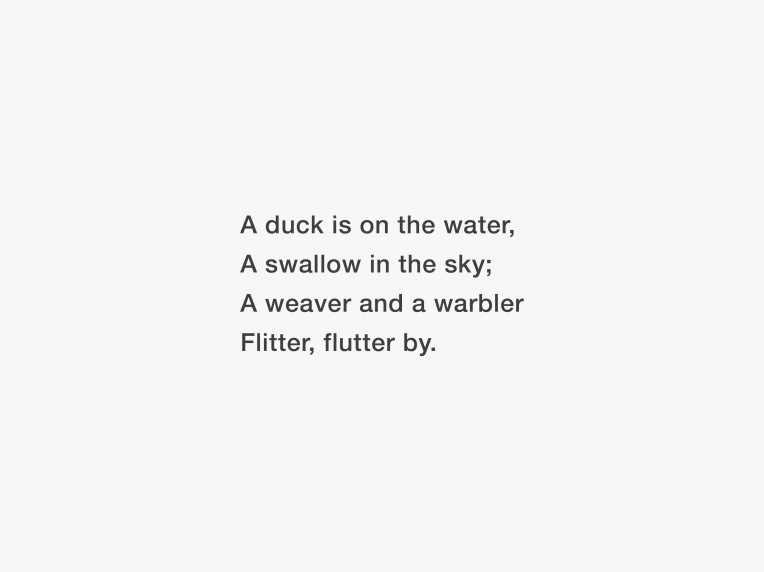
The final version of the second stanza in simple, fluid English.
As a small consolation for the sacrifice, I make reference to Afrikaans by using anglicised versions of its names for dragonflies and the above-mentioned cisticola: the former becomes ‘needleholders’, after naaldekokers [naahldhkwkers] (‘needle-quivers’), and the latter, ‘wetland tinkler’, after vleitinktinkie [flaytnk-tnky] (‘little wetland tinkle-tinkler’). Whilst this too introduces unfamiliarity, I find it bearable not knowing exactly the meaning, which a footnote may succinctly supply.
It had, of course, occurred to me to compose a wholly Afrikaans version, but without the contrast of the English setting, even ‘vleitinktinkie’ became unremarkable. For this reason, I lost interest in the version early on, abandoning it altogether after one draft. The version then that will be considered for the anthology is the English one. Though I was in South Africa at the time of its completion, I regret not taking the opportunity to visit Klipdrift, there to recite it to the river.
Weaver finches known as Red Bishops (Euplectes orix) in their red display feathers flitter about the reeds below the bridge at Klipdrift in the early evening. Taken 13 September 2019.
Childhood Recollections
Two poetic sketches now remain, ‘Boys’ and ‘The Last Time I Saw Fireflies’. Both were written in mid-2017, placing them among the earliest drafts for what would ultimately become this collection-in-the-making; both were at some point discarded as potential ideas and then reconsidered upon reflection; and both are recollections of childhood. ‘Boys’ remembers bicycles, dirt roads and pears picked from a wayside tree; ‘The Last Time I Saw Fireflies’, my first encounter with fireflies in a shrub on a seaside dune.
‘Boys’ and ‘The Last Time I Saw Fireflies’ are the eight-year-old within me attempting to fix in rhyme those fleeting moments that make forever an impression on the soul. In the light, lyric lines that have come to define my style in the course of composing this anthology, the two poems will describe their themes in vignettes, skipping along, if I am successful, in a happy reminiscence. ‘Boys’ is already in development, to be followed by ‘The Last Time I Saw Fireflies’, finally completing the composition phase.


 Forgotten Fields