This October

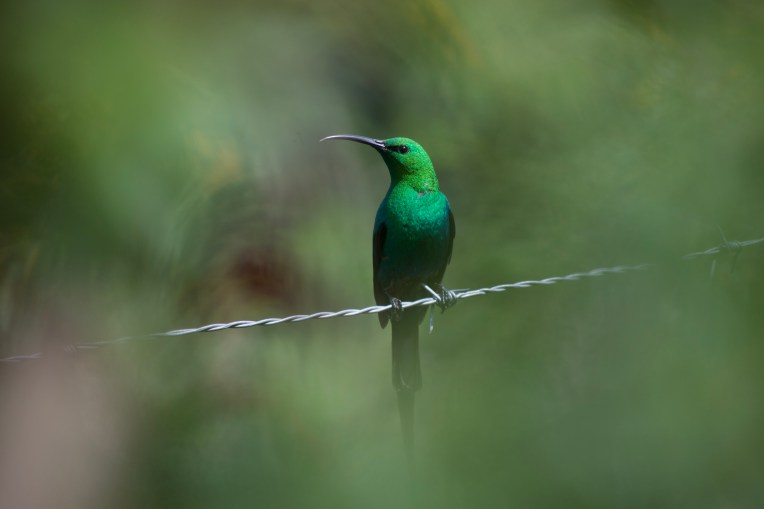
A Malachite Sunbird, 10 October 2018. Copyright 2018 Forgotten Fields. All rights reserved.
I photographed this exquisite Malachite Sunbird, one of two males who visit the Cape honeysuckle daily. I recognise this one by the marks on his lower neck.

I revised and revisited poems

Every poem I complete leaves me at once exhausted and invigorated. The former for the mental and emotional exertion of wrestling with poetic lines and the latter for the joy and newfound enthusiasm success in these endeavours, however modest, brings. “A Dream of Summertime”, three verses recalling pastoral details from my childhood, is now complete. Its final title, “Of a Summertime”, is the last line of the poem.

I began revising “Give Me the Fields!” on 13 October, fortuitously exactly one year after composing it as a spontaneous tweet1 in 2017. I enjoyed the verse so much that I added a second, third and fourth! It is now in that dabbling phase where I explore different ways of expressing the ideas behind the poem in rhyming verse. This eventually produces a range of poetic possibilities which I refine into a final composition.

“A Sunbird” is an earlier poem I had completed but since edited in parts, altering its structure somewhat and rendering it unfinished once more. I returned to it unexpectedly in October to fully implement the adjustments. As a result, the poem is more vivid, flowing and succinct. This is why I think it worthwhile to live with one’s work for a protracted period, returning to it anew with a better understanding of its essence.
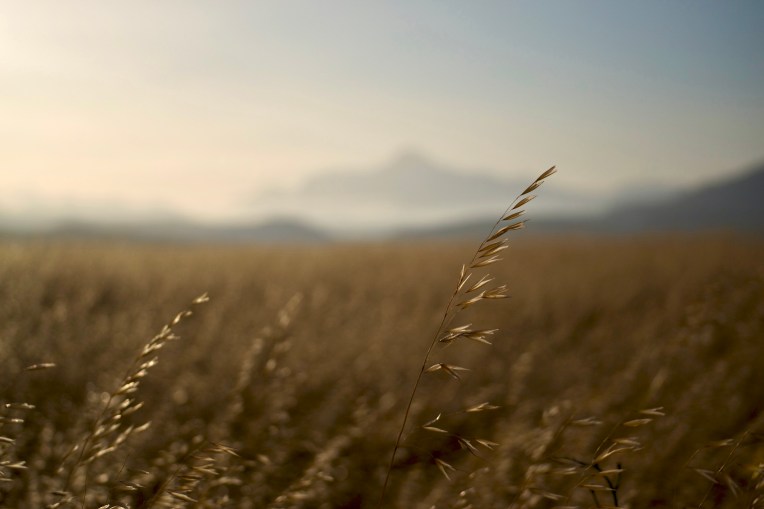
My Favourite Field, 25 October 2018. Copyright 2018 Forgotten Fields. All rights reserved.
Where the valley between the Babilonstoringberge and Kleinriviersberge (of which I wrote in “This September”) spills inland, my part of the Overberg region begins. You see above the Babilonstoringberge with clouds at their feet looming in the distance.

I bought an atlas

In my last post2, I wrote about the two years I spent in the valley between the Babilonstoringberge3 (Tower of Babel Mountains) and Kleinriviersberge (Small River Mountains)4. There I attended a small farm school where I was taught by my mother, a school teacher. Naturally, she cultivated in me a love for her favourite subjects, Afrikaans and Geography. My love of poetry comes from the former and of maps from the latter.

I remember drawing copies of my atlas, poring over the markings and lines, and inventing maps of my own! A few weeks ago, I purchased a Reader’s Digest Atlas of Southern Africa published in 1984, the very year I entered my mother’s class. It shows South Africa as it was when I was a boy with the provinces and names as they were then. The purchase was a nod to my eight and nine-year-old self, who is, of course, thrilled!

Atlas Detail, 28 October 2018. Copyright 2018 Forgotten Fields. All rights reserved.
A detail from the atlas. The photograph preceding this one was taken from the spot marked by the yellow dot looking westward.
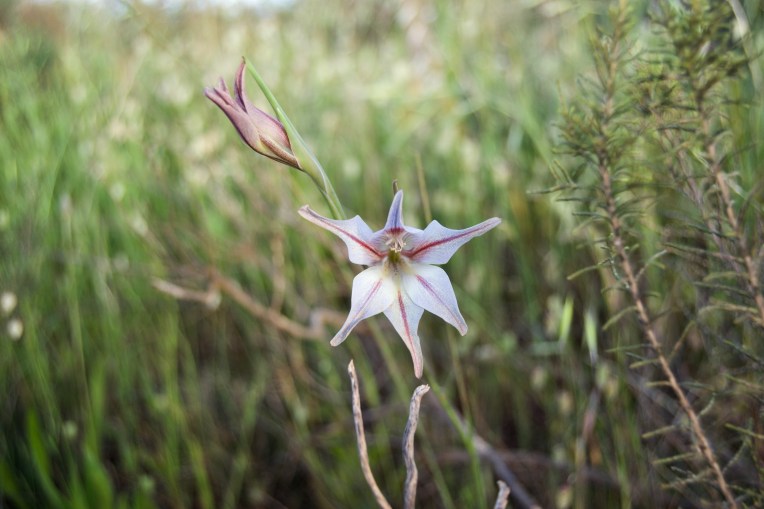
Aandpypie (Gladiolus liliaceus), 19 October 2018. Copyright 2018 Forgotten Fields. All rights reserved.
A single Gladiolus liliaceus by the wayside.

I admired a lily

We are in the midst of the South African spring and the countryside is in bloom, from the common Limonium perezii with its purply papery blossoms to the rare and unusual Gladiolus liliaceus. It was the latter I hoped to find a week ago and was delighted to discover by the wayside! Gladiolus liliaceus is a protected indigenous plant, know to us as the Aandpypie (Afrikaans for “little evening pipe”, pronounced “aah-nd-pay-pee”).

It opens at sunset and perfumes the air with an intoxicating (and unmistakeable) scent, an event that causes the lily to change its earthy daytime hues (when it is closed) to purple at night. The purpose of this transformation is to attract nocturnal insects but also, I fancy, to delight its human admirers. The lily is another connection to the time I spent in the Babilonstoringberge valley where I was introduced to it by my mother.

It is one of her favourite wildflowers. Watching sheep as a child, the Aandpypie, then still abundant, was her companion in the pastures, growing in the mountains and marshes in flocks of their own. It was there she learned to revere Nature, a virtue she passed to me. As I knelt to admire my wayside discovery, I felt it was a transgression even to behold it… Compelled to capture its beauty, I took my photographs reluctantly.

I wept before a poem

My mother was recently a surprise guest during a television interview with my youngest sister about her ventures in the South African wine industry5. Thinking she might be asked about this region, my mother resolved to include in her answer two lines from “In die Hoëveld”6, a poem by the Afrikaans poet Toon van der Heever7 (1894–1956): “[W]aar dit oop is en die hemel wyd daarbo, / Waar kuddes waaigras huppel oor die veld…”

The Afrikaans translates roughly thus: “Where it is open and heaven wide above, / Where herds of grass skip across the field…” Only once before have I encountered a description so vivid of a sight so sublime—one that lies at the heart of my poetry and music—that of Eugène Marais (1871–1936) in “Winternag”8 where he likens the windblown waving grass to beckoning hands. I loved Toon van der Heever’s poem instantly.

I had not encountered it before my mother told me of it some days after her interview. I read the whole poem the next day. In the verses, Toon van der Heever longs for his beloved fields… There he played as a child, there his little house awaits him, there the wind makes waves of the grass… Ah! It was as if every string inside me was suddenly plucked! I was that boy! I am that man! I wept as I read because I understood every word9.

October Interests and Inspirations

I thought I would include here some of the things that interested and inspired me during the month:

  • The House of Small Cubes (2008), an outstanding short animated film by Kunio Kato exploring the unstoppable advance of time;
  • Calluna (2015) by Andrew Chalk and Tom James Scott, a delicate and meandering album with fleeting melodic fragments;
  • The term of venery “a loveliness of ladybirds”, which delighted me no end;
  • Carles Viarnes’ handwritten notation for his contemporary classical piano album Schematismus (2016) which I purchased; and
  • An insightful review by Doug Thomas of Origins by Affan, the inaugural release of Lonely Swallow, my micro label.

Footnotes

  1. I posted it first to Twitter here and the day after to other social media platforms.
  2. “This September”
  3. Babilonstoringberge is pronounced “bah-bee-lons-twuh-Ruh-ng-beR-guh” (the “o” in “or”, the “e” in “wet” and trilled “R”s).
  4. Kleinriviersberge is pronounced “clayn-Ruh-fee-Rs-beR-guh” (the “e” in “wet” and trilled “R”s).
  5. Under the aegis of a local wine farm, she owns a wine brand named after the hamlet in which we grew up and where I live now.
  6. Afrikaans, pronounced “ihn di hoo-uh-feld” (the “ih” in “sit”, the second “i” as in “did” and the “e” in “meld”), meaning “in the highveld”.
  7. Pronounced “toowin fun dihR yih-fihR” (a trilled “R”, the “y” in “year” and the “ih” in “sit”).
  8. Marais is pronounced “mah-R-ai” (a trilled “R” and the “ai” in “air”). “Winternag” is Afrikaans for “winter night”, pronounced “vihn-teR-nah-ch” (the “ih” in “sit”, a trilled “R” and the “ch” in “loch”).
  9. I wrote briefly of my own longing for the fields in “My Pastoral Romance”, which goes some way to explain why Toon van der Heever’s lines affected me so!
New Year, New Music

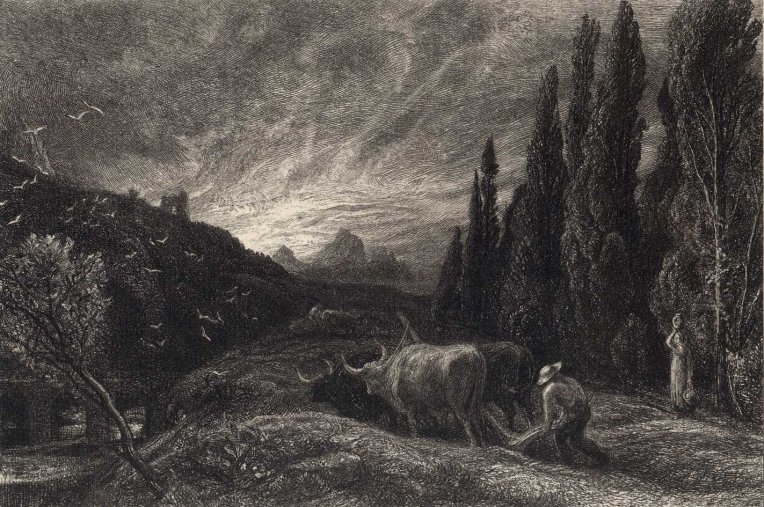
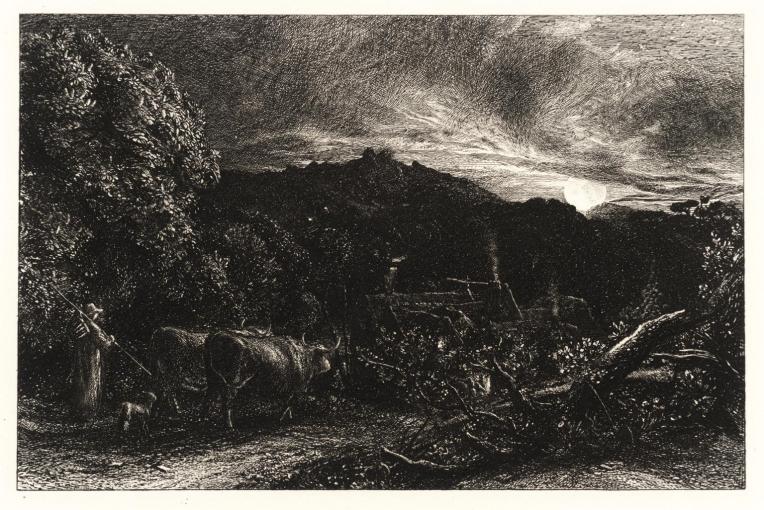
“The Early Ploughman”, circa 1860, an etching by Samuel Palmer (1805–1881). Source: Tate

Story

Whilst it is possible to enjoy ambient music without any context, an album concept can transform the way one experiences the music. Depending on the objectives of the musician, the concept will lie somewhere between elegantly explained and deliberately obscured. My approach is nearer to the former. I enjoy telling stories and music allows me to do so in words, pictures and sound. This year, I want to give context to my music using words in the form of poetry and pictures in the form of unique album artwork.

Poetry

To me, words are inextricable from music, whether they are the lyrics to a song or the title of an instrumental track. On my first album, I experimented with this word-music relationship, adding lyrics (to be sung by the listener) to “Silently You Sail”, and I want to further explore this idea by using poetry as an integral part of new music. There are currently two projects in pre-production which will be built around poetry. They draw inspiration from many poems but two stand out as being most influential in developing the concepts behind the music: the untitled verses for the rabbit Silverweed by Richard Adams in Watership Down chapter 16 and “Winternag” (Afrikaans, “winter’s night”) by Eugène Marais. Richard Adams captures the wistfulness and Eugène Marais the melancholy I want to express in my own poetry and music.

This is the first stanza of the Richard Adams poem containing my favourite opening line in poetry:

The wind is blowing, blowing over the grass.
It shakes the willow catkins; the leaves shine silver.
Where are you going, wind? Far, far away
Over the hills, over the edge of the world.
Take me with you, wind, high over the sky.
I will go with you, I will be rabbit-of-the-wind,
Into the sky, the feathery sky and the rabbit.

And this is the first stanza of the Eugène Marais poem describing a landscape scorched by fire:

O koud is die windjie (O cold is the slight wind)
en skraal (and spare).
En blink in die dof-lig (And bright in the dim light)
en kaal (and bare),
so wyd as die Heer se genade (as vast as the grace of the Lord),
lê die velde in sterlig en skade (lie the fields in starlight and ruin).
En hoog in die rande (And high in the ridges),
versprei in die brande (scattered in the fires),
is die grassaad aan roere (are the grasses astir)
soos winkende hande (like beckoning hands).

“The Weary Ploughman”, circa 1860, the companion piece to “The Early Ploughman”, an etching by Samuel Palmer (1805–1881). Source: The British Museum

Artwork

It may seem premature to think of artwork this early in pre-production but it is a defining feature of an album and one of the chief ways in which an ambient musician can communicate the main theme of his music. I want to use artwork to augment the overall concepts of my new projects, so I think it makes sense to develop the artwork in tandem with the music. This is how I approached the artwork for my first album. By making it part of the process from the outset, the result feels like a natural outcome of the process rather than an arbitrary afterthought.

I have approached a number of artists about developing artwork for upcoming projects. I am particularly interested in the idea of presenting machine-made music in a handmade medium. It introduces an element of contrast in the production process, which I like for its complementary quality. This is why I am investigating traditional methods of creating artwork. Etching is one possibility—the highly atmospheric prints of Samuel Palmer are great examples of what it can produce—but whatever the final method, this will be its underlying philosophy.

Music

The music will build on the idea of repeating musical phrases but will incorporate new elements. My tracks typically start out as piano sketches which I then reinterpret digitally, adding elements that suit the theme of the music. On my first album, this included a combination of digital keyboards and synthesised classical instruments, such as the French horn in “Airship” and the bassoon in “Giant in the Sky”. This really appeals to me and hence all the tracks currently in pre-production will make use of this combination in some form.

In addition to the solo material, I will also work on two separate collaborations with Krzyzis and Astoria Sound. (There may be one other collaboration with Ghost Signs but nothing has been decided.) I am planning a two-track EP with Krzyzis as a kind of preview of what is to come but in collaborative form; and my work with Astoria Sound will be for a dedicated collaborative album of theirs. I am excited to see how these projects influence my solo music and I am truly grateful for this opportunity to work with these very talented musicians:

FORGOTTEN FIELDS

Apple | Spotify | Bandcamp | Twitter | Facebook | YouTube

Thoughts and Things of Autumn 

https://youtu.be/bXOH_GzfGPA

Pastoral bliss

Autumn is a time when the earthy beiges of summer turn verdant green. In the countryside, where I am fortunate to reside, this change in the landscape marks the beginning of my favourite time of the year. As the season progresses, the wheat stands tall enough to blow in the wind. Their wavelike movement always reminds me of Winternag (Afrikaans for “winter’s night”), a poem by Eugène Marais. In it, he likens the grasses blowing in the wind to beckoning hands. And that is exactly how I experience them. They invite me; the fields call out to me! I am compelled to stand in their midst and revel in their beauty!

A poem

In the autumn of 2012, I listened almost exclusively to the music of July Skies. Their gentle blend of disarming instrumentals and melancholy vocals made me fall in love with my surroundings, over and over again. So much so that I was inspired to write Autumn, which I humbly share with you, here:

Autumn

I smell the wispy, rising smoke as autumn fires burn,
I feel the crispness of the air as shortened days return.
How the sky seems clearer,
Bluer in the cold;
How the green hills dearer
Than all of summer’s gold!

Mornings come with gentle mist that quietly greets the day,
All about the countryside the brightest hues are grey.
I need only wait a while
Before the hills appear;
I need only see them smile
My heart to fill with cheer!

I wonder at the long, thick grass that won’t give up the dew,
Midday finds them glistening still, in gentle sunlight, new!
Soon the day is ending,
Already evening falls;
To the moon ascending,
I hear a nightjar calls!

When the rainfall comes, the shallow rivers flood
Drizzle turns to torrents and moistened soil to mud.
Now and then the sun will show
Through heavy cloud to shine;
Now and then, the winding road
To make a silvery line!

FORGOTTEN FIELDS