Autumn Lilies

Friday, out among the hills in the company of my mother was a joy. March is the beginning of autumn in South Africa. It arrived with showers of rain and lilies unique to the Western Cape province. The lilies are unusual in that they flower suddenly, straight from the bulb—not a leaf in sight—giving the impression that they were stuck into the ground rather than emerged from it. The leaves follow later, once the flowers have died—as if they are an afterthought.

The Paintbrush lily

The first of these we encountered was the blood-red Paintbrush lily, Haemanthus coccineus. There was a cluster on one side of the dirt road verge, another against a sheer drop where the road crossed a channel, and even more, scattered at the foot of a steep hill. Never before have we seen so many of these flowers; so red are they that from a considerable distance, we were able to spot another cluster at the far end of a small field, later on.
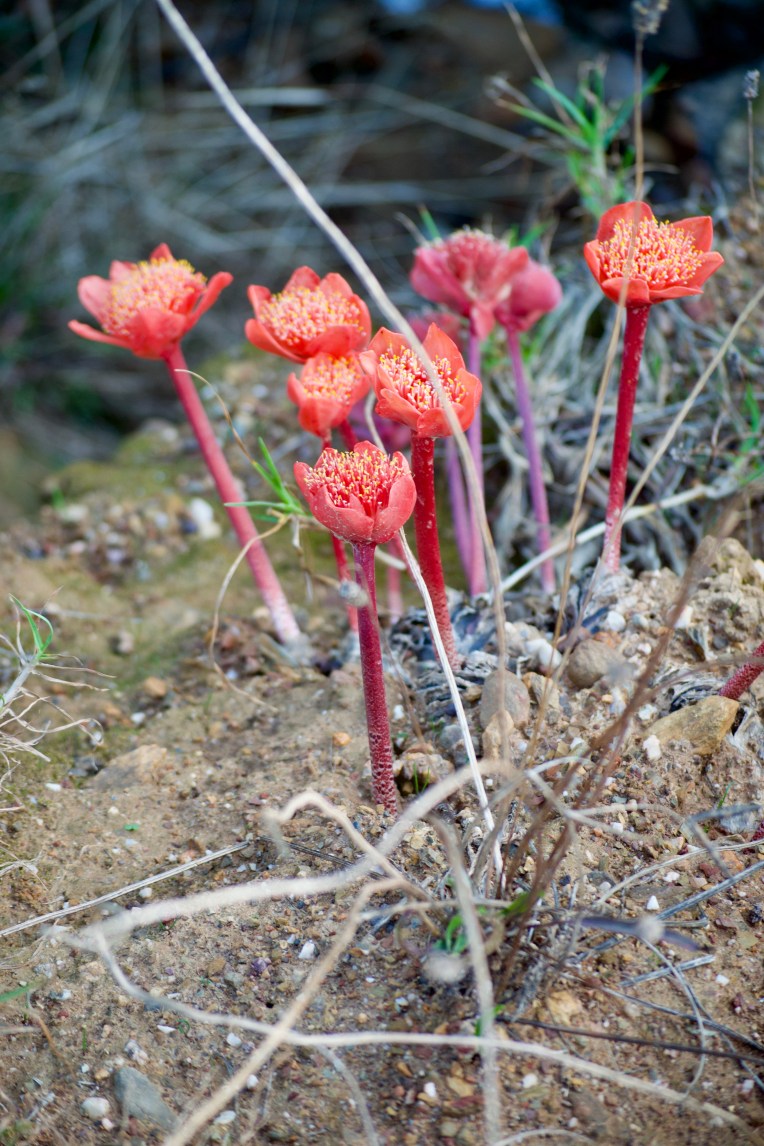
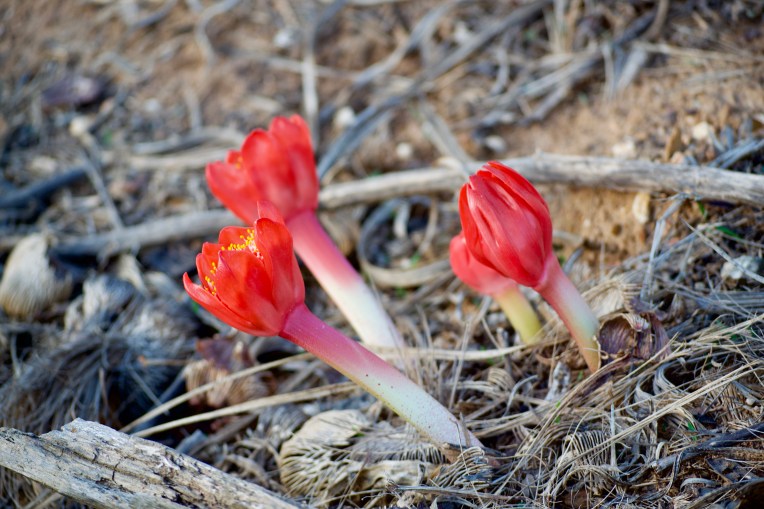
Paintbrush lily (Haemanthus coccineus), 15 March 2019. Copyright 2019 Forgotten Fields. All rights reserved.
Paintbrush lily (Haemanthus coccineus)
Paintbrush lily (Haemanthus coccineus), 15 March 2019. Copyright 2019 Forgotten Fields. All rights reserved.
Paintbrush lily (Haemanthus coccineus)

The Belladonna lily

The second kind was a much smaller group of four Belladonna lilies, Amaryllis belladonna, of which only one was in bloom; the rest had already flowered and produced fruits. They stood in a meadow, one I had passed through a week ago—it was thanks to my mother that I spotted them, this time. In Afrikaans1, they are aptly named the Maartblom, “March-flower” (pronounced “maah-Rt-blom”, with a trilled “R” and a shortened version of the “o” in “or”).
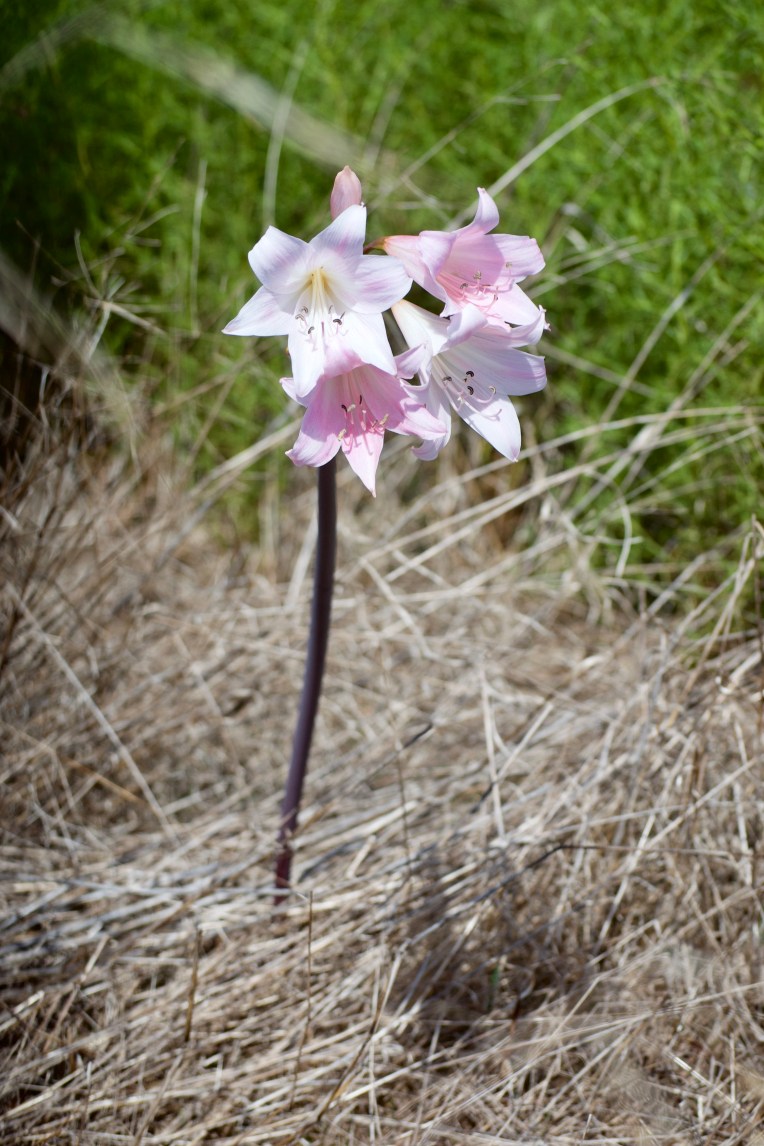
Belladonna lily (Amaryllis belladonna), 15 March 2019. Copyright 2019 Forgotten Fields. All rights reserved.
Belladonna lily (Amaryllis belladonna)

The Chandelier lily

The third was the Chandelier lily, Brunsvigia orientalis2. These were the first “straight-from-the-bulb” lilies I ever encountered, this time last year. Where there were three then, there were now five. I did not photograph them because they were already in the later stages of flowering and so not very arresting, but I include a photograph from last year’s sighting instead. The flowerhead dries out, breaks off in one piece and rolls in the wind to disperse its seeds.
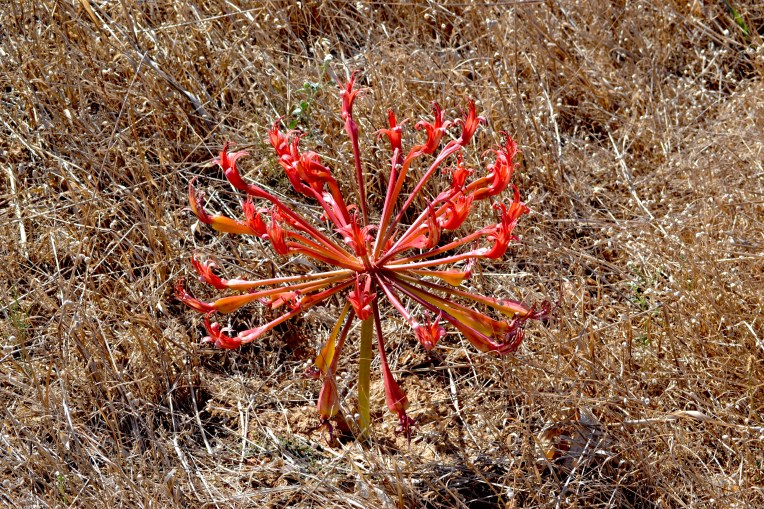
Chandelier lily (Brunsvigia orientalis), 9 March 2018. Copyright 2018 Forgotten Fields. All rights reserved.
Chandelier lily (Brunsvigia orientalis)

Footnotes

  1. Afrikaans is the native language of the Western Cape province.
  2. Possibly Brunsvigia litoralis, a slight variant.
“To a Swallow II”

The next poetic sketch I shall develop is on a favourite subject: swallows. It is yet another attempt at exalting the loveliest of birds. The South African autumn is here, and they will soon begin their northward journey; when they return in September, I shall welcome them again—with verse!

The working title of this draft is “To a Swallow II”1, a celebration of the birds at the height of summer. It follows “To a Swallow I” (now “Swallows!”), which welcomes them in spring. I have already begun testing variations on one of the lines and shall immerse myself in the work in the weeks to come.

Footnotes

  1. I thought of titling “To a Swallow II” “Lines Written upon Watching a Flight of Swallows in Late Spring”, in the spirit of Wordsworth’s elaborate “Ode, Composed upon an Evening of Extraordinary Splendour and Beauty”; but I was inspired by his simpler “To a…” convention instead. (Since “To a Swallow I” no longer exists as a title, I have decided to remove the Roman numeral, making the working title of this poem “To a Swallow”, for the time being.)

Why “Forgotten Fields”?

SubscribeStar AQ05

AQ05

“Fields”

I grew up in the Overberg region of the Western Cape province of South Africa. There are farms of every description in every direction. In the part where I was raised (and where I live now), they are chiefly for the cultivation of wheat and barley, and the rearing of sheep. It is a region with endless hills, divided here and there by modest rivers, and presided over by low mountain ranges. I spent the whole of my childhood there—here—and it was—and is—heaven on earth.

It was only when I left for college that I fully experienced city living. It was not palatable to me then (though I did my best to adjust to it), nor is it to me now (so I do my best to avoid it). Whilst for many years, I lived in a large town beyond the Hottentots Holland Mountains—the Overberg region lies beyond or “over” these mountains or berge (Afrikaans)1—I always sought accommodation on the edges of the town, even though the town itself was not densely populated.

Nonetheless, I would visit my family home in the countryside as often as I could, as a means of escape. Nearly every weekend, I would make my way “over the berg” and immerse myself in the loveliness of pastoral life. When I could bear being separated from it no longer, I started thinking about returning permanently. I distinctly remember the moment I made the decision to do so: alone upon a hill, listening to the sound of a distant flock. A few months later, I moved back.

“Forgotten”

But eventually, familiarity did its work, and with time, I grew accustomed to the landscape and its creatures. They were still a comfort, but I was unable to recognise their true wonder. Much of this I now ascribe to a sense of alienation that has plagued me all my life, born of a deep sense of abandonment and disconnection that I felt in childhood. This perception came to a head at age six when I was sent to what for brevity’s sake, I shall call boarding school.

I would not have felt the periodic separation from my family quite so keenly had I earlier in life known that natural bond (and its security) with my parents. Sadly, the failings of my father and the pressures upon my mother meant that I was raised as an infant by my grandmother and nursemaids. Consequently, being sent away for most of my school life was overall a negative experience which produced in me a tendency to detach from people—and, I now realise, places.

That I would drift away from the very countryside I so loved was perhaps inevitable. It was a concerted effort on my part to overcome my inner struggles that led me to reconnect with it once again. This project was born at the beginning of that process. I soon found the more progress I made psychologically, the more I reconnected with the rural wonder about me. The Zephyr and the Swallow was my first, lucid response to it. “Forgotten Fields” then describes this journey.

Footnotes

  1. Berge is Afrikaans for “mountains”; the singular is berg. The former is pronounced “beh-R-guh” with the “eh” (and “g”) in “get” and a trilled “R”; the latter, “beh-R-CH” with a trilled “R” and “CH” the guttural “kccch” sound in “loch”, that is, not the “ck” in “lock”.