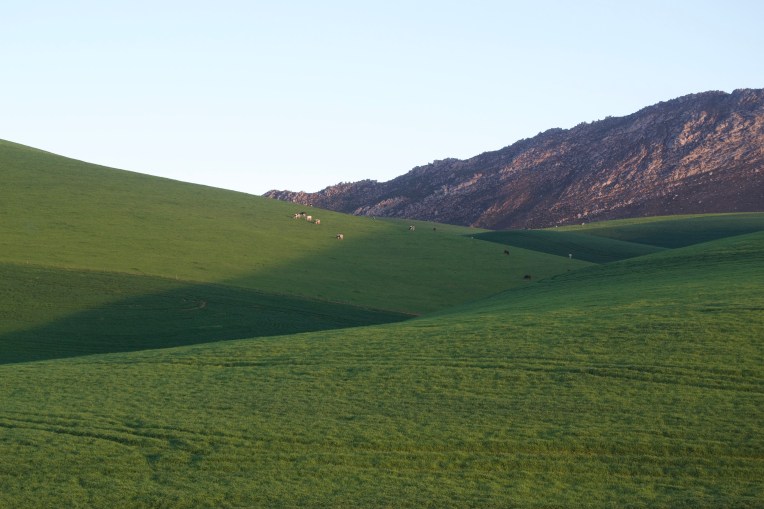
A rough ridge of the Little River range watching over a quiet herd upon the hills.
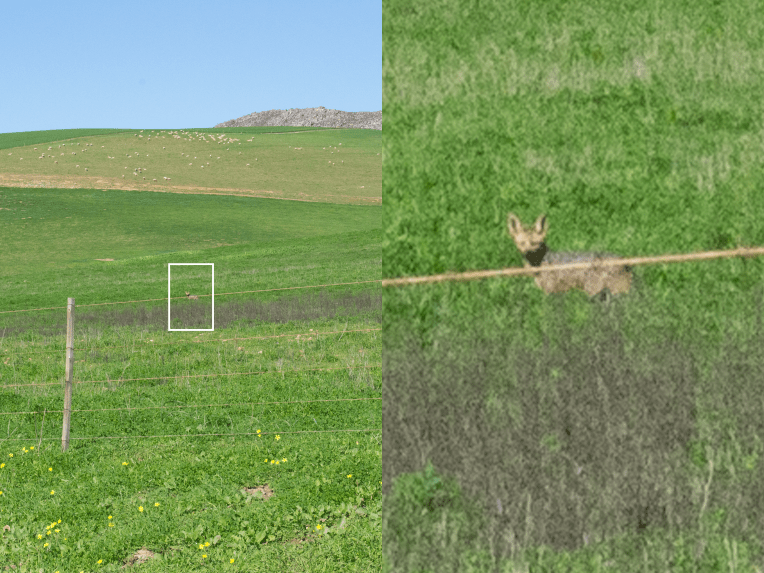
Yesterday, for the first time, I saw a fox! I had heard of fox mischief during my childhood but had never actually seen the creature, and so I was stunned to spot one in broad daylight, making its way up a hill, turning briefly to watch me scramble for my camera. The photograph below was the frantic post-scramble result, taken with a hopelessly inadequate lens, as I was set up to photograph landscapes, ill-prepared for the zoom necessary in the moment.
It was, undoubtedly, a Cape Fox (Vulpes chama), also called the Silver-backed Fox, a small animal—about 50 cm (20 in) long, the tail adding a further 30 or so cm (11 in); about 30 cm (12 in) at the shoulder—supposedly nocturnal.
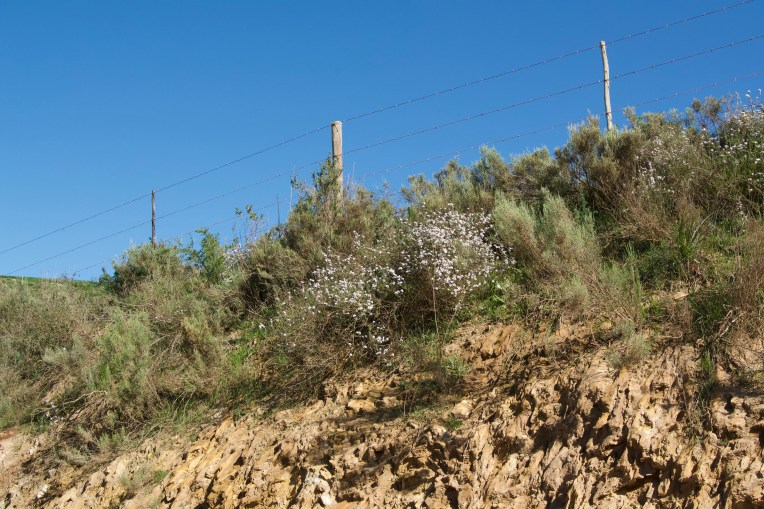
I also saw a shrub in bloom on a north-facing slope which, like so many species of fynbos1, had been unassuming throughout the year, suddenly to impress in late winter. Unable to come sufficiently close to it, I could not identify it; however, it may be part of the Sutera family—a wild guess, based upon vague similarities with certain species in that family. When next I am in that spot, I shall make the precarious uphill climb and attempt to inspect it properly.
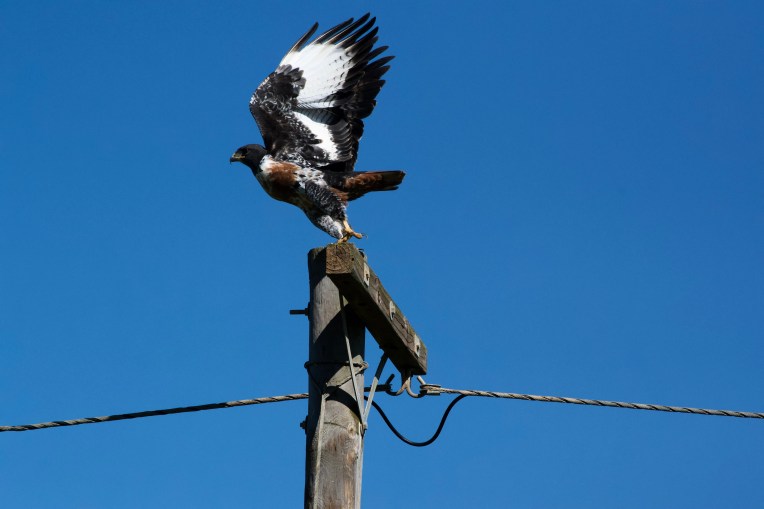
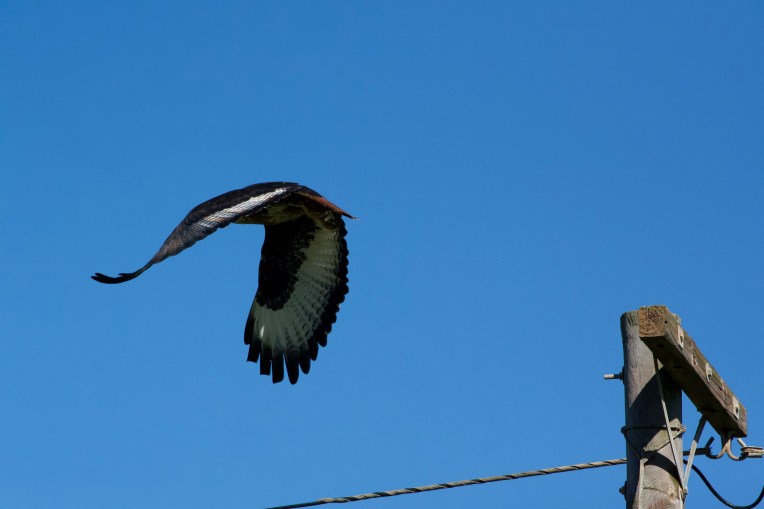
Another sighting (this time, photographed with a more appropriate lens) was of an adult Jackal Buzzard (Buteo rufofuscus)—a bird I have photographed many a time, and which I captured in hallmark circling flight, three years ago2.
Fynbos (Afrikaans for “fine-bush”, pronounced [feynboss], with the [ey] in “feign” and the [o] in “or”, but shortened)—so named for the relative fine-ness of the shrubbery in the Western Cape province of South Africa—is an extremely heterogeneous heather-like vegetation exclusive to the region; indeed, the province (roughly the size of England) has more plant species than the whole of Europe.
Whilst recording footage for the “Verse One” short film. I shared the unused footage in question to both Facebook and Twitter.
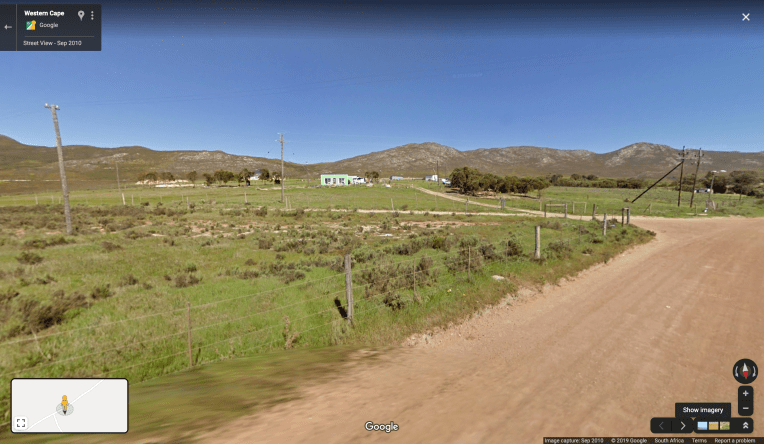
The cottage my mother grew up in, very different in appearance today. Directly to the left behind it, the gentle divide between two elevations of the Little River Mountains where I assumed (incorrectly) she tended the sheep. The actual pasture was toward the far left of the scene, up and over the slope (just left of the first telephone pole; at the time, she lived in a little hamlet just beyond the frame). (Google Street View)
“Shepherd Girl”, the poem I am currently developing, describes a day in the hard but simple youth of my mother. At eight years old, it was her duty to watch sheep up the nearby mountain, spending many hours alone on the eastern extension of the Little River range. Twice now have I been confronted with an erroneous understanding (on my part) of the details she had shared of that period.
The slope and fold, for example, were not where I thought they were, and she lived then in a different locale! These discoveries I had to weave anew into the composition as, upon pressing her further, she provided greater clarification. There is in the work a touch of pastoral romanticism—a fragile girl on a rugged mountain—but I want as far as possible her actual experience reflected in the lines.
Whilst out among the hills, I was amazed to see three separate flights of swifts and swallows along the route! The biggest of these I filmed, a flock of at least a hundred birds: Alpine and African Black Swifts and White-throated Swallows. Though swifts look very much like swallows on the wing, they are in fact classified as hummingbirds; even so, they behave much the same. Watching them mill high and low about me was otherworldly! They do this to feed on flying insects, but I like to think also for the pure exhilaration of flying.
I watched a crane leaping in the wind
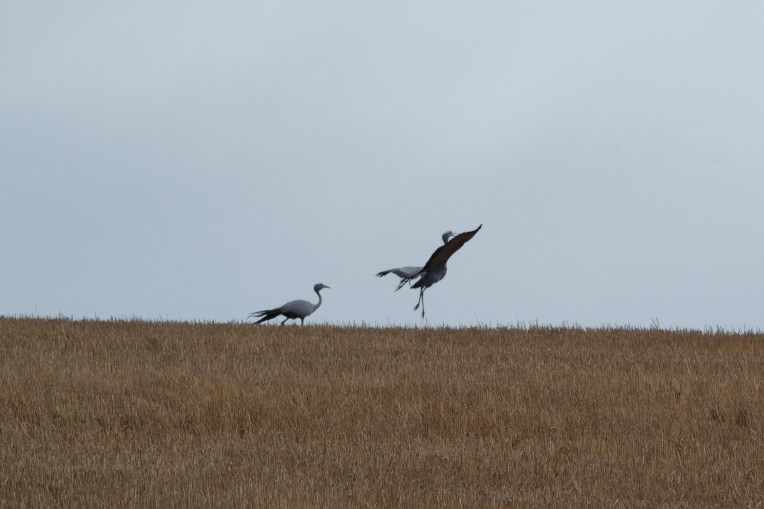
On another occasion, I saw two pairs of Blue or Paradise Cranes (Grus paradisea) among the hills. This time of year, they are watching their eggs, laid directly on the ground, usually in the stubble of harvested wheat fields. The first pair was at the summit of a gentle hill. At one point, the male spread his wings and leapt into the air on the wind! Blue Crane males dance to attract a partner, but since he was already paired up, I presume he was simply enjoying the flow of air. The second pair was more serene, quietly pacing in the stubble.
The crane leaping into the air! Blue Cranes are to me the deities of this region. Although their numbers are relatively stable, they are still considered endangered.
I started composing “Over the Mountain”
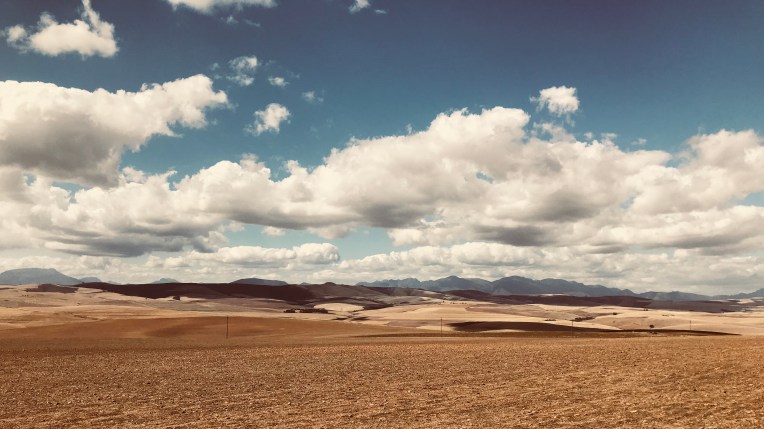
“Over the Mountain” started out as a caption to a photograph I posted to social media1 in late 2017. It showed the open skies, rolling hills and distant mountains so typical of the region in which I live, the Overberg2. Accompanying this impromptu photograph was the line “The fields become the hills and the mountains become the sky”. Not long after, it occurred to me that it may have poetic value. Initially, I thought to explore in “rolling” lines the undulating landscape of the region, and a rough sketch titled “A Vista” was born.
At the end of 2018, I began developing the draft. My intention was to compose one verse extolling the beauty of the landscape, but as I reflected on the photograph—and the frame of mind that prompted the original sketch—it became clear that this would not be adequate. There is so much more to the region than the distinctive patterns and colours of agriculture upon the land: splendid creatures dwelling in the valleys and mountains! I sought therefore to encapsulate my admiration for the Overberg in a kind of poetic “song”.
The fields become the hills and the mountains become the sky. (Taken 22 November 2017)
Inspired by the name of the region, “Over the Mountain”—a play on Overberg—slowly took shape, resulting in a number of amusing verses and refrains, amongst others: “Over the berg! / Over the berg! / Over the berg I go! // No more ’scrapers, / No more papers, / Over the berg I go!” This, of course, did not align with the style and tone of the collection, and it was clear that I had to write from a different perspective. The “song” route was not entirely fruitless, however, for it provided the raw material for the approach that would replace it.
Instead of composing a lighthearted “ditty”, I chose to think of the poem as a “hymn”. Consequently, it became more solemn—though no less exuberant—each verse painting a vignette of the Overberg, scenes I would not trade for the world: the hillsides where the Rhebok3 watches, the fields where the wheat blows in the wind, the heavens where the buzzard4 circles, to name a few examples. The poem is now in its final phase where I must select from the many verse variations I developed, those most promising for the final composition.
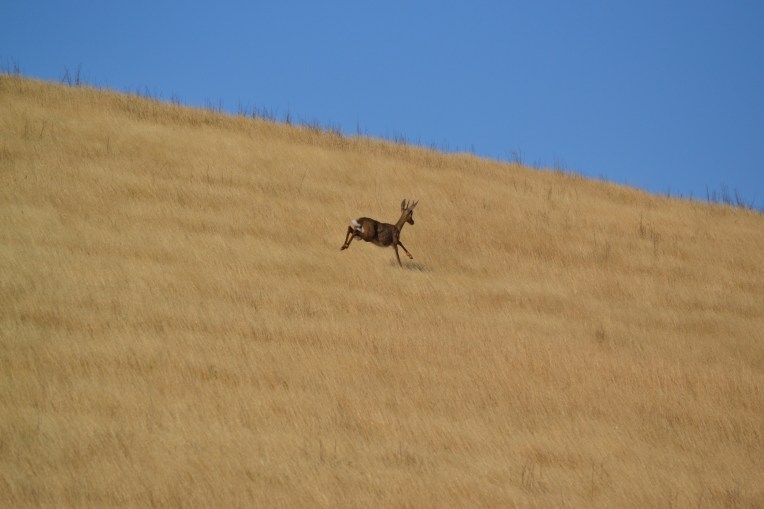
The Grey Rhebok darting across the hill. (Taken 8 December 2017)
I learnt about the plight of the rhebok
“Over the Mountain” naturally lead me to research the Rhebok. I was dismayed to discover that it was declared endangered in September 2017. This is mainly the result of hunting and a loss of habitat. Hunters consider them a great prize since they are difficult to find, stalk and shoot. You see them very rarely; they are shy, cautious and fast. Hunting, in addition to the expansion of farmland and the use of traps set for other animals, has devastated their numbers; and thus they join the Blue Crane on the threatened species list.
The unfortunate news brought to mind my earliest encounter with the Rhebok (or Ribbok5, in Afrikaans). It was not a sighting, but a song from my childhood. “Die Oukraalliedjie” is a well-known Afrikaans folk song (about a song) about a farm called Oukraal6. In one of its verses, it mentions “’n ribbok wat daar teen die rantjie staan”7 (“a rhebok that stands against the hill”). Imagine my delight when decades later, upon one of my rambles, I should see a Rhebok for the first time in just such a scene: quietly grazing against a hillside—
Incredibly, at first, my presence did not disturb it. It was only when I produced my camera that it lost its nerve and bolted swiftly up and over the hill. I was fortunate to capture this flight in a series of photographs which I later used to confirm that it was indeed the Grey Rhebok, Pelea capreolus. Though I pass that area often, I have not seen it since. There was one evening I saw a buck darting by the wayside in the bushes; I suspect it may have been a young Rhebok, but in the low light, I could not tell. I wait patiently to see one again.
A chiefly agricultural region in the Western Cape province of South Africa. “Overberg” (pronounced “oowuh-fiR-beh-R-CH”, a trilled “R” and a guttural “CH” as in “kccch” or “kgggh”) is Dutch for “over the mountain”.
The Rhebok is a medium-sized South African antelope.
Incidentally, the buzzard is a large bird of prey resembling a hawk. I photographed it early in 2018 and posted it here (Twitter). As you will see, it is not a vulture, as American English suggests. It is often seen circling high above, something I was able to capture (by complete accident) in 2017, which can be watched here (Twitter).
Pronounced “Rh-bock” with a trilled “R” and the “o” a shortened version of that in “or”.
“Die Oukraalliedjie” (pronounced “di oh-kRaahl-likki” with the “i” in “it” and a trilled “R”) is Afrikaans for “The Ol’ Pen Ditty”. “Liedjie” (pronounced “likki” with the “i” in “it”) is Afrikaans for “ditty” or “little song” and “Oukraal” (pronounced “oh-kRaahl” with a trilled “R”) is Afrikaans for “Ol’ Pen” (“ol’” as in “old” and “pen” as in an enclosure for animals), the name of a farm.
Literally, “a rhebok that there against the little hill stands”. The line appears at the end of the first verse around the 0:20 mark. You can listen to the song as recorded by Groep Twee (Afrikaans for “group two”, pronounced “CHRoup tweeuh” with the guttural “CH” as in “kccch” or “kgggh” and a trilled “R”) on Apple Music, Spotify or Youtube.
 Forgotten Fields