A line that succeeds on its own may not succeed in a verse, and so a verse in a poem, a poem in a collection, and a collection in a tradition. Context is everything—for it determines everything.
On Titles
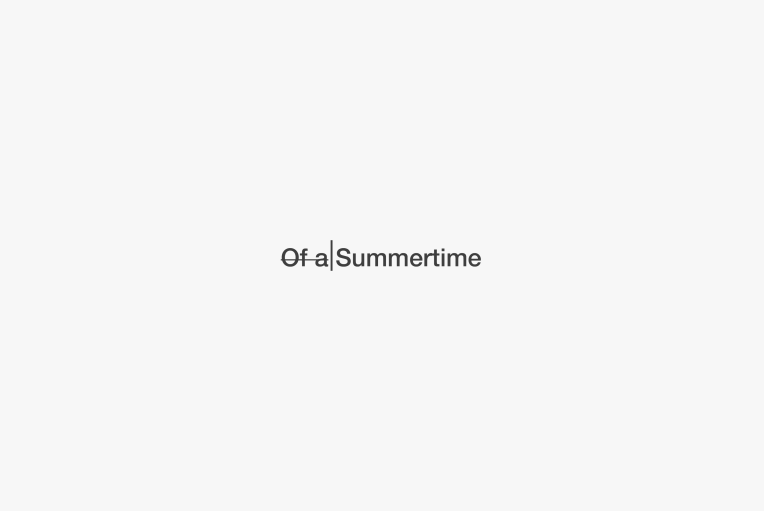
To indulge my need for minimalism (something one would never guess from these verbose posts), simplicity and consistency, I thought to limit all the poem titles within the collection to no more than two words; but glancing through the list, it soon became clear that it was a fool’s errand—for whilst one or two-word titles suit some poems, their brevity adds nothing to others; I had to abandon the idea.
I was forced to admit the obvious: that there are instances where a longer title brings to a poem a necessary colour or meaning. The best example is “Of a Summertime” for nostalgic glimpses from childhood that “Summertime” fails to evoke. (Some instances are thematically more uncertain: is “A Crane at Eventide” more evocative than “A Crane”, or “The Last Time I Saw Fireflies” more wistful than “Fireflies”?)
Ultimately, beyond its pragmatic function, a title must encapsulate and, where necessary, complete a poem—or not exist at all (which, in my view, is preferable to the spineless, spiritless and evasive “Untitled”—a “title” I only accept in exceptional cases—but I digress). Happily, these are decisions I can make poem by poem; and my guiding principle remains: that the barest minimum is preferable.
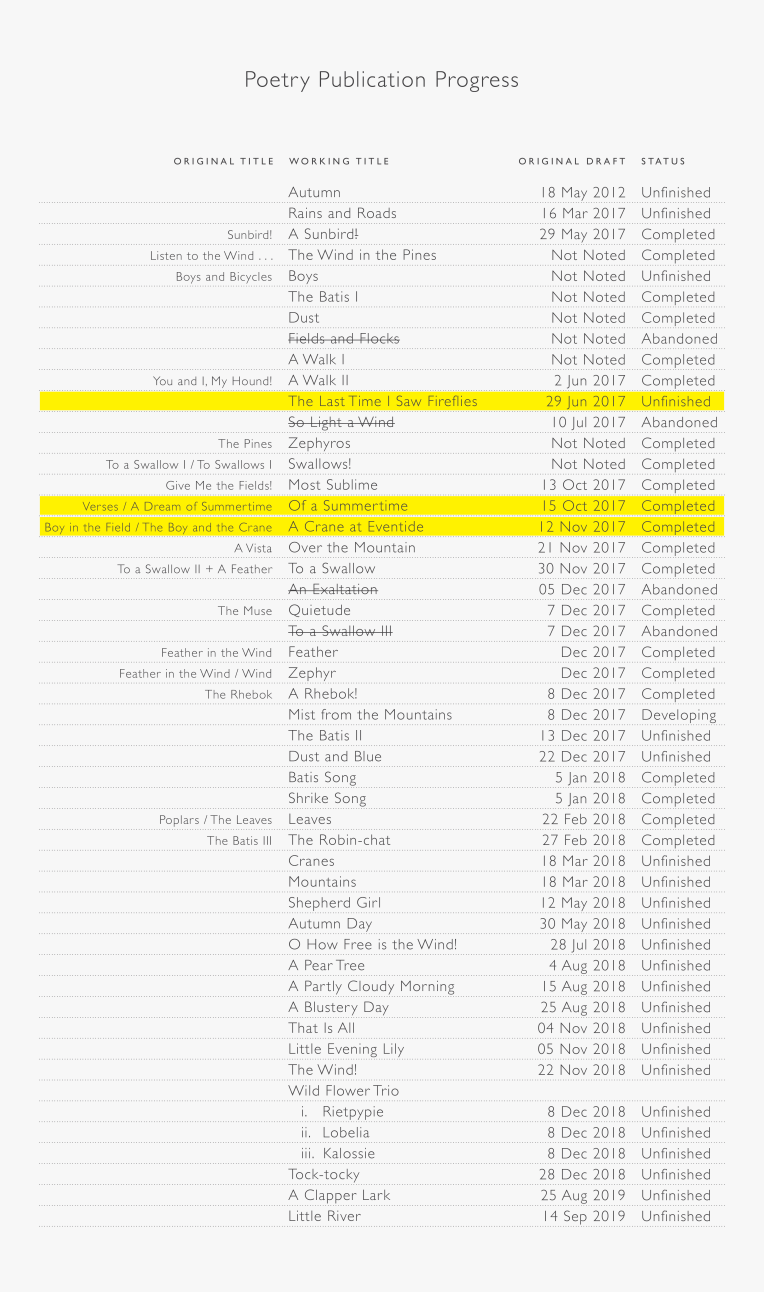
Whilst the individual verse idea for the first direction of the “Mist from the Mountains” sketch appeals to me, the multi-stanza idea is developing beautifully, creating unique poetic opportunities of its own: internal rhyme, rhyme scattered across stanzas, subtle and overt literal and visual alliteration—all the joys of lyric poetry! I, therefore, lean heavily toward the multi-stanza idea for the poem’s first direction, but will develop the individual verse concept nonetheless—who knows what other opportunities I may encounter in the process!
 Forgotten Fields